


The funeral flowers had only just begun to fade when the calls started. I was in my kitchen on a Thursday morning, two weeks after we buried Helen, watching the steam curl from a mug I hadn’t touched. The dark green ceramic, chipped at the handle—a Father’s Day gift from my granddaughter Emily years ago—now felt heavy, foreign, like it belonged to a man I no longer was.
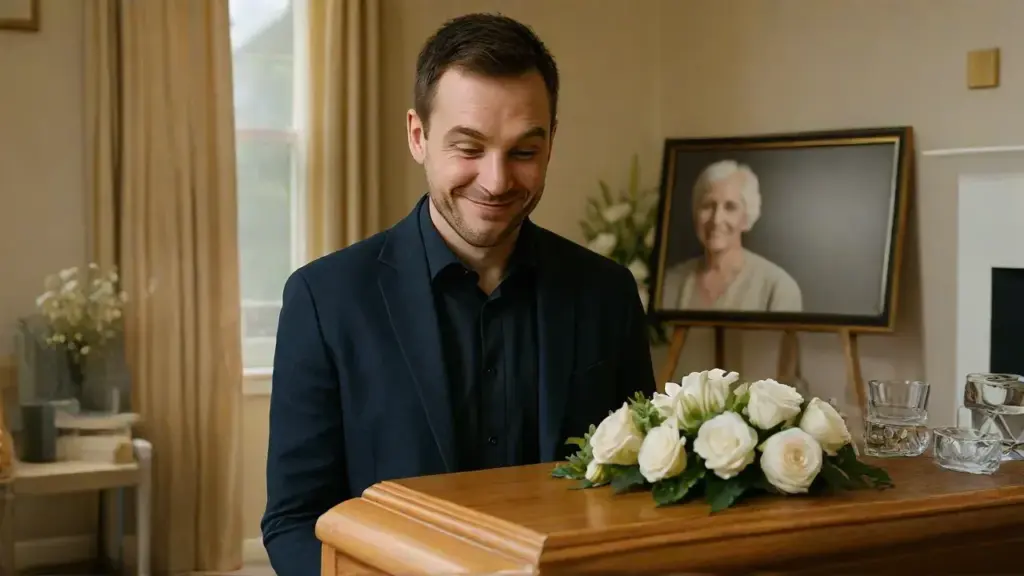
Everything felt foreign. The house, my reflection in the hallway mirror, even my voice when I answered the relentless phone calls from my children.
“Don’t forget to subscribe to the channel and comment where you’re watching from. Dad, we need to talk about the house,” Mark’s voice carried the restrained impatience I’d known since he was a teenager asking for money. Only now, at thirty-eight, he wasn’t asking. I set the mug down without drinking.
“Good morning to you too, Mark,” I said.
“Don’t start with me,” he replied. “Laura and I have been talking. This place is too big for you alone. The taxes, the upkeep—it’s not realistic. We’ve already found a buyer.”
“There’s no mortgage,” I said, the words flat and factual. Helen and I had paid it off six years ago, but I’d never told the kids. They assumed, and I let them.
Silence. Then a short laugh, sharp and dismissive, the same one he inherited from me, though I’d never used it like a blade. “Dad, please. Mom’s pension barely covered her medications. We all know you’re under strain.”
I walked to the window above the sink, looking out at the garden Helen and I had tended for twenty-five years. The rosemary leaned into the stone path. The lemon tree needed pruning. Every plant, every stone wall had become a monument to everything I’d lost.
“You’re worried about me, is that it?” I asked.
“I’m worried about what’s practical,” he replied, each word clipped.
“We could put the money from the sale to good use. Laura’s got Emily’s tuition, and Laura and I—” I stopped listening at his wife’s name. My mind was already building the scene: Mark at their dining table, laptop open, a spreadsheet glowing with columns labeled Dad’s House Sale, Price, Proceeds, Split. I knew the layout of his thinking. I had taught him numbers when he was eight, making him calculate change for the ice cream truck. Now he was calculating me.
“Mark,” I said, keeping my tone even, “you’ve been planning this for a while.”
“That’s called being responsible,” he countered. “We can’t sit around until something happens to you.”
I let the sentence hang there, ugly and unpolished: until something happens to you. “Thanks for your concern,” I said, my voice as flat as the lemon tree’s shadow across the path. “I’ll think about it.”
“Dad—”
But I ended the call before he could sell me my own life in bullet points. The house was quiet again, but the silence had changed shape. It was no longer the stillness of a home in mourning. It was the pause between one blow and the next.
I rinsed the coffee down the drain. My hands smelled faintly of the rosemary Helen used to cut for the Sunday roast. She’d hand me sprigs like small trophies, fresh from the source, smiling even though we both knew I’d just been standing there watching her work.
The phone rang again. Laura this time. I considered ignoring it, but grief teaches you that avoidance doesn’t stop what’s coming.
“Dad,” she began, her voice pitched a little too high, the way she spoke when trying to make bad news sound like a gift. “Mark and I are on the same page. We both think—”
“You both think I should sell the house,” I finished for her.
She hesitated. “It’s for the best. You could move in here. We’ve got the finished basement, a full bath. Mark says we could add a kitchenette. You’d have your entrance, your own space. It’s perfect.”
“Perfect,” I repeated. A word too big for four walls below ground. “And the money?”
“Well, after we cover the contractor for the basement, you could set some aside. Help with Emily’s tuition. Maybe help Mark with his new place. It’s all family, Dad. Win-win.”
I could hear the echo of Mark’s voice in hers, the rehearsed cadence of people who had already agreed on the ending before asking if I’d read the script. “Laura,” I said, “when was the last time you called me to talk about something other than money?”
“That’s not fair,” she protested. “I’ve been busy. Emily’s in her junior year. Work’s been—”
“Two months,” I said. “It’s been two months since you called for anything else.”
Silence, brittle and thin. “You’ve been sending Emily money every month?” she blurted, as if it were an accusation.
“Yes,” I said. “Five hundred dollars. For two years.”
Another pause. “She doesn’t need to know that,” Laura said.
Of course she didn’t. Because if Emily knew, she might question the stories she’d been told about her grandfather—the fragile old man who couldn’t manage his affairs, the one who needed decisions made for him.
“I need to go,” I said, and hung up before the conversation could turn uglier.
For a long time, I stood in the hallway. The late morning light slanted through the front windows, catching the dust on the console table. Helen’s reading glasses were still there, folded neatly on top of a paperback she’d never finish. I reached out, then stopped. Touching them felt like a step I wasn’t ready to take.
My feet carried me to her study. The room smelled of lemon oil and the faint trace of her perfume, something floral and subtle that clung to the curtains. Her desk was exactly as she’d left it: a pen resting diagonally across a yellow legal pad, the corner of an envelope peeking from under a stack of papers. I sat in her chair. The leather was worn smooth where her elbows had rested. For the first time in two weeks, my shoulders eased.
There was a bottom drawer on the left, stiff from years of sticking. I pulled it open. Inside were the usual layers of life—old tax returns, appliance manuals, greeting cards. Beneath them, my fingers found the edge of a pale blue folder. It was heavier than it looked. The paper inside shifted with a faint whisper, like it knew it had been waiting for me.
I didn’t open it. Not yet. I set it on the desk and rested my palm on the cover. A yellow sticky note was stuck to the front, Helen’s handwriting in tidy block letters: If you’re reading this, you need to know what’s inside.
I sat there, the late morning light warming the side of my face, and for the first time since the funeral, I felt something other than loss. It wasn’t hope, not yet. But it was direction.
The pale blue folder sat in front of me like an unopened letter from the past. Helen’s note stared back, those square, deliberate letters that made even grocery lists feel important: If you’re reading this, you need to know what’s inside. I hesitated, my fingers tracing the paper’s edge. Outside, a breeze moved through the lemon tree, scattering sunlight across the desk. The air smelled faintly of rosemary from the garden, pressing against a memory I wasn’t ready to name.
When I opened the folder, the first thing I saw was a sheaf of financial statements. Bank accounts I didn’t recognize—not the joint accounts we’d had for decades, but individual ones, all in Helen’s name. One was from a small credit union in another county, another from an online bank I’d never heard her mention. Each had modest sums—$8,400 here, $12,200 there. Not fortunes, but enough to make me wonder why they’d been kept separate.
Under the statements were property documents. My breath caught when I saw the first: a deed for a villa in the Algarve region of Portugal, purchased ten years ago. The owner’s name: Helen Margaret Hale. No mention of me. I flipped to the next page, a letter from a law firm in Lisbon, dated last spring, confirming the property’s current value and offering to manage a rental contract. Helen had declined in a handwritten note at the bottom: Not yet. Keep private.
Private. The word sat there like a pebble in my shoe. There were more documents. Life insurance policies I’d never signed, all naming beneficiaries I expected—Mark and Laura. But one caught my eye: a newer policy, much smaller, with only one beneficiary, Emily. No mention of her parents.
I leaned back in Helen’s chair. The lemon-scented polish in the wood seemed stronger now, mixing with the metallic taste in my mouth. Helen had always been deliberate. She didn’t forget things. If she’d kept this from me, it wasn’t oversight. It was intent.
I picked up a smaller envelope tucked into the back of the folder. Inside was a letter, dated two years ago, written in Helen’s looping cursive:
Richard, if you’ve found this, I’m gone. And if I’m right, the calls have already started. They will circle you, not because they need you, but because they want what you’ve built. I’ve watched it for years—small comments, questions about money, the way they count what isn’t theirs yet. You’ve always given the benefit of the doubt. I stopped doing that long ago. The house is yours. It stays yours. I paid it off so you’d never have to answer to them about it. But I also knew they’d try to make you believe you couldn’t manage alone. That’s why there’s a second plan. The villa in Portugal is for you, but not on paper. You’ll find instructions in the back. Follow them if you need to disappear for a while. Sometimes the only way to win is not to play their game.
Helen’s voice was in my head as I read. Calm. Even. Not angry, but certain. I turned to the back pocket of the folder. There was a typed page with contacts for the Lisbon law firm, a local caretaker named Anna, and a key taped to the paper. Next to the key, a note in Helen’s hand: Trust Anna. She owes me her life. Long story.
I let the paper fall onto the desk. My pulse was steady, but my mind was racing. For the rest of the afternoon, I moved through the house like a man walking in two timelines at once. Every object I passed—the framed photo of Mark at his high school graduation, Laura’s ceramic vase from college, Emily’s crayon drawing of the garden—now felt like evidence in a case I hadn’t known I was building.
In the kitchen, I stared at the spice rack Helen had arranged by height, not alphabet. She’d always said it looked better that way, but now I wondered how many small, deliberate choices she’d made that I’d never questioned. I poured a glass of water and stood at the sink, watching the late afternoon light turn the garden gold.
I remembered the last conversation Helen and I had about the kids before she got sick. “They love you,” I’d said, irritated that she’d been distant with Mark during his last visit.
“They love the version of me that helps them,” she’d replied. “The version that says yes.” I’d dismissed it at the time as one of her darker moods. Now, it played back in my mind like a warning I’d ignored.
That evening, Mark called again. I didn’t answer. He left a voicemail: “Dad, just think about what I said. We can make this easy for you. Don’t make it harder than it needs to be.”
Easy. For him, maybe. Laura texted an hour later: We’ll come by Saturday to talk. Bring Emily. It’ll be good to see you.The phrasing wasn’t lost on me: Bring Emily. Like I was the guest, not the host.
I put the phone face down and went back to Helen’s study. The folder was still on the desk. I opened it again, this time studying the insurance policy naming Emily. The date was from last year, well after Helen’s diagnosis. She’d made a choice.
As night settled over the house, I turned on the lamp in the study. The warm pool of light caught the edge of a photograph tucked in the back of the folder. It was of Helen and Emily in the garden, both wearing straw hats, their hands dirty from planting herbs. Helen’s arm was around Emily, her smile wide and unguarded. On the back, Helen had written: Teach her how to keep what matters.
I sat with that photograph for a long time. The room was silent except for the ticking of the old clock on the wall, the one Helen insisted we keep even when it ran slow. I thought about calling Emily, telling her everything. But Helen’s note said, if you need to disappear, not if you need to explain. This wasn’t the time to show my cards. Not yet.
Near midnight, I locked the study door for the first time in years. The folder went into the bottom drawer of my desk, not Helen’s. The key to the villa went into the small safe behind the bookcase, the one no one but Helen and I knew existed. I stood there for a moment, hand resting on the shelf, listening to the quiet house. Somewhere in the darkness, I could almost hear Helen’s voice: You don’t have to fight the way they expect.
The next morning, I woke before dawn. I made coffee, drank it this time, and sat at the kitchen table with a pad of paper. I wrote two columns: What They Know and What They Don’t. The first list was short. The second was longer than I expected.
When the sun broke over the garden, I looked at the lemon tree and thought about Portugal. About Anna, whoever she was. About disappearing, not out of fear, but on my terms. For the first time since Helen’s funeral, I felt something sharp under the grief—not anger exactly, but resolve. They thought I was an old man standing on the edge of a cliff, waiting to be pushed. They had no idea I’d already built a bridge.
Saturday came with a pale winter sun, thin and reluctant, the kind of light that makes everything look like it’s holding back. I’d been up since six, walking the garden paths in my coat, feeling the crunch of frost under my boots. By eight, I’d pruned the rosemary, swept the stone steps, and put the kettle on. It wasn’t about tidying for them. It was about reclaiming my rhythm before they arrived.
At nine-seventeen, the sound of tires on gravel reached me from the drive. I stayed at the kitchen window long enough to see Mark’s black SUV ease in, the paint so polished it caught the morning light like a blade. Laura sat in the passenger seat, phone already in hand. Emily was in the back, forehead pressed to the glass.
I opened the door before they could knock. “Morning,” I said, keeping my voice even.
Emily smiled and ran up the steps first. “Hi, Grandpa!” She wrapped her arms around my waist, her hair faintly smelling of the strawberry shampoo Helen used to buy for her.
“Hey, kiddo,” I said, holding her a moment longer than I needed to. “Come on in. It’s warmer inside.”
Mark and Laura followed, bringing the scent of expensive perfume and cold air. Mark didn’t take off his sunglasses until we were in the kitchen. “You’ve been busy,” he said, glancing around. “Place looks neat.”
I poured tea into the heavy mugs Helen liked to use for guests. “I had time.”
Laura’s eyes swept over the counters, the cabinets, the framed photo of Helen and me on our twenty-fifth anniversary. She smiled, but it didn’t reach her eyes. “We thought it’d be good to see you, Dad. And talk.”
I gestured toward the table. “Talk then.”
They sat across from me, side by side, like a united front. Emily wandered off to the living room, flipping through a stack of children’s books. I could hear the faint sound of pages turning.
Mark cleared his throat. “Look, Dad, we don’t want to drag this out. We found a buyer. Solid offer. More than the place is worth, honestly. It’s a chance for you to downsize and not worry about taxes or maintenance.”
I stirred my tea slowly, letting the spoon ring against the ceramic. “I told you. There’s no mortgage. Taxes are manageable.”
“That’s not the point,” Laura said, leaning forward. “It’s about… practicality. You don’t need all this space. You’re alone here.”
I looked from one to the other. “Practicality for me or you?”
Mark’s jaw tightened. “You think we’re doing this for ourselves?”
“I think you should answer the question,” I said.