


James Carter stood on the doorstep of the dilapidated house, holding seven-year-old Emma’s hand. The girl coughed quietly—almost imperceptibly—but her father heard every sigh. In that cough was their entire story of the last two years—endless hospitals, expensive medications they had to buy by borrowing money. And his wife’s gaze, gradually turning from sympathetic to irritated—then disappearing altogether along with her.
Emma looked up, her eyes scanning the yard overgrown with weeds and the leaning fence. “Dad, is this going to be our home?” she asked, her voice weak but carrying that childish hope that kept James from giving up completely.
“Yes, sunshine, this will be our home,” he replied, squeezing her small hand. In the pocket of his jeans lay the last of their money from selling their city apartment. Almost all of it had gone toward this half-ruined house in a quiet rural town in Nebraska—but here there was clean air, silence, and no one to look at them with pity or judgment.
The house looked depressing. The paint had peeled off, hanging in shreds like old skin. The roof sagged in places, and the windows were boarded up with planks. But James saw more than that. He saw a place where Emma could recover—where they could start over, far from hospital corridors and the sympathetic stares of neighbors.
Old lady Margaret, who sold them the house, had warned that the place was restless—but James dismissed it as small-town superstitions. He had no choice; this was the only property he could afford. Besides, what problems could be worse than those they had already endured?
When they went inside, Emma ran to explore the rooms, and the house echoed with children’s laughter for the first time in months. James felt something warm stir in his chest.
Maybe they would manage. Maybe here, among these old walls, his daughter would finally get better. The first weeks passed in endless work. James patched the roof from morning till night, replaced rotten boards, and fixed the stove. His hands were covered in calluses, his back ached, but the work helped him avoid thinking about how little money was left—and what would happen when it ran out.
Emma helped as she could, handing tools and sweeping debris, and her cough gradually became less frequent. The neighbors were few and reserved. Occasionally, Mrs. Clara from the next house came by—a wiry old woman with sharp eyes—who brought milk and vegetables. But she looked at them warily, as if expecting something bad.
“The house has been empty for a long time,” she said once, watching James paint the window frames. “The previous owners left at night without saying anything. And before them, others lived there only briefly.”
“Why did they leave?” James asked, not looking up from his work. Mrs. Clara shrugged. “Who knows? People said different things. But the place is restless, that’s for sure.”
James didn’t ask further. He had enough problems without worrying about small-town gossip. The main thing was that Emma felt better. Her cheeks turned pink, the cough nearly disappeared, and she started running around the yard like a healthy child.
But then the sounds began. At first, James thought it was the wind in the chimney or the creak of old boards. At night, the house made many sounds—creaking, crackling, sighing like a living thing. But these sounds were different. They came not from the house but from somewhere deep in the yard, and they sounded like crying—quiet, drawn-out crying that started deep in the ground and rose, becoming clearer. James listened, lying in bed, feeling chills run down his spine.
The sound was too human to be the wind—but too strange to be real crying. “Dad, do you hear it?” Emma whispered one night, crawling under his blanket. “What, sunshine?” James hugged his daughter, feeling her little heart pounding.
“Someone’s crying—in the yard.” James listened to the night silence.
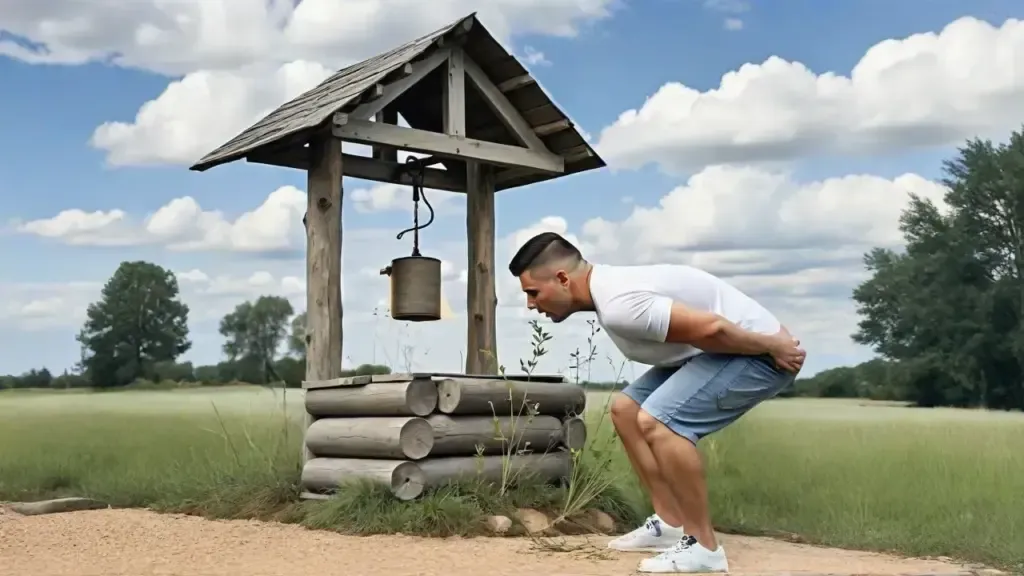
The sound was barely audible but definitely there—a quiet, hopeless sobbing from the darkness. In the morning, James decided to inspect the yard. In daylight, everything looked normal—an overgrown plot with weeds, an old shed, a leaning fence. But in the far corner, hidden by tall grass, he found something he hadn’t noticed before—an old well.
The well was ancient, built from stones darkened by time. The iron cover was rusted and shifted aside, leaving a gaping black hole. James approached and looked down. The darkness was absolute; even dropping a stone, he didn’t hear a splash or impact at the bottom. “Deep,” he muttered, feeling an inexplicable anxiety.
That evening, the sounds resumed. Now James knew exactly where they came from—the well. The crying was quieter but more distinct, and words seemed to be in it—indistinct, distorted, but definitely human. James got out of bed and went to the window. Moonlight illuminated the yard with a silvery glow, and the well appeared as a black spot among the grass.
The sound grew stronger, almost calling—and James thought someone was calling his name. “Don’t go there, Dad,” Emma whispered, appearing beside him. “I’m scared.”
“It’s okay, sunshine. It’s just the wind,” James lied, though he didn’t believe it himself. There was no wind; the night was completely still.
The next day, he decided to talk to Mrs. Clara. The old woman listened silently, nodding as if expecting this conversation. “I know about that well,” she said finally. “It’s old; my grandfather told stories about it. They dug it during hard times, looking for water. They found it, but the water was bad. Whoever drank it got sick, and some died outright.”
“And what did they do with it?” “They tried to fill it in, but it wouldn’t fill. The earth caved in, stones sank, like a bottomless pit. Then the sounds started. They say someone lives there—someone who can’t find peace.”
James wanted to laugh, but something in the old woman’s voice made him take her words seriously. In her eyes was real fear, weathered by years. “What do you advise?” he asked.
“Leave here. While it’s not too late.” But James couldn’t leave. He had no money for new housing, and most importantly—Emma was recovering. The country air was working; the cough had nearly vanished, and she became active and cheerful again. How could he take that away because of some night sounds?
Instead of leaving, he decided to deal with the well once and for all. If someone or something was there, he needed to find out. He was a grown man, and small-town superstitions couldn’t scare him. James bought a lantern, rope, and hook in the nearby town of Lincoln. If the well was bottomless, he’d find out how deep it was. And if something was there, he’d handle it like a man.
Meanwhile, the night sounds became clearer. Now James could make out a voice—female, young, full of despair. The voice called for help, begged, cried. Sometimes it seemed to call his name, but that could be his imagination.
“Jim! Help me, Jim!” His heart clenched at that call. The voice held such pain, such hopelessness, that James felt a physical need to help. Whoever it was, they needed help.
Emma heard the voice too. The girl became restless, often waking at night and asking to sleep in her father’s bed. She said little, but James saw fear in her eyes. “Dad, what if we move?” she asked one morning, poking at her oatmeal with a spoon.
“Why, sunshine? Don’t you like it here?” “I do. But the voice in the well—it’s sad. I feel sorry for it.”
James realized he couldn’t delay anymore. Emma was too impressionable, and these night sounds could harm her psyche. He had to act.
That evening, after Emma fell asleep, James took the lantern and rope and headed to the well. But first, he prepared thoroughly. In the shed, he found an old ladder, checked its strength, and gathered tools that might be useful. If someone needed help, he had to be ready for any situation.
The sounds started as he left the house—quiet crying that grew louder with each step. But now James heard more details. It wasn’t just crying; it was sobs, moans, sometimes words. And another sound that stopped him in the yard—quiet gurgling, like someone trying to breathe underwater.
His heart pounded wildly, but he forced himself forward. Up close, the well seemed even more ancient than in daylight. The stones at its base were archaic, like remnants from a forgotten era. On some were strange symbols—carved or scratched with an unknown tool. James took out his phone and photographed several symbols. In the flash, they seemed sinister—curved lines resembling snakes or tree roots, intertwined in a complex pattern. One symbol stood out, larger than the others, above the well’s entrance—a figure like a person with arms outstretched, but instead of a head, a spiral.