


The rain poured down in heavy sheets, hammering the cracked pavement of Jefferson Avenue in Baltimore, turning the street into a shimmering, treacherous mirror. Streetlights flickered weakly, their faint glow struggling to pierce through the storm and illuminate the tired brick facades of the storefronts. It was well past eleven, and the neon sign of the Blue Moon Diner buzzed faintly, casting a soft red and blue hue across the wet sidewalk.
Alyssa Morgan, a warm-hearted waitress with a resilient spirit, had spent years pulling double shifts at the diner, her wages barely enough to cover the bills. Despite the exhaustion that clung to her like a second skin, her kindness never wavered. Her dark skin glistened with sweat from the night’s work as she wiped down the counter, her braided hair tucked neatly under a faded cap. The diner was supposed to close soon, but Alyssa wasn’t one to lock the door on someone in need. Not in a world that had already dealt out enough hardship.
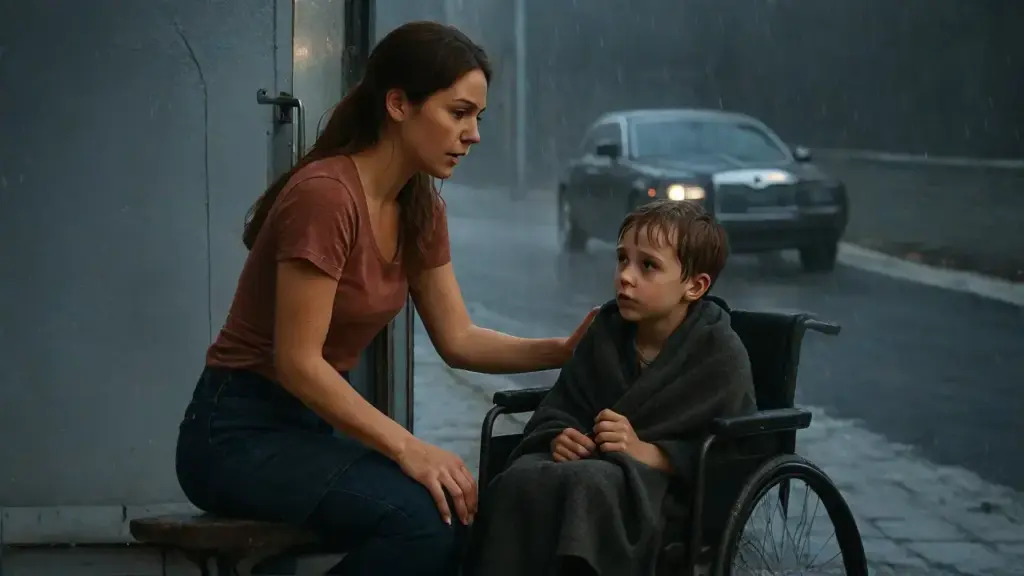
Through the rain-streaked window, she spotted a small figure hunched in a wheelchair just beyond the diner’s glow. A boy, no older than twelve, his sandy hair soaked and plastered to his pale face, his thin frame shivering beneath a worn jacket that did little to shield him from the cold. His hands clutched a tattered blanket, useless against the biting wind. Alyssa’s heart tightened. Dropping her rag, she pushed open the door, the chilly gust hitting her like a slap.
— Hey, honey, she called softly, kneeling beside him. What’re you doing out here in this storm all by yourself?
The boy startled, then looked up, his green eyes wide and wary, searching her face for something—trust, maybe.
— I’m waiting for my dad, he muttered, his voice nearly drowned out by the rain.
Alyssa scanned the empty street. No cars, no people, just the faint flicker of a pawn shop’s neon sign across the road and the hiss of tires on wet asphalt in the distance.
— Where’s he at? she asked, her voice gentle but edged with concern.
The boy shrugged, pulling the blanket tighter. Alyssa sighed, her breath visible in the cold air. She’d seen too many kids like him, left waiting for someone who might not show.
— You can’t stay out here in this mess, she said, offering a warm smile. Come on inside with me, alright? It’s warm, and I’ve got something good for you.
He hesitated, his eyes flickering with uncertainty, but then he nodded slowly. Alyssa gripped the wheelchair’s handles with care and guided him into the diner, the warmth of the place wrapping around them like a soft embrace. The scent of fried bacon and strong coffee filled the air. She settled him in a booth near the heater, draping a clean towel over his shoulders before kneeling to meet his gaze.
— I’m Alyssa, she said, her smile bright. What’s your name, sweetheart?
— Ethan, he replied, his voice small as he clutched the towel, his fingers no longer trembling.
— Ethan, huh? That’s a solid name, she said, nodding approvingly. You hungry?
He gave a shy nod. Alyssa didn’t need more than that. She moved to the kitchen, her movements quick and practiced, pulling out a loaf of fresh cornbread and a block of cheddar. Soon, she set a steaming plate before him—a golden grilled cheese sandwich, paired with a bowl of creamy tomato bisque, her grandmother’s recipe for nights when the world felt too heavy.
— This one’s on me, she said, tucking a napkin into his lap.
Ethan’s eyes lit up as he took a bite, the cheese pulling in long, warm strands.
— This is amazing, he said, his voice soft with awe.
Alyssa laughed, leaning against the booth.
— Good food fixes a lot, doesn’t it?
But her heart ached. She knew that look in his eyes—too young to carry such weight, too small to face the world alone. What she didn’t know was that someone was watching.
Across the street, a sleek black Rolls-Royce idled in the shadows, its tinted windows reflecting the diner’s neon glow. Inside, James Whitaker sat motionless, his piercing blue eyes fixed on the scene. At forty-eight, James was the untouchable CEO of Whitaker Innovations, a tech empire that dominated Baltimore’s skyline. His wealth was built on cold precision, calculated decisions, and a refusal to let emotions cloud his judgment. Yet now, he watched his son, Ethan, being cared for by a stranger—a Black waitress in a worn apron, in a diner that looked like it hadn’t been updated since the ’80s.