


In the bustling chaos of Chicago O’Hare International Airport, where hurried travelers wove through crowded terminals under the hum of fluorescent lights, seventeen-year-old identical twins Emma and Ava Thompson stood at the center of a storm they never anticipated. Their trembling hands gripped their boarding passes as the gate agent’s cold sneer sliced through the air.
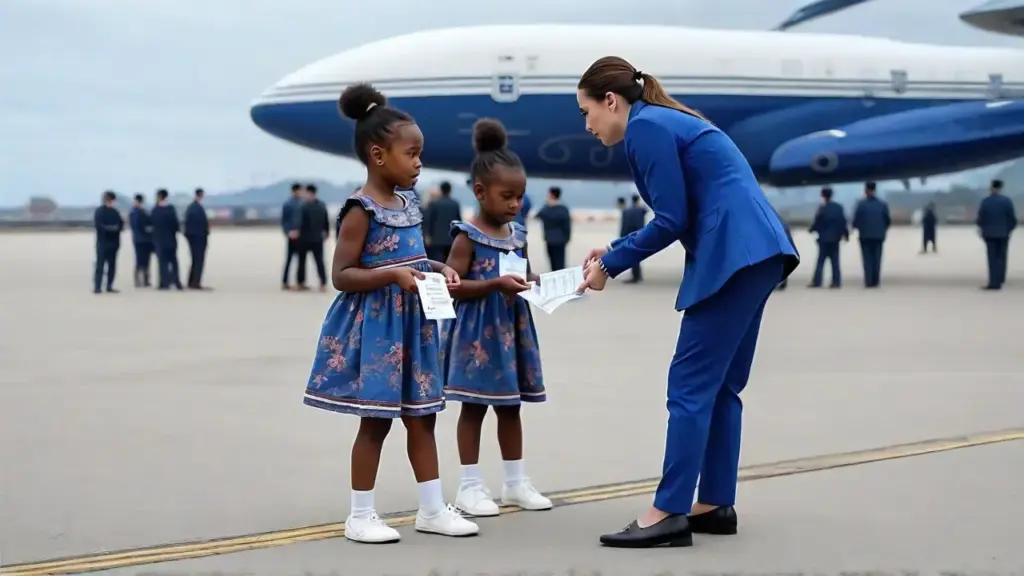
— I don’t care who your father supposedly is, you’re not getting on this flight, he snapped, his voice carrying to nearby passengers.
Emma and Ava exchanged a knowing glance, the sting of familiarity settling in. This wasn’t the first time they’d faced this kind of treatment, but it still burned. Emma unlocked her phone, her fingers steady despite her racing heart, as Ava leaned in and whispered,
— Do it.
Neither could have imagined that this single call would not only get them home but would halt every plane in Horizon Air’s fleet, exposing a decades-long pattern of systemic discrimination that would shake the airline industry to its core.
Emma and Ava, honors students at Lincoln Academy, were on a college tour to New York, a trip that symbolized more than just visiting campuses. For the first time, their protective father, James Thompson, had allowed them to travel alone, a milestone in their journey toward independence. Dressed in casual sweatshirts, jeans, and slightly scuffed sneakers, they blended in with the sea of travelers, their identical faces framed by neatly styled cornrows, their brown eyes sparkling with excitement. What no one around them could know was that James Thompson wasn’t just any doting parent.
He was the newly appointed CEO of Horizon Air, a role he’d kept under wraps to shield his family from scrutiny and to quietly evaluate the airline’s culture without the weight of his title influencing staff behavior. The twins held first-class tickets, a practical choice James made to ensure their comfort and safety, not a flaunting of status.
The line at the Horizon Air check-in counter moved briskly until the twins reached the front. The agent, a man whose name tag read Brian Carter, looked past them to the next passenger.
— Next! he called, ignoring the two Black teenagers standing directly before him.
A white couple in their forties stepped around the twins, assuming they weren’t in line, and Brian began processing their tickets with a warm smile.
— New York’s great this season, he said cheerfully.
Ava cleared her throat politely.
— Excuse me, sir, we were next in line.
Brian’s smile vanished, his eyes narrowing as he finally acknowledged them.
— You’ll wait your turn, he said sharply, continuing to type for the couple.
— But we were next, Emma said, her voice calm but resolute.
— We’ve been waiting for twenty minutes.
Brian’s jaw tightened.
— I’ll get to you when I’m ready.
The twins shared a look. They’d felt this kind of invisibility before, but it didn’t hurt any less. They stood patiently as Brian lingered with the couple, chatting about New York’s skyline while casting sly glances at the twins, a faint smirk tugging at his lips.
After the couple left, Brian helped three more white passengers before reluctantly waving the twins forward.
— Tickets and ID, he barked, avoiding eye contact.
Emma placed their first-class boarding passes and student IDs on the counter. Brian’s eyebrows shot up as he scanned the tickets.
— First class? You sure you’re at the right counter? His tone implied they’d made a grave error.
— Yes, our father bought these tickets, Ava said evenly.
— We’re visiting colleges in New York.
Brian picked up the passes as if they were suspect.
— These don’t look right. Where’d you get them?
— Our father purchased them directly from the airline, Emma replied, her patience fraying slightly.
— Is there an issue?
Brian’s lips thinned.
— I need to verify these, and your student IDs aren’t enough. I’ll need more identification.
— We’re seventeen, Ava explained.
— We don’t have driver’s licenses yet. Our father was told student IDs would suffice for domestic flights.
Brian sighed theatrically.
— Well, someone misinformed your father. Wait here.
He vanished into a back office with their tickets and IDs. The twins stood awkwardly at the counter for nearly twenty minutes as other agents processed passengers who’d arrived after them. Muffled laughter drifted from the office. When Brian returned, he slapped down two new boarding passes and their IDs.
— System error, he announced loudly.
— You’ve been reassigned to economy, Gate 19.
Emma examined the passes, her brow furrowing.
— These aren’t the seats our father booked. We’re supposed to be in first class.
Brian leaned in, his voice low and cutting.
— Look, I don’t know what scheme you’re running, but certain folks need to realize first class isn’t for everyone. Be grateful you’re even on this plane.
The emphasis on “certain folks” left no room for misinterpretation. Ava opened her mouth to retort, but Emma touched her arm, a silent reminder of how their anger could be turned against them.
— Our father booked first-class tickets, Emma insisted, her voice steady.
— I’d like to speak to a supervisor.
Brian’s face hardened.
— Supervisor’s tied up. Take it up at the gate if you’re unhappy. Next!
He waved to the passengers behind them. Humiliated, the twins gathered their altered passes and stepped away.
— We should call Dad, Ava whispered.
— No, Emma said, though it took effort to hold back.
— He’s in that board meeting today. He said no calls unless it’s an emergency.
— This feels like an emergency, Ava muttered, but she relented.
— Let’s get it sorted at the gate, Emma said, though doubt crept in.
They didn’t notice Brian watching them with a smug grin or see him pick up a phone to make a quick call.
— It’s Brian. Two Black teenagers, identical twins, trying to scam first-class tickets. I moved them to economy, but keep an eye out. Something’s off.
He hung up, confident he’d upheld the status quo. At the security checkpoint, the twins noticed a pattern: white passengers breezed through with minimal hassle, while they were singled out.
— Randomly selected for enhanced screening, announced TSA agent Lisa Harper, her smirk suggesting otherwise.
They were directed to a separate lane for additional checks.
— Is this necessary? Emma asked politely.
— We’re already behind schedule.
Lisa’s expression turned cold.
— Questioning security protocols? I can make this much harder if you’d like.
Her hand hovered over her radio, a clear threat.
— No, ma’am, Ava said quickly, shooting Emma a warning look.
— We understand.
Lisa motioned to their carry-ons.
— Everything out of the bags. Now.
The twins complied, unpacking their neatly organized belongings. Emma winced as Lisa roughly pulled out her laptop, scratching it against the table.
— Careful, please, Emma said.
— That’s got all my schoolwork.
Lisa’s eyes narrowed.
— If you’re worried about your stuff, maybe you shouldn’t be flying. I can deny you boarding right now if you interfere.
Her voice carried, drawing stares. Ava touched Emma’s arm as Lisa rummaged through their clothes, flipped through their journals, and opened a sealed envelope of Emma’s medication, spilling allergy pills across the table.
— What are these? Lisa demanded, as if uncovering contraband.
— Cetirizine, Emma explained.
— For my allergies. The prescription’s on the bottle.
Lisa ignored her, setting the pills aside for “further inspection.” Another agent approached.
— Arms out, feet apart. Pat-down time.
The pat-down was invasive, the agent’s hands lingering uncomfortably. Lisa commented loudly,
— Gotta check these intricate hairstyles. You’d be shocked what people hide in them.
Nearby TSA agents chuckled. A white woman in line began recording, but a supervisor appeared.
— Ma’am, recording security procedures is prohibited. Delete it now.
— This is wrong, the woman protested.
— Those girls aren’t doing anything to deserve this.
— Delete it, or you’re detained, the supervisor warned.
Reluctantly, the woman complied, giving the twins an apologetic glance. After nearly fifty minutes, the screening ended. Their belongings were haphazardly repacked, Emma’s laptop scratched, and they were cutting it close to their flight.
— Have a nice trip, Lisa said with mock sweetness.
— Better hurry. Gate 19’s strict on timing.
Ava pulled out her phone.
— We need to call Dad. This is beyond ridiculous.
Emma checked the time.
— He’s in that closed-door board meeting. His assistant said no interruptions. We’ll handle this and tell him tonight.
Shaken but resolute, they rushed to Gate 19, unaware that their ordeal was far from over. At the gate, privileged boarding for first-class passengers had begun. After visiting a customer service desk—where a curt agent restored their first-class seats with no apology—the twins approached with cautious hope.
The gate agent, a middle-aged white man named Paul Mitchell, was ushering first-class passengers through when he saw their passes. His smile vanished.
— There’s a problem with these, he said loudly, drawing attention.
— Step aside while I verify.
Ava’s patience snapped.
— What problem? Our seats were changed once already, then fixed. What’s the issue now?
Paul’s eyes narrowed.
— ID, now. And lower your voice.
They handed over their student IDs. Paul examined them with exaggerated care, flipping them over, holding them to the light, while waving other first-class passengers through with barely a glance.
— These don’t look legit, he declared.
— Student IDs are easy to fake.
— They’re official IDs from Lincoln Academy, Emma said, struggling to stay calm.
— They have our photos and the school seal. The airline confirmed they’re valid for domestic travel.
Paul reached for the PA system.
— Security to Gate 19. Security to Gate 19.
The announcement echoed, prompting whispers and phone recordings from nearby passengers.
— This is discrimination, Ava said firmly.
— We have valid tickets and ID. You’re delaying us because we’re Black. That’s illegal.
Paul’s face reddened.
— That’s a serious accusation. I could have you banned from this airport for slandering staff. I’m following protocol.
— Which protocol requires a fake security alert? Emma challenged.
— Or scrutinizing our IDs while ignoring others’?
A new voice interrupted.
— What’s the issue, Paul?
A woman in her fifties, with dark skin and a tight bun, approached. Her name tag read Karen Williams, Supervisor. The twins felt a flicker of hope.
— These two have potentially fraudulent first-class tickets, Paul said, as if reporting a crime.
— They’re accusing me of discrimination to bully their way on board.
Karen gave the twins a tight smile.
— Let’s see what’s going on.
She examined their passes and IDs, then motioned them aside, away from the crowd.
— Paul, keep boarding. I’ll handle this.
Alone with Karen, the twins hoped for understanding.
— Thank you, Ava began.
— We’ve faced this treatment all day, and we’re just trying to get to New York.
Karen’s demeanor shifted, her voice dropping to a harsh whisper.
— Listen carefully. I don’t know what game you’re playing, but people like us need to know our place to be treated fairly.
The betrayal stung.
— People like us? Emma repeated, stunned.
— What’s that supposed to mean?
— It means, Karen said, her voice low,
— making a fuss and crying discrimination won’t get you anywhere. It just proves what they think about us. You need to be twice as polite, twice as patient, twice as perfect. That’s reality.
— We’ve been nothing but polite, Ava protested,
— while being discriminated against at every step.
Karen’s expression hardened.
— You think I got here by calling out every slight? This is the real world, not some social media crusade.
She glanced at their passes.
— I’ll let you board, but this is a warning. Don’t cause trouble on my airline.
She led them back to the gate, where Paul watched with clear displeasure.
— Their documentation’s fine, Karen said coldly.
— Let them board.
As the twins moved toward the jet bridge, Karen’s words lingered, the betrayal from someone who should have been an ally cutting deep. But their ordeal wasn’t over. At the jet bridge, a tall man in a Horizon Air uniform blocked their path. His name tag read Steven Clark.
— Step aside, he said loudly.
— There’s an issue with your tickets.
Passengers maneuvered around them.
— What issue? Emma asked, exhausted.
— Our tickets have been verified multiple times.
Steven’s face was impassive.
— A system alert flagged suspicious activity with your reservation. I need to run more checks.
— What suspicious activity? Ava demanded.
— We’re high schoolers visiting colleges. What’s suspicious about that?
Steven ignored her, directing other passengers through. Minutes dragged into half an hour, with Steven making quiet radio calls, glancing at them with a hint of satisfaction. As the last passengers boarded, he approached.
— The flight’s full and overbooked. Your seats were reassigned to passengers in good standing.
— That’s impossible, Emma protested.
— We have confirmed first-class tickets. You can’t just take them.
— I can, Steven countered.
— Airline policy allows reassignment for security or overbooking. You hit both.
— What security concerns? Ava asked, her voice rising.
— We’ve done nothing wrong. This is discrimination.
Steven reached for his radio.
— Security to Jetbridge 19. Passenger issue.
Two security guards, Michael Evans and David Lee, appeared, hands near their weapons.
— What’s the problem? Michael asked Steven, not the twins.
— They’re refusing to accept they’ve been denied boarding, Steven said, twisting the truth.
— They’re getting aggressive and slandering staff.
— We’re not aggressive, Emma insisted.
— We’re asking why our confirmed seats were taken after being deliberately delayed.
David stepped forward.
— The system randomly selects passengers for denial when flights are overbooked. Nothing personal.
His smirk belied the lie. Ava pulled out her phone.
— I’m recording. We’ve faced discrimination all day, and we have proof.
Michael reached for her phone.
— Recording security procedures is prohibited. Hand it over.
— This isn’t a security procedure, Emma said.
— You’re covering up discrimination with fake security claims.
— That’s a serious accusation, David warned.
— Keep it up, and you’ll be detained.
The threat of detention loomed, risking their entire trip.
— Fine, Emma said, touching Ava’s arm.
— We’ll leave, but this isn’t over.
— It is for today, Steven said smugly.
— Your seats are gone. Find another way to New York or go home.
Escorted away by security, the twins walked in silence, the weight of defeat heavy. Every step had met resistance, prejudice, and obstruction, despite their patience and compliance. As their flight’s final boarding call echoed, Ava turned to Emma, tears in her eyes.
— We have to call Dad now.
Emma nodded, pulling out her phone. Seated on a bench in a quiet terminal corner, her hand shook as she dialed James. He answered immediately.
— Emma, everything okay, honey?
His warm voice nearly broke them.
— Dad, Emma said, struggling to stay composed,
— they wouldn’t let us board.
After a pause, James’s tone turned serious.
— Tell me everything, from the start.
For ten minutes, the twins recounted their ordeal: Brian’s check-in snub, Lisa’s invasive TSA screening, the restaurant incident with hostess Sarah Miller and manager Robert Hayes, the gate confrontation with Paul and Karen, and Steven’s final denial. James listened silently, his breathing growing heavier. When they mentioned their seats being revoked and restored only to be taken again, a sharp snap—likely a pen—came through the phone.
— Dad? Ava asked.
— Are you there?
— I’m here, James said, his voice eerily calm.
— Did you get names and badge numbers?
— Yes, Emma confirmed.
— We wrote down everything.
— Good, James said.
— Girls, there’s something I should’ve told you. I’m the new CEO of Horizon Air.
The twins froze, stunned.
— You’re what? Ava managed.
— I was appointed six weeks ago to fix the airline’s issues, James explained.
— I kept it quiet to assess the culture without my title skewing things. That’s why I booked your tickets privately.
— So we’ve been treated like this, Emma said,
— as the CEO’s daughters?
— Exactly, James said, his voice tight with anger.
— Discriminated against by people who didn’t know who they were dealing with.
— What do we do now? Ava asked.
— Our flight’s gone.
— Stay put, James ordered.
— I’m activating Emergency Protocol Omega. Keep your phone on and record everything.
The line stayed open as James issued commands to others.
— In two minutes, you’ll get calls from executives offering everything—private jets, luxury hotels. Don’t accept anything. Say you’re waiting for my instructions only.
— Yes, Dad, they said in unison.
— Stay strong, James said.
— I love you both.
True to his word, their phones rang with Horizon Air’s Executive Office caller ID. Panicked voices offered private flights and VIP perks, but the twins declined, citing their father’s instructions. Then Paul Mitchell, the gate agent, approached, his earlier arrogance replaced by panic.
— Ms. Thompson, Ms. Thompson, he panted.
— There’s been a misunderstanding. We’ve arranged a private jet to New York.
— No, thank you, Emma said coolly.
— We’re waiting for our father’s instructions.
Paul’s face twisted.
— Claiming family connections won’t help. False statements could get you on a no-fly list. Let’s discuss this privately.
— Is that a threat? Ava asked, recording.
James’s voice boomed from the phone.
— Mr. Mitchell, this is James Thompson, CEO of Horizon Air. Everything is recorded. Return to your gate and await instructions.
Paul paled and fled.
— Dad, what’s Emergency Protocol Omega? Emma asked.
— Watch the departure boards, James said grimly.
The boards flickered, and flights began showing “Delayed – Gate Return.” Announcements followed:
— Attention Horizon Air passengers, all flights are held for executive-ordered safety verification. Please remain seated.
Confusion spread as passengers checked phones and agents scrambled. James’s voice came through, issuing orders.
— Ground every flight. I want the Chicago station manager in a video call in five minutes.
— Dad, Ava said,
— what are you doing?
— Using my authority, James replied.
— Shutting down the system gets attention. Every Horizon flight—over 300 planes, 40,000 passengers—is grounded.
— Won’t this cost millions? Emma asked.
— Yes, James said,
— and that’s why it’ll force change.
The terminal buzzed with frustration as news crews arrived. A management team, led by Linda Foster, Terminal Operations Director, approached.
— You need to move, Linda said.
— You’re causing a disruption.
— We’re sitting quietly, Ava said.
— How are we disruptive?
— Your presence is linked to the operational issues, Linda replied.
— We’re minimizing passenger anxiety.
— You’re trying to hide us because we’re Black teenagers who’ve been discriminated against, Emma said, holding up her phone.
— This is James Thompson, CEO. Want to explain why you’re removing his daughters?
Linda paled.
— Mr. Thompson? There’s a misunderstanding—
— Focus on gathering the personnel I requested, James cut in,
— not harassing my daughters.
The team retreated. The story exploded online, with #HorizonDiscrimination trending. Passengers and employees shared similar experiences, amplifying the twins’ story. In Horizon’s Manhattan headquarters, investor Charles Bennett raged at the news.
— He grounded the fleet?
His assistant nodded.
— Stock’s down ten percent.
Charles, who’d opposed James’s appointment, saw an opportunity. He contacted a Wall Street Journal reporter, framing James as emotionally unstable, and rallied board members for an emergency meeting to oust him. He also instructed VP of Operations Laura Bennett to isolate the twins.
— Get them to a private lounge, away from the press, Charles ordered.
Laura arrived at the terminal, all smiles.
— Emma, Ava, I’m Laura Bennett, VP of Operations. I’m horrified by your experience. We’ve prepared our VIP lounge for your comfort.
Emma held up her phone.
— Dad, Laura Bennett’s here, offering the VIP lounge.
James’s voice was wary.
— Put her on speaker.
Laura’s smile wavered.
— Marcus, I had no idea until your email. I’m here to ensure your daughters’ safety.
— They stay in public view, James said.
— Any interactions must have witnesses.
Laura leaned closer, whispering,
— Your father’s caused a crisis. Millions are being lost. His job’s on the line. Accept our hospitality and let us handle this.
— Is that a threat? James asked coldly.
— Next time you intimidate my daughters, clear your office first.
Laura walked away, furious, calling Charles to report her failure. Meanwhile, Horizon’s IT Director, Mark Davis, faced pressure to erase evidence. As he accessed security systems, a notification stopped him: “Access denied. Protocol Omega active.” His screen showed active monitoring. His phone rang.
— Mr. Davis, this is Emma Thompson.
— You’re trying to access security footage.
— How are you monitoring my system? Mark stammered.
— I’m a bit of a coder, Emma said.
— Dad said you’re ethical. That’s why I’m calling instead of logging your attempts to destroy evidence.
Mark froze.
— I’m following orders.
— From Charles Bennett, not the CEO, Emma said.
— I’ve backed up all evidence—recordings, ticket changes—on a secure server. I’m also scanning for fake social media posts from our accounts. Impersonation’s a federal crime, Mr. Davis.
Mark made his choice, securing evidence instead of deleting it. He messaged James,
— I’m preserving the footage. I’ll testify if needed.
The twins rallied witnesses. Maria Gonzalez, a Latina waitress from the airport’s Skyline Bistro, sent videos of Robert Hayes’s racist remarks. Passengers shared recordings from the gate. The twins’ real school records were published, debunking falsified leaks. By evening, #HorizonDiscrimination trended nationally, exposing a broader pattern.
At the emergency board meeting, Charles pushed to remove James.
— He’s costing us millions over a personal matter, he argued.
James joined, calm but firm.
— Before you vote, see the facts.
He shared a report on Horizon’s discrimination complaints, 350% above industry average, buried by prior management.
— My daughters’ experience was the catalyst, not the cause, James said.
— I’ve uncovered attempts to erase evidence and defame my daughters, linked to Mr. Bennett’s office.
Charles erupted,
— I’ll ruin you and your daughters!
— This meeting’s recorded, James said coolly.
— Care to rephrase?
Board members backed James, and Charles’s motion failed. James announced sweeping reforms: mandatory training, transparent complaint reporting, and an independent review board. The employees involved would help design the training, their salaries donated to civil rights groups.
The next day, the twins’ detailed post, “Our Experience at Horizon Air,” went viral, supported by evidence and witness accounts. The public outcry forced industry-wide scrutiny, with other airlines launching reforms. Charles resigned under pressure, his influence shattered.
Six months later, Emma and Ava stood at Gate 19, boarding a flight to New York. The gate agent, Priya Patel, smiled warmly.
— New York today?
Their boarding was seamless, a stark contrast to before. Onboard, Karen Williams, now a flight attendant, paused by their seats.
— Emma, Ava, thank you.
— Your courage changed us. I’m sorry for my part.
— It was hard, Emma said,
— but necessary.
As the plane landed, the captain announced,
— Thank you for flying Horizon Air, with First Officer Gonzalez and our crew led by Karen Williams.
The twins smiled. Their fight had sparked a transformation, not just for Horizon, but for an industry. A young Black girl in economy gazed around with excitement, unburdened by the barriers they’d faced. That, they knew, made it all worthwhile.
The story of Emma and Ava Thompson teaches profound lessons. It shows how systemic discrimination persists until challenged, how evidence is critical in countering denial, and how courage from those with the least power can drive change. Most importantly, it proves that addressing discrimination strengthens institutions, aligning ethics with economics for a better future.