


A man worth ten billion dollars disguised in clothes from a thrift store sits alone in the most expensive restaurant he owns. He’s not here for the food. He’s hunting for something money can’t buy: honesty. But in a world of fake smiles and calculated kindness, his search feels hopeless. He orders the five hundred dollar emperor’s cut steak, a silent test for the staff. The young waitress who serves him seems different.
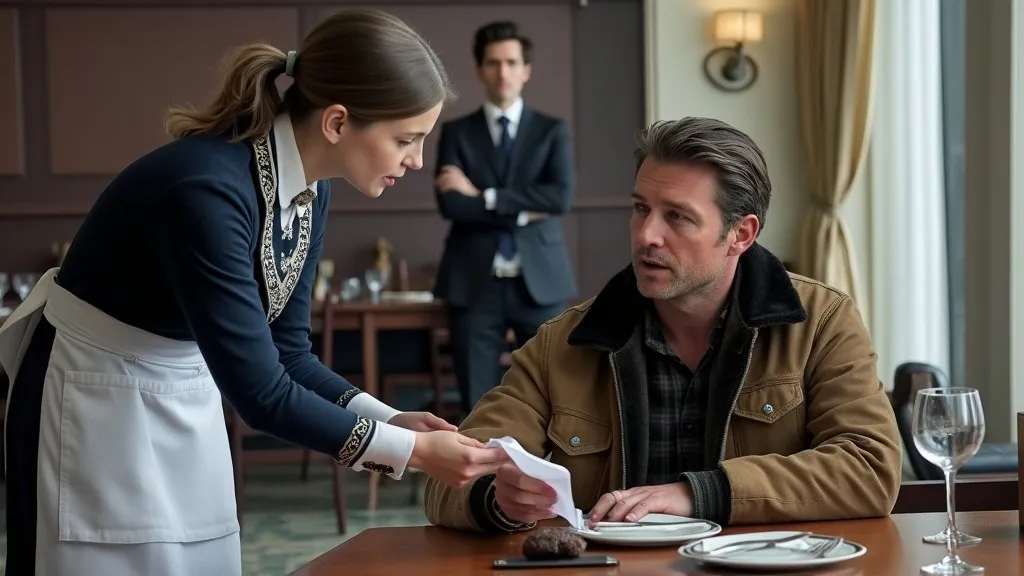
There’s a quiet desperation in her eyes that cuts through his cynicism. As she clears his plate, her hand trembles as she slips a folded napkin towards him. He expects a phone number, a plea for cash.
But when he opens it, four chilling words stop his heart and threaten to bring his entire empire crashing down. The weight of Jameson Blackwood’s fortune was a physical thing, a bespoke suit of armor woven from stock certificates and real estate deeds. It was impossibly heavy.
At forty-two, he commanded Blackwood Holdings, a sprawling global conglomerate with interests in everything from luxury hospitality to biomedical technology. From his penthouse office, which scraped the clouds above Chicago, he could manipulate markets and shape city skylines with a single phone call. He was a king in a kingdom of glass and steel, and he was profoundly, achingly alone.
The world he inhabited was a curated one. Every interaction was buffered by assistants, lawyers, and public relations handlers. The people he met had been vetted.
Their smiles polished their intentions, sanitized. They laughed at his jokes, even the bad ones. They agreed with his opinions, even the half-formed ones.
He was surrounded by mirrors, each one reflecting a carefully constructed image of the man they thought he wanted to be. The real Jameson, the one who had grown up in a small Ohio town with dreams of being an architect, had been lost somewhere along the climb. This evening’s exercise in self-flagellation was born from that loneliness.
It was a ritual he performed every few months, a pilgrimage back to reality. He would shed the skin of Jameson Blackwood, the titan of industry, and don the shabby persona of Jim, a man adrift in the world. The clothes were carefully chosen from a second-hand store on the city’s south side: a faded corduroy jacket with worn elbow patches, a plaid shirt that had seen better decades, and jeans that were soft with age.
A pair of scuffed work boots and a day’s worth of stubble completed the transformation. He even wore a pair of non-prescription glasses with thick, unflattering frames. Looking in the cracked mirror of a gas station bathroom, he saw not a billionaire, but a man who might be struggling to make next month’s rent.
The anonymity was a relief, a cool balm on the perpetual burn of public scrutiny. His destination was the Gilded Steer, the flagship steakhouse of his hospitality division. It was the jewel in his culinary crown, a place famous for its dry-aged beef, thousand-dollar bottles of wine, and a patron list that read like a who’s who of the city’s elite.
He had acquired the restaurant group two years ago, and while the profit margins were excellent, he had never set foot in this particular location. His reports, compiled by his C.O.O., Arthur Pendleton, spoke of flawless service, impeccable quality, and record-breaking revenues. But reports were just numbers on a page.
They couldn’t measure the soul of a place. Jameson wanted to see it for himself through the eyes of someone who didn’t matter. He pushed through the heavy ornate brass doors, and the city’s clamor was instantly replaced by the hushed symphony of fine dining.
The air was thick with the scent of seared meat, old leather, and expensive perfume. A wave of warmth from the roaring fireplace washed over him. The hostess, a statuesque blonde whose smile was as bright as it was brittle, gave his attire a swift, dismissive glance.
«Can I help you?» she asked, her tone implying he had wandered in by mistake.
«A table for one?» Jameson said, his voice a little rougher, a little less commanding than usual.
She hesitated, her eyes flicking around the opulent, dimly lit dining room.
Most tables were filled with couples in evening wear and groups of men in tailored suits.
«Do you have a reservation?»
«No. Is that a problem?»
Her smile tightened.
«We are typically fully booked. Let me see what I can do.»
She tapped at her tablet with a perfectly manicured finger, the exaggerated motion designed to convey what an enormous inconvenience this was.
After a moment, she looked up.
«I can seat you at a small table near the kitchen entrance. It’s all we have available.»
It was a classic brush-off, a table reserved for walk-ins deemed unworthy of the main floor.
«That’s fine,» Jameson said, playing his part.
He followed her past tables, where diners paused their conversations to watch his passage, their curiosity tinged with disdain.
He was an anomaly in this curated environment, a weed in a rose garden. He felt their judgment like a physical touch, and a familiar bitter resentment coiled in his gut. This was the world he had built, a world that judged a man’s worth by the cut of his suit.
He was deposited at a small, wobbly table, tucked into an alcove, just as she’d promised. The swinging doors to the kitchen provided a constant jarring percussion of bangs and muffled shouts. It was the worst seat in the house.
It was perfect. From his vantage point, he could observe the restaurant’s machinery. He watched the waiters move with a predatory grace, their smiles calibrated to the perceived wealth of their tables.
He saw the manager, a slick, dark-haired man in a suit that was just a little too tight, schmoozing with a table of what looked like city council members. Jameson recognized him from the corporate files: Gregory Finch. Finch exuded an oily charm that didn’t quite reach his eyes.
He laughed loudly at a patron’s joke, clapping him on the back, but the moment he turned away, the smile vanished, replaced by a hawk-like vigilance. He barked a quiet but sharp order at a passing busboy who flinched and scurried away. Jameson settled in, becoming part of the scenery.
He was invisible, and from this position of invisibility he could finally see. He saw the subtle dance of class and expectation. He saw the performative deference, the transactional kindness.
It was exactly what he had expected. It was a well-run machine, efficient, profitable, and utterly soulless. A deep sigh escaped him.
Was this all his empire was creating: polished surfaces, with nothing underneath? He had been nursing a glass of water for about ten minutes when a waitress approached his table. She was different from the others. While the rest of staff had a hard, professional sheen, she seemed softer, almost fragile.
She was young, perhaps in her early twenties, with wide, intelligent brown eyes and chestnut hair pulled back in a simple, severe ponytail. Her uniform was neat, but showed signs of wear. The white apron faded at the creases.
What he noticed most, however, was a faint tremor in her hand as she placed a basket of bread on his table. There were dark circles under her eyes, a weariness that her polite smile couldn’t quite conceal.
«Good evening, sir,» she said, her voice quiet but clear.
«My name is Rosemary, and I’ll be taking care of you tonight. Can I get you started with something to drink?»
He looked at her name tag. Rosemary.
It suited her. It was a classic, gentle name. He deliberately ordered the cheapest beer on the menu.
He watched for any flicker of disappointment, any subtle change in her expression that would betray her judgment. He saw none.
«Of course,» she said with the same steady, pleasant tone.
«I’ll be right back with that.»
As she walked away, he noticed her shoes. They were standard-issue black non-slips, but the soles were worn almost smooth, the leather cracked and peeling near the toes.
They were the shoes of someone who spent countless hours on her feet, someone for whom a new pair was a luxury she couldn’t afford. It was a small detail, but it told a bigger story than any of Arthur Pendleton’s financial reports. For the first time all night, Jameson Blackwood felt a sliver of genuine curiosity.
Who was this girl Rosemary who looked at a man in thrift-store clothes and saw not a lesser person, but simply a person? He didn’t know it yet, but his simple, cynical test was about to unravel a conspiracy that reached into the very heart of his company, and this quiet waitress with the tired eyes and worn-out shoes was the only one brave enough to light the fuse.
Rosemary Vance, Rosie to the few friends she had time for, moved through the controlled chaos of the Gilded Steer like a ghost. She was efficient, she was polite, but she kept a part of herself locked away, a necessary act of self-preservation.
The restaurant was a stage, and every night she played the part of the attentive, cheerful waitress. But behind the curtain of her smile, a storm of anxiety was raging. Her younger brother Kevin was the center of her universe.
At seventeen, he should have been worried about college applications and prom dates. Instead, his life was a cycle of doctor’s appointments, medication schedules, and terrifying trips to the emergency room. He had a rare genetic disorder that affected his lungs, a cruel lottery ticket drawn at birth.
The treatments were experimental and astronomically expensive, and their insurance had long since hit its lifetime cap. Every dollar Rosie earned, every tip she pocketed, went into the bottomless pit of Kevin’s medical bills. The job at the Gilded Steer paid better than any other service job she could get, but it came at a cost.
The manager Gregory Finch was a predator in a well-tailored suit. He had discovered a discrepancy in the previous month’s inventory, a mistake Rosie had made out of sheer exhaustion, logging a shipment incorrectly. It was a minor error, easily correctable.
But in Finch’s hands, it became a weapon. He had cornered her in his office, his voice a low, menacing purr. He’d accused her of theft, threatened to have her fired and blacklisted, ensuring she’d never work in a reputable restaurant in the city again.
And then he had offered her a deal. She could work to pay off the loss, which he had inflated to a staggering five thousand dollars. Her paychecks would be garnished, her tips monitored.
She was, in effect, his indentured servant. She knew he was lying. She knew the debt was a fabrication.
But she had no proof, and the threat of losing this job, the only thing keeping Kevin’s head above water, was paralyzing. Worse still, Finch had begun forcing her to help him with the real books late at night. She’d had two years of community college, majoring in accounting, before Kevin’s condition worsened and she had to drop out.
Finch used that knowledge. He made her reconcile his fabricated invoices to help him hide his own, much larger crimes. She saw the numbers that didn’t add up, the invoices from suppliers she had never heard of, the vast sums of money being funneled into an account under a shell corporation.
She was trapped, a reluctant accomplice to a crime she was only just beginning to understand. Every shift was a tightrope walk over a canyon of fear. When she first saw the man in the corduroy jacket, seated at table thirty-two, her sympathy was immediate.
It was the worst table, a place where Finch stuck people he deemed undesirable. She had seen the hostess lead him there with a barely concealed sneer. The other waiters would likely ignore him, focusing their energy on the tables with a higher probability of a hefty tip.
Rosie wasn’t built that way. Her mother had always taught her that a person’s worth wasn’t in their wallet, but in their character. She approached him with the same genuine respect she offered the CEO at table five.
When he ordered the cheapest beer, she simply nodded and smiled. It was a small act of defiance against the restaurant’s unwritten caste system. As she went about her duties, she kept an eye on him.
He wasn’t on his phone, nor was he trying to catch anyone’s eye. He was just watching, his gaze sweeping over the room with a quiet, unnerving intelligence. There was a stillness about him, a self-possession that seemed at odds with his shabby appearance.