


This is Shola. At just 12 years old, she had experienced more pain and hardship than most people do in a lifetime. Born and raised on the streets by a mentally ill mother, Shola had no father, no home, and no one to fight for her future. She spent only two years in school before dropping out because the one woman paying her fees disappeared. Hopeless, forgotten, yet incredibly smart, Shola’s life changed one day. She met Jessica, the daughter of a billionaire, studying in the best school money could buy, yet struggling to learn.
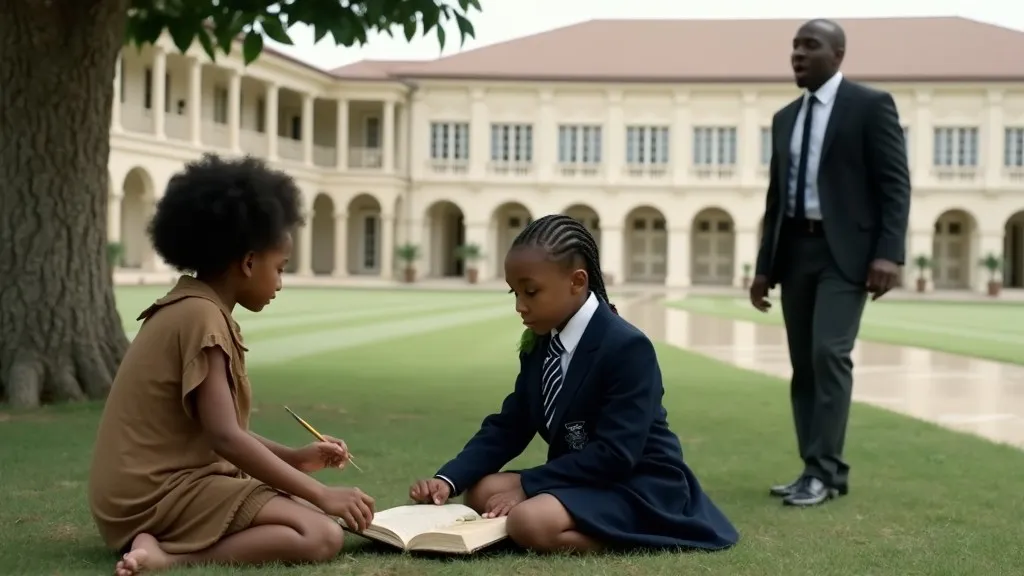
It was Shola, the barefoot girl from the gutter, who became her secret teacher. When Jessica’s powerful father discovered a homeless child teaching his daughter under a mango tree, what he did next will leave you speechless. So, grab your popcorn, sit back, and get ready for one of the most powerful stories you’ve ever heard.
If you’re new here, don’t forget to subscribe and hit the like button to support more inspiring stories like this one. A raw slap of spit landed just inches from Shola’s bare feet. She didn’t move. She’d grown used to the insults.
The market woman’s voice pierced the air again. “Is this a rubbish ground? You and that mad woman better shift before I pour water on you!” Shola tightened her grip on her mother, Abini, who sat barefoot beside the gutter, mumbling to herself and tracing patterns in the dust with one trembling finger.
Her wrapper had fallen halfway, exposing scars and filth, but Abini didn’t notice. She was lost in another world, one only she could see. People walked past.
Some slowed down. Some stared. One woman paused, shook her head, and kept walking.
No one helped. No one ever did. Shola was 12 years old, but the streets had aged her soul.
She didn’t cry anymore when people called her names—daughter of a madwoman, gutter girl, cursed child. She’d heard them all. What hurt more was the pity, the empty kind that came with a mighty shake of the head and no hand to help.
Her mother used to be beautiful, or so Shola imagined. On rare lucid days, Abini would sing old Yoruba lullabies and call Shola “princess,” but those moments were like shooting stars—brief and gone before you could touch them. Most days, Abini couldn’t even remember where she was.
She’d scream at her reflection in puddles, throw stones at shadows, and run from imagined monsters. Shola had no father—not even a name, not even a photo. “Who’s my daddy?” she’d once asked years ago.
Abini had looked at her with hollow eyes and replied, “I don’t know. The rain. Maybe the rain.”
That was the end of that conversation. They slept under a broken kiosk near Mile 12. If it rained, they got wet.
If it was hot, they burned. Their mattress was a flattened carton. Their blanket was silence.
Shola didn’t even know what it meant to dream anymore. Survival was the only language she spoke. Each morning began the same way.
Abini would wake up screaming, clawing at the air. Shola would grab her, hold her close, and whisper, “It’s me, Mommy. It’s me.”
Then she’d gently clean her up, sometimes with just a rag and water from a gutter pipe, and lead her back to the same begging spot on the street. Her mother begged. Shola watched.
That was their life. Occasionally, people dropped coins. Mostly, they dropped insults.
“Mommy, don’t talk today, okay?” Shola whispered that morning, tucking her mother’s wrapper more tightly around her. “Just sit. Just be quiet.”
But Abini suddenly stood and shouted at a passing car, “Give me my wings! I left them in your boot!” The driver honked and swerved.
Shola felt her cheeks burn. She turned and met the eyes of a schoolgirl across the street, neatly dressed, holding a lunchbox. The girl stared for a moment, then quickly looked away, whispering to her friend and laughing.
Shola looked down at her own legs, covered in dust, her toenails chipped, her hands dry. Her stomach grumbled, but she ignored it. Hunger was a constant companion.
Still, beneath it all, she dreamed. She dreamed of sitting in a classroom, raising her hand to answer questions. She dreamed of wearing a uniform, writing in notebooks, and reading books that weren’t soaked in rainwater or torn at the edges.
She dreamed of someone, anyone, calling her by name without scorn. But who would send the daughter of a madwoman to school? Who would care about a girl whose mother chased birds because she thought they were demons?
And yet, Shola still hoped. She watched children pass with their backpacks and neat braids, and she whispered to herself, “One day.” One day, she would sit in a real classroom.
One day, she would escape this cursed corner of Lagos. One day, her mother would smile again and know her name. As she reached into her bag to count the N10 note and the three coins they had gotten so far, she heard a hawker shout behind her, “Thunder fire poverty!”
Shola didn’t look back. She just held her mother tighter and whispered, “Amen.” It started with a plate of jollof rice.
Shola had been crouching beside her mother near Oshodi that afternoon, her stomach tying itself into knots from hunger. Her mother was having one of her silent days, just rocking back and forth like a broken record, her eyes unfocused, lips twitching. That’s when Shola noticed a woman watching her from across the road.
The woman stood behind a steaming food stand with plastic chairs, a wooden table, two coolers, and the unmistakable scent of cooked rice and pepper soup. She was fair-skinned, full-bodied, and wore a simple Ankara gown. There was something in her gaze, something that wasn’t pity.
Shola looked away, embarrassed. She hated being watched like an animal in a zoo. Minutes later, the woman crossed the road and stood in front of her.
“What’s your name?” she asked gently. Shola stared at her bare feet, then whispered, “Shola.” “Where’s your mother?” Shola pointed at the woman beside her, who was now singing to an empty bottle.
The woman’s eyes softened. “She’s sick, isn’t she?” Shola nodded. “What did you eat today?”
Shola didn’t answer. Instead of asking further, the woman held out a covered takeaway plate. “Here, eat.”
Shola hesitated. Strangers didn’t give food without expecting something in return, something she wasn’t willing to give. “Don’t worry,” the woman smiled. “I’m not like the others.”
That was the first time she met Auntie Linda. The food was hot, the rice sweet, the meat soft. Shola hadn’t eaten meat in months.
That same evening, Auntie Linda returned with bottled water and soap. “What’s your story, child?” she asked as she helped Shola wash her hands. Shola told her everything—the madness, the market, the school she once peeped into, the hunger, the hope, the dreams.
She didn’t cry, but her voice cracked. Auntie Linda wiped her hands with a handkerchief. “Tomorrow, come to my shop.”
“You’ll help me clean. In return, I’ll feed you. Deal?” Shola nodded so hard her head almost fell off.
The next day, Shola came. She swept. She washed plates.
She served customers. She watched Auntie Linda carefully, how she smiled at people, how she ran her small business with quiet power. One afternoon, Shola sat under the counter, writing numbers in the sand with a stick.
Auntie Linda leaned down and asked, “Where did you learn that?” Shola answered, “From watching the school near the express road. I memorized what the teacher said.” The woman blinked.
“You mean you never went to school?” “I did, once. For three weeks. Auntie Beasy paid, but she moved away.”
Auntie Linda was silent for a long time. The next week, she returned with a gift—a brand-new exercise book and a pack of pencils. The week after that, she went a step further.
Three weeks later, Shola stood inside a dusty public school classroom, her hands trembling, heart pounding. She wore a secondhand uniform that Auntie Linda had bought from a thrift market. It was too big, but it felt like a crown.
“Behave yourself, oh,” Auntie Linda said that morning as she let her in. “Make me proud. I don’t have money to waste.”
Shola nodded quickly, holding the nylon bag with her new book like it was gold. The first day was strange. Children stared.
Some giggled. But the moment the teacher asked a question and Shola answered before anyone else could raise a hand, everything changed. She was smart—too smart.
She answered questions older students couldn’t. She memorized poems after hearing them once. She wrote with speed and precision.
Even the headmistress asked one day, “Who trained this child?” Shola always said, “Auntie Linda.” Every evening after class, she returned to the food stand to work.
She cleaned, helped serve, and sometimes got to taste leftover soup or fruit. But her real reward was watching Auntie Linda nod in approval and say, “Good girl.” It was the first time Shola felt seen, felt loved.
Then, just when life seemed like it was turning, everything changed. Auntie Linda came home one night holding a white envelope. “My sister in the UK finally processed my papers,” she said, tears in her eyes.
“After seven years of waiting.” Shola smiled. “So we’re traveling?” The woman stopped smiling.
“No, Shola, just me.” The room grew quiet. Shola blinked. “What about me?”
Auntie Linda sighed deeply. “I paid for your school up to this term. Maybe God will send someone else to help you. I’ve done all I can.”
Shola stared at her plate. She wanted to scream, “Take me with you, please!” But she only nodded.
Three weeks later, Auntie Linda was gone. No one told her goodbye. No one else came to pay the next term’s fees.
The headmistress called her one day and said, “We’re sorry, Shola. Without fees, you can’t remain.” She stood outside the school gate for hours, clutching her bag, waiting for Auntie Linda to come back.
She never did. She waited outside the school gate until the sun began to fall behind the buildings. Her uniform was dusty.
Her book bag hugged her side. Flies buzzed near her ear, but she didn’t move. Her eyes were fixed on the bend of the street where Auntie Linda had promised to return.
But that bend remained empty. Shola’s stomach rumbled. Her throat burned from the dust she’d swallowed all day.
Children walked past in clusters, laughing, chasing each other, their parents waiting with snacks and hugs. No one came for her. Eventually, the gateman walked up.
“Little girl, it’s time to go.” Shola nodded slowly. She stood, dusted herself off, and walked away.
But she didn’t go home. Where was home, anyway? The broken kiosk she used to sleep in with her mother now had a new tenant—a drunk who threatened her with a belt the last time she tried to return there.
The corner by the bakery where Abini used to beg was now occupied by two boys who sniffed glue and fought anyone who looked at them wrong. The streets had changed while she was gone. The only thing that hadn’t changed was her mother, still mad, still barefoot, still talking to ghosts and demons in the air.
When Shola found her by the gutter that night, her mother was trying to feed a dead pigeon with gari soaked in brown rainwater. “Mommy, it’s me. Let’s go somewhere safe,” Shola whispered, but her mother only hissed and slapped her.