


In the midst of a brutal snowstorm on Highway 70, a black diner owner quietly counted her last $47 with only 7 days left before losing everything. At her lowest moment, 15 weary Hell’s Angels knocked, seeking shelter. Without hesitation, she opened the door and shared her final meal. By morning, the roar of hundreds of motorcycles filled the air outside her diner.
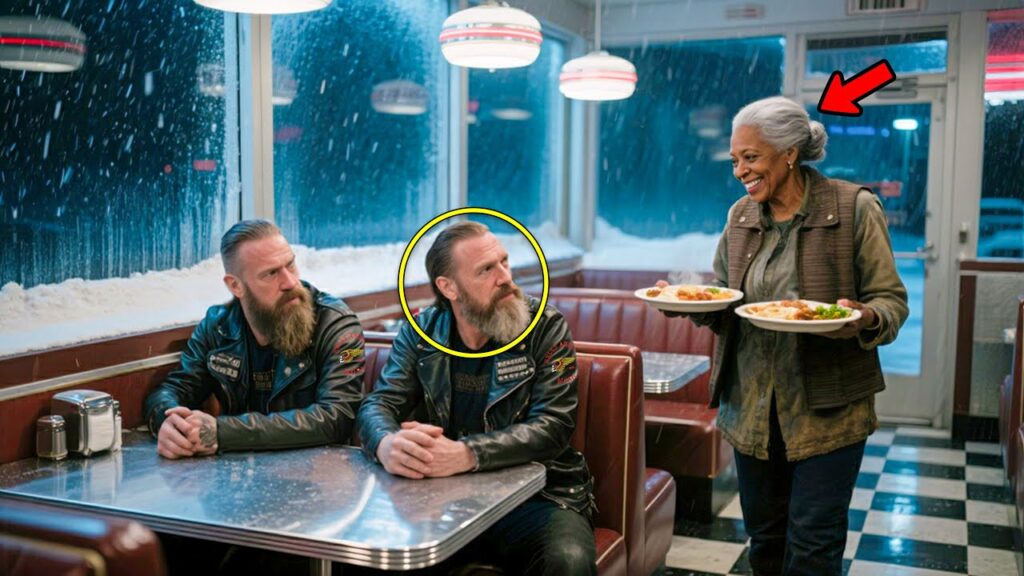
Sarah Williams stood behind the counter of Midnight Haven Diner, staring at the stack of crumpled bills in her weathered hands. $47. That was it.
That was all that stood between her and the final notice tucked beneath the cash register, the one that gave her exactly 7 days before the bank took everything. The wind howled outside, rattling the windows of the small diner perched on Highway 70 in the Colorado Mountains. Snow fell in thick, angry sheets, turning the world beyond the glass into a white void.
At 50 years old, Sarah had seen plenty of storms, but this one felt different. This one felt like an ending. She moved slowly around the empty diner, her footsteps echoing off the worn linoleum floor.
The red vinyl booths sat empty, their surfaces cracked from years of use. The coffee pot gurgled weakly, half full of the bitter brew that had been sitting there since noon. It was nearly 8 o’clock now, and she hadn’t seen a customer in over 3 hours.
Sarah paused at booth number 4, Robert’s favorite spot. Even 2 years after the cancer took him, she could still see him sitting there, his gentle smile warming the room more than any heater ever could. They’d bought this place together 15 years ago with nothing but dreams and a small inheritance from her grandmother.
«We’ll make it work, baby,» Robert used to say. His dark eyes twinkling with optimism. «This place will be a light for travelers. A home away from home.»
Now the lights flickered overhead, threatening to go out just like everything else. The heating system groaned and wheezed, fighting a losing battle against the mountain cold. Sarah pulled her cardigan tighter around her shoulders and walked back to the counter, where the foreclosure notice seemed to mock her with its official letterhead and cold bureaucratic language.
The diner’s CB radio crackled weakly in the corner, its antenna bent from years of neglect. Once that radio had been their lifeline to the trucking community. A constant stream of voices sharing road conditions, warnings, and the occasional joke.
Now it mostly sat silent, just another relic of better times. Sarah opened the register again, counting the money one more time as if the numbers might magically change. They didn’t.
$47 wouldn’t even cover the electric bill, let alone the three months of back payments the bank demanded. She’d already sold her wedding ring, Robert’s tools, everything of value they’d accumulated over their 23 years of marriage. This diner was all she had left.
The wind picked up outside, shaking the building so hard that the old neon sign buzzed and flickered. Through the window, she could see the snow piling up against the gas pumps, burying them under white drifts that looked like gravestones in a cemetery. Highway 70 was completely invisible now, lost beneath the storm.
Sarah glanced at the clock above the coffee machine. 8:15. Time to close up, flip the sign, and admit defeat.
Tomorrow she’d call the lawyer, maybe see if she could work out some kind of payment plan, though she knew it was hopeless. The bank had been patient enough. She was reaching for the light switch when she heard it.
A low rumble that cut through the howling wind like thunder. At first she thought it might be a snowplow, but the sound was different. Deeper. More rhythmic.
Like a heartbeat made of steel and chrome. Sarah pressed her face to the window, squinting through the snow. At first she saw nothing but white.
Then slowly, shapes began to emerge from the storm. Headlights. Lots of them.
And beneath the lights, the distinctive silhouettes of motorcycles, big ones, Harley Davidsons by the look of them. The rumble grew louder as the bikes approached, their engines revving against the wind. Sarah counted 15 machines in total, all riding in tight formation despite the treacherous conditions.
As they pulled into the diner’s parking lot, their headlights swept across the windows like searchlights, filling the empty dining room with harsh white light. Sarah stepped back from the window, her heart pounding. She’d heard stories about motorcycle clubs, seen them in movies, but she’d never actually encountered one.
These men—and they were all men, she could tell even through their heavy winter gear—looked like something out of a nightmare. Leather jackets, boots, helmets that hid their faces. They moved with the confidence of people who weren’t used to being told no.
The lead rider dismounted first, a tall man with broad shoulders who seemed to command the others without saying a word. He looked toward the diner, and Sarah could feel his gaze even through the window. Slowly, deliberately, he began walking toward the front door.
Sarah’s hand hovered over the light switch. She could turn off the lights, lock the door, pretend the diner was closed. These men wouldn’t know the difference.
They’d probably just move on, find somewhere else to wait out the storm. Somewhere that wasn’t her problem. But as the man approached the door, she saw something that stopped her cold.
He was limping. Not badly, but enough to notice. Behind him, the other riders were dismounting, and she could see that several of them were struggling.
They’d been riding in this storm for hours, maybe longer. They were cold, exhausted, and probably desperate for shelter. The man reached the door and paused, his gloved hand hovering over the handle.
Through the glass, Sarah could see his face clearly now. He was older than she’d expected, maybe 45, with gray streaking his dark beard. His eyes were tired, weathered by years on the road.
They were the eyes of someone who’d seen enough hardship to recognize it in others. He knocked, three gentle raps that somehow managed to be both respectful and urgent. Sarah looked back at the $47 on the counter, then at the foreclosure notice, then at the man waiting in the storm.
Robert’s voice echoed in her memory: «A light for travelers, baby. A home away from home.» She walked to the door and turned the lock.
The moment Sarah opened the door, the full force of the storm hit her like a physical blow. Snow swirled into the diner, and the temperature dropped 20 degrees in seconds. The man standing on her threshold was covered head to toe in ice and snow.
His leather jacket frozen stiff. His beard white with frost. But it wasn’t just one man.
Behind him, Sarah could see the others dismounting from their motorcycles, and her breath caught in her throat. These weren’t ordinary bikers. The leather jackets bore the unmistakable patches she’d seen in news reports.
The death’s head logo. The winged skull. The words «Hell’s Angels» emblazoned across broad shoulders and backs.
Fifteen of them. All massive men with arms thick as tree trunks. Faces weathered by years of hard living and the kind of presence that made smart people cross to the other side of the street.
The leader was easily six foot four, with salt and pepper hair pulled back in a ponytail and a gray beard that reached his chest. Tattoos covered every visible inch of his arms. Intricate designs that told stories Sarah didn’t want to know.
A jagged scar ran from his left temple to his jawline, and his eyes—pale blue and sharp as winter ice—held the weight of someone who’d seen too much and done things he couldn’t take back. Behind him, the others looked like they’d stepped out of a movie about motorcycle gangs. One had a shaved head covered in tattoos, including a spider web on his neck.
Another sported a mohawk despite being well into his fifties, with arms so heavily muscled they strained the seams of his leather jacket. The youngest couldn’t have been more than 25, but he carried himself with the swagger of someone trying to prove he belonged with these dangerous men. «Ma’am,» the leader said, his voice rough from the cold and probably decades of cigarettes.
«I know this is an imposition, but we’ve been riding for 12 hours straight. The highway’s completely shut down about 10 miles back, and we’re not going to make it much further in this weather.» Sarah’s heart hammered against her ribs.
Every instinct screamed at her to close the door, to lock it, to call the police. These men looked like they could tear her diner apart with their bare hands and probably had done worse to people who’d crossed them. The patches on their jackets weren’t decorations.
They were warnings. But then she saw something that gave her pause. Despite their intimidating appearance, they stood respectfully in the snow, waiting for her answer.
None of them pushed forward or tried to force their way in. The leader kept his hands visible, his posture non-threatening despite his size. And there was something in his eyes—exhaustion, yes, but also a kind of desperate hope that she recognized all too well.