


Hollis Miller had been thirty-six years upon this earth, and many of them carved deeper lines in him than his age allowed. A widower’s weight rested on his shoulders, with no children to carry his name and no partner to share the hearth. The cabin was his only companion, its logs darkened with years of storms and seasons. At night, he sat by the fire alone, the chair across from him as empty as the other half of his bed.
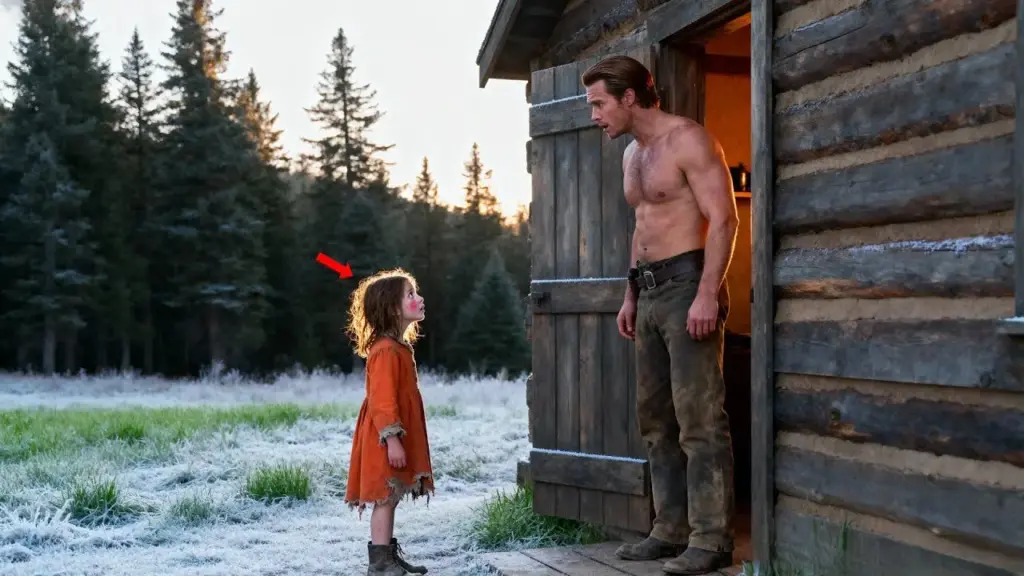
Those who knew him in town spoke of his size before they spoke of his nature. «Giant Miller,» they called him. Strong as an ox, with hands like hammers. But the truth of him lived not in his strength, but in his silence. He did not go to the saloon nor court the laughter of neighbors. He kept his words few and his world smaller still.
That evening, the air pressed close, heavy with the smell of wood smoke and snow, when a sound broke against the cabin door. It was not the wind, nor the loose rattle of branches. It was deliberate—a knock, sharp, hurried, and trembling. Hollis paused with a log in his arms, his head lifting, every instinct sharpening in the stillness. No one came to his door after dark, not in winter, not without reason.
He set the log down slowly, moved to the door, and pulled it open with a cautious hand. There she stood, small as a bird and nearly as fragile. A girl no more than seven, her hair tangled and damp from snow, her cheeks blotched red with cold. She wore only a thin dress, torn at the hem, her boots so worn the toes peeked out raw. Her eyes were wide, not from the cold but from a fear that had settled deeper than the frost.
She looked up at him, a giant shadow in the doorway, and whispered words that hung in the air like smoke from a dying fire.
«They beat my mama. She’s in too much pain.»
Hollis felt the words strike against the silence of his cabin, echoing in places he thought long closed. For a moment, he did not move. The girl’s lips trembled, but she did not cry. She had already run out of tears. She stood with a desperate dignity that no child should know, holding herself as though she could keep the world from shattering if she only stood still enough.
«Who is your mama, child?» Hollis asked at last, his voice low, like the rumble of earth before a storm.
She swallowed hard, her throat small and thin beneath the dirt smudged across her skin. «Mary Ellen. Mary Ellen Carter. They—they left her at the shack by Miller’s Creek. She can’t get up. Please, sir, please help her.»
Mary Ellen Carter. The name pulled at him like a half-forgotten tune. He had seen her once or twice in town, a woman of soft features dulled by weariness, her eyes always downcast when her husband was near. Elias Carter was his name, broad-shouldered but quick with drink and quicker with his fists.
Hollis had watched once as Elias barked at her in the store, his hand too near her face, and she had wilted like grass beneath a boot heel. Hollis had turned away, as most men did, not out of cruelty but out of the old Western truth: another man’s home was not yours to trespass upon, even when it was cruel. Yet hearing her name now from the lips of her child pierced him deeper than the winter wind.
He crouched low, the boards of the porch creaking under his weight, so that his great height would not frighten the girl. «What’s your name, little one?» he asked.
«Laura May,» she whispered.
Hollis saw her eyes glisten, though the tears did not fall. He studied the bruises on her small arms, the way she clutched the torn sleeve of her dress as if it might keep her safe. Something hardened in him then, not anger loud and burning, but a quiet fury that ran deeper, like fire hidden in the roots of a tree.
«Get inside,» he told her, standing tall again.
The girl hesitated, as though unsure if she could trust a man so large, so stern. But when the wind gusted and nearly knocked her sideways, she stepped past him into the warmth. Hollis pulled his coat tighter and strode into the night, his boots breaking a steady trail across the snow. Miller’s Creek lay a mile off, through bare cottonwoods that rattled like bones.
The cold pressed sharp against his face, but his steps never faltered. He carried no lantern, trusting the pale wash of the moon and his own memory of the land. The shack came into view, a sagging ruin of logs and broken shingles, smoke long gone from its chimney. He pushed the door open, the wood groaning on its rusted hinges.
Inside, the air reeked of damp straw and stale whiskey. In the corner, upon a pallet of rags, lay the woman, Mary Ellen. Even in the shadows, her injuries told their story. Her cheek was swollen, purpled, one eye nearly closed. Her lips bore the split of a heavy hand, and her arms showed the marks of rough handling, wrists raw where rope had burned.
Yet her gaze, when it lifted to him, was not pleading. It was proud, steady, as though she would rather die on the floor than beg another soul for mercy. Hollis stepped closer, his shadow filling the small room.
Mary Ellen’s voice came hoarse and thin. «You shouldn’t have come. They’ll say things. They’ll ruin you.»
He knelt slowly, the floor creaking beneath his weight, and looked into her bruised face. «Let them say,» he murmured. He slid his arms beneath her with a tenderness that belied his size, lifting her as though she weighed nothing at all. Her breath caught at the sudden movement, but she did not protest. She closed her eyes, perhaps from shame, perhaps from the strange safety she felt in his grasp.
He carried her through the snow, his coat wrapped around her slight frame, her head resting against his chest. The storm seemed to ease its howl as they moved, as though even the winter paused to watch. At the cabin, Laura ran to the door, her small hands clasped tight together. When she saw her mother in Hollis’s arms, her face lit with a relief that made her seem years older and years younger all at once.
He carried Mary Ellen inside and laid her gently upon his own bed, the only bed in the cabin. She stirred, whispering faintly that she could not take his place, but he hushed her with a quiet shake of his head. Laura climbed onto the bed beside her mother, tucking herself close, her thin body trembling from the day’s ordeal.
Hollis moved to the hearth, stoking the fire higher, the flames crackling strong. He fetched water, tore cloth, and with rough but careful hands began to clean Mary Ellen’s wounds. She winced but never cried out. He worked in silence, the kind that spoke more than words ever could. Each gesture said what his lips did not: you are safe here, and no hand will strike you again.
Outside, snow fell heavier, blanketing the prairie in white. Yet within that cabin, a fragile warmth took root. Laura’s breathing softened into sleep beside her mother. Mary Ellen’s eyes, half-closed with weariness, flicked once to Hollis as he sat by the fire, his broad shoulders bent forward, his face lined by both the firelight and something deeper—loneliness, perhaps, or the quiet ache of a man who had carried too much silence. She wanted to speak, to thank him, but the weight of shame held her tongue.
Still, for the first time in years, she closed her eyes with a small measure of peace. But peace was a fragile thing in those lands. Already, in the tavern across town, Elias Carter’s voice carried loud and bitter, slurring over spilled whiskey. He told anyone who would listen that his wife had been stolen, that Miller had taken her into his bed. He spat Hollis’s name with venom, vowing to reclaim what was his, to make the giant bleed for shaming him. Men muttered and nodded, eager for drama, for scandal, for a story to tell through the long winter nights.
Back at the cabin, Hollis stood from the fire, looking down upon the sleeping mother and child. Something stirred in him he had not felt in years. Not desire, not yet, but the raw pulse of responsibility, of belonging. He stepped to the window, pulling back the curtain. The prairie stretched dark and endless, the snow lit faintly by the moon.
Somewhere out there, he knew, Elias was sharpening his anger. Hollis’s jaw tightened. His hand rested against the wood of the window-frame, steady as stone. He had made his choice the moment he lifted Mary Ellen from the dirt floor of that shack. Whatever came now, he would not let her fall again.