


At my brother’s wedding, I was handed a paper badge that read, «Limited Access Guest.» My mom whispered, «That means no plate.» I looked over, walked to the gift table, retrieved my envelope with the $7,500 fund check and said, «I think you won’t need this anymore.» Then I left. My brother ran after me, and my parents shouted, «Come back!» But I didn’t.
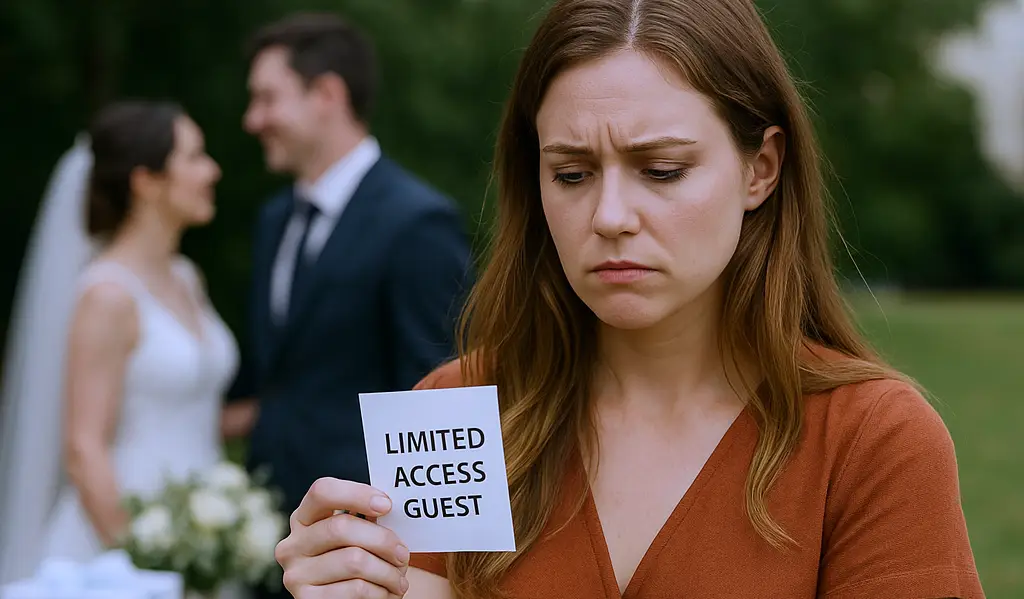
It was offensive. No other word for it. My envelope was lying there on the gift table, plain white, a little bent at the corner from when I placed it down earlier, holding a $7,500 check I’d earned the hard way.
It had taken me months of saving, extra hours, skipped vacations, and saying no to things I wanted, just so I could do something meaningful for my brother. And unfortunately for them, I was about to take it back.
I had no idea anything was wrong until I arrived at the reception venue.
The church ceremony had been fine. Quick, pretty, the kind of thing that’s all blur and applause. My brother had barely spoken to me that morning, but I chalked it up to nerves.
I didn’t expect red carpet treatment. I’m not that girl. But I assumed I was part of the day—family, after all.
When I reached the reception check-in, I was behind a couple who were handed shiny envelope-style badges, gold-trimmed with their names and table numbers printed in calligraphy. Then it was my turn. The woman behind the table didn’t even look up.
She handed me a paper badge. I stared at it: white, flimsy, printed with thick black text that read, «Limited Access Guest.» I paused.
I thought maybe it was a mistake. Then my mom appeared like she’d been waiting nearby just for this moment. She leaned in and whispered like we were sharing a joke. «That means no plate.»
I waited for her to smile, to wink, to make it a joke. But she just walked off before I could even ask anything.
I stood there holding the badge, suddenly aware of how quiet everything got in my head, like I was underwater. I walked into the hall anyway, telling myself maybe there had been a mix-up. But as soon as I saw the tables, the seating chart, and the servers placing dishes, it hit me.
My name wasn’t listed anywhere. I checked the family tables. Nothing. Not even at the far end. No chair, no plate, not even a name card.
I wasn’t a guest. I was a placeholder, a loose end they didn’t bother to cut. I stood near the wall, watching everyone settle in. My brother raised a toast. My parents clapped.
His fiancée leaned in and kissed his cheek while people snapped photos. I waited for someone to notice me, for someone to walk over and say it was a misunderstanding. No one did. They saw me. They just didn’t care.
So I made my way out of the main hall and back to the entrance where the gift table stood. It was crowded earlier, but now it was quiet. Just a few scattered envelopes and gift bags. I spotted mine immediately.
It was the only one that wasn’t sealed with a sticker or ribbon, just folded closed. I picked it up, opened it, took out the check, and held it for a second.
Then I said, not loudly, but clear enough, «I think you won’t need this anymore.» I turned and walked toward the exit. I didn’t make it ten steps before I heard chairs scraping, someone calling out my name, then my brother’s voice—louder, angrier—and then my parents.
They were all shouting now, «Come back! Come back!» I didn’t. I walked calmly to my car, started the engine, and drove off without a second glance.
They could toast and dance all they wanted, but now the honeymoon they’d been so desperate to afford just got a little less golden. They didn’t want me there. Fine, but they wouldn’t get to use me either.
I didn’t sleep that night, not because I was angry (though I was), but because everything that happened kept running through my head in perfect detail, over and over, like it was burned into the inside of my eyelids.
I couldn’t stop thinking about that envelope sitting on the gift table, how proud I was when I dropped it off. I thought I was doing something good, something meaningful. I thought I was part of something.
Instead, I was the girl with the paper badge, the girl who didn’t get a seat, the girl whose own family decided she didn’t quite belong. That wasn’t some oversight. That wasn’t a mistake. That was deliberate.
By morning, the texts started. First my mom, then my dad, then my brother: «Can we talk?» «Please don’t make this a thing.» «Let’s not ruin the weekend.»
No one said they were sorry. No one admitted anything. It was all deflection and sugar, as if my reaction was the problem, not their treatment.
My mom actually wrote, «We assumed you’d be okay with standing since you always say you don’t care about fancy stuff.» Anyway, like I was supposed to be grateful for the privilege of being excluded with a smile.
Around noon, my dad called. I ignored it. He called again, then sent a text: «Come over. We want to talk. Your brother’s here too.»
I didn’t answer right away. I took a shower, made breakfast, and cleaned the kitchen. I didn’t owe them urgency, and I didn’t owe them the benefit of the doubt either.
But still, part of me wanted to go, not to fix anything, just to watch them squirm a little. They needed that check. I knew that. I knew how close to the edge they were financially.
I’d heard my brother complain about the venue cost and how stretched they were trying to book a honeymoon in the same month. So I went, not out of forgiveness, but out of curiosity.
When I pulled into the driveway, my brother’s car was already there. So was my dad’s. I walked in without knocking, and all three of them were in the living room.
My mom tried to look casual, smiling like I was back from a long vacation. My dad nodded, like this was going to be a reasonable conversation. My brother stood and half-raised a hand, like he wasn’t sure if he was supposed to hug me or shake hands.
I sat down and didn’t say anything. I waited.
My dad spoke first. He said it was really unfortunate how things went yesterday. Not that they made it unfortunate, just that it happened to be unfortunate.
My mom followed with some lines about miscommunication and logistics. She used the word «oversight» a few times, as if I’d just slipped through the cracks, as if my absence at any table and my exclusion from dinner had been a spreadsheet error.
My brother didn’t say much. When he did, it was vague: «I didn’t know that’s how it would be. I thought you’d understand.» Like I was supposed to be some enlightened monk who would just float above the humiliation.