


«Are those supposed to be real?» The question, laced with the casual disdain of a man who had never known hardship, echoed in the cavernous silence of the courtroom. Judge Albright, a man whose tailored suit cost more than the motorcycle Fred Hudson had ridden here, leaned forward over his polished dais, a smirk playing on his lips. He peered down at the old man standing before him for a simple traffic violation.
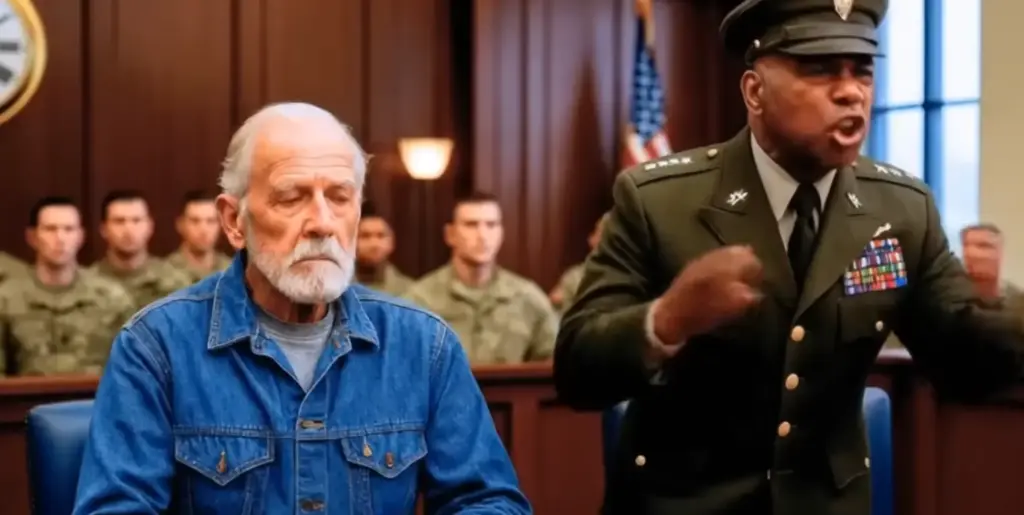
Fred Hudson, 84 years old, stood perfectly still. His back was straight, a testament to a discipline forged in a time and place this judge could not begin to imagine. He wore a simple faded denim jacket, the kind that had seen decades of sun and rain.
Pinned to the left breast, just over his heart, were three rows of ribbons and a single star-shaped medal hanging from a pale blue ribbon. They were the source of the judge’s amusement. «Your Honor,» Fred’s public defender, a young woman named Sarah Jenkins, began, «My client’s service record has no bearing on this case.»
Judge Albright waved a dismissive hand, not even gracing her with a glance. His eyes remained fixed on Fred. «I’m sure it doesn’t.»
«I’m just curious. It’s quite a collection for a man who can’t seem to remember the speed limit on a county road. Let me guess, you bought them at a surplus store? A little costume jewelry to impress the folks at the VFW.»
The small gallery, mostly filled with people waiting for their own minor infractions to be called, shifted uncomfortably. A few snickers could be heard from the back row, but most just stared, a mixture of pity and secondhand embarrassment on their faces.
Fred Hudson said nothing. His eyes, clear and gray as a winter sky, were fixed on the state flag hanging behind the judge. He wasn’t angry. He wasn’t insulted. He seemed to be somewhere else entirely, a place of profound and unshakable calm.
«I asked you a question, sir.» The judge pressed, his voice rising. He enjoyed this, the small-town power of his position, the ability to dismantle a person piece by piece under the guise of judicial authority. «Are you going to answer me, or are you as deaf as you are decorated?»
Sarah Jenkins stood up straighter, her face flushed with anger. «Your Honor, this is inappropriate. Mr. Hudson is a veteran and deserves our respect.»
«Respect is earned, Counselor,» Albright shot back, his voice like the crack of a whip, «and parading around with a chest full of tin doesn’t automatically earn it in my courtroom. Now, Mr. Hudson, for the last time, where did you get the medals?»
Fred’s gaze slowly lowered from the flag and met the judge’s. His voice when it came was quiet but carried a surprising weight, like stones worn smooth by a river. «They were given to me.»
The simplicity of the answer seemed to enrage the judge further. It offered no purchase for his mockery.
«Given to you. By whom? The costume shop manager?» He leaned back in his large leather chair, a caricature of smug authority. «Let’s be clear. I am tired of men of a certain generation thinking a uniform they wore half a century ago gives them a free pass.»
«You ran a stop sign. You were clocked at twenty miles over the limit. And you stand here in this ridiculous jacket as if it’s some sort of shield. I find it insulting to the real heroes who served.»
Each word was a calculated blow, designed to humiliate. Sarah could feel the tension in her own body, a coiled spring of outrage. She looked at her client. Fred’s hands, gnarled with age and speckled with liver spots, rested calmly on the defense table.
He didn’t fidget. He didn’t flinch. He just stood there, absorbing the judge’s venom without a flicker of expression.
«Take the jacket off,» the judge commanded. A collective gasp went through the courtroom.
This was no longer about a traffic ticket. This was a public stripping of dignity. «Your honor, you can’t be serious,» Sarah pleaded, her voice trembling slightly.
«I am perfectly serious, counselor. This is my courtroom. The defendant will show it the proper respect. That display is a distraction. Take it off, Mr. Hudson, or I will find you in contempt.»
The bailiff, a burly man who had seen his share of courtroom drama, took a hesitant step forward. His eyes met Fred’s, and for a moment he looked uncertain, even apologetic. Fred did not move.
He did not look at the bailiff or the judge. He looked at the medals on his own chest, his gaze lingering for a fraction of a second on the one hanging from the blue ribbon. He seemed to be listening to a distant echo, a sound no one else in the room could hear.
His silence was his answer. It was a profound and unyielding no.
«Fine,» the judge spat, his face turning a blotchy red. «Bailiff! Add a charge of contempt of court, and a five hundred dollar fine. Maybe that will get his attention.»
The judge’s eyes narrowed on the most prominent medal, the one that hung slightly apart from the others. He pointed a fat finger at it. «Especially that one. The gall to wear a replica of the Medal of Honor.»
«Do you have any idea what that represents, old man? The blood and sacrifice it stands for. You wearing that is a slap in the face to every person who ever served honorably.»
As Judge Albright spoke, the sterile wood-paneled courtroom seemed to dissolve around Fred Hudson. The judge’s mocking words faded into a roar, not of a hostile crowd, but of rotor blades and screaming men. The air, thick with the smell of floor polish and stale coffee, was suddenly choked with the metallic tang of blood and the acrid smoke of cordite.
For a fleeting second, he wasn’t standing on worn linoleum but was back in the sucking mud of a rice paddy outside Hue City. He wasn’t looking at a judge’s sneering face but at the terrified wide eyes of a young private, a kid from Ohio named Miller, whose leg had been shredded by machine gun fire.
The blue of the medal’s ribbon was the impossible, brilliant blue of the sky he glimpsed through the jungle canopy just before he’d scrambled from the relative safety of a bomb crater. He could feel the weight of Miller on his back, the hot, wet soak of blood through his fatigues, the deafening chatter of the enemy guns stitching a line in the mud just inches from his head.
He remembered the burning in his lungs, the singular, desperate thought—not of living or dying but of getting that boy to the medevac chopper. The medal wasn’t a piece of tin. It was the weight of another man’s life.
The memory vanished as quickly as it came, leaving Fred back in the silent, tense courtroom. He blinked slowly, his composure unbroken. Only his breathing had changed, becoming just a fraction deeper, a little more measured.
Sarah Jenkins watched the entire exchange, her heart pounding with a helpless fury. She saw the judge’s cruelty, the crowd’s cowed silence, and Fred’s incredible, almost unnerving stoicism. She knew with a certainty that chilled her to the bone that this was a terrible injustice. The judge wasn’t just wrong; he was desecrating something holy.
She looked down at the case file. Fred Hudson. A few prior speeding tickets over the last twenty years. Nothing else. Address. Social security number. Date of birth. On the intake form, in the box marked «Military Service,» Fred had simply written «yes.»
He hadn’t specified a branch, a rank, or a single honor. The humility of it, in the face of this public flogging, was staggering. An idea sparked in her mind: a desperate long shot.
While the judge was busy pontificating to the court reporter, adding his self-righteous justifications to the official record, Sarah leaned over to Fred. «Mr. Hudson,» she whispered, her voice urgent, «is there anyone I can call, from your old unit?»