


The Officers’ Club at Ramstein Air Base was a sanctuary of success, a meticulously curated bubble of polished mahogany, aged leather, and the quiet, confident hum of power. The air itself seemed different here, filtered and scented with expensive scotch and the faint metallic tang of awarded medals. Portraits of stoic four-star generals from decades past stared down from the walls, their painted eyes serving as silent judges of the current generation.
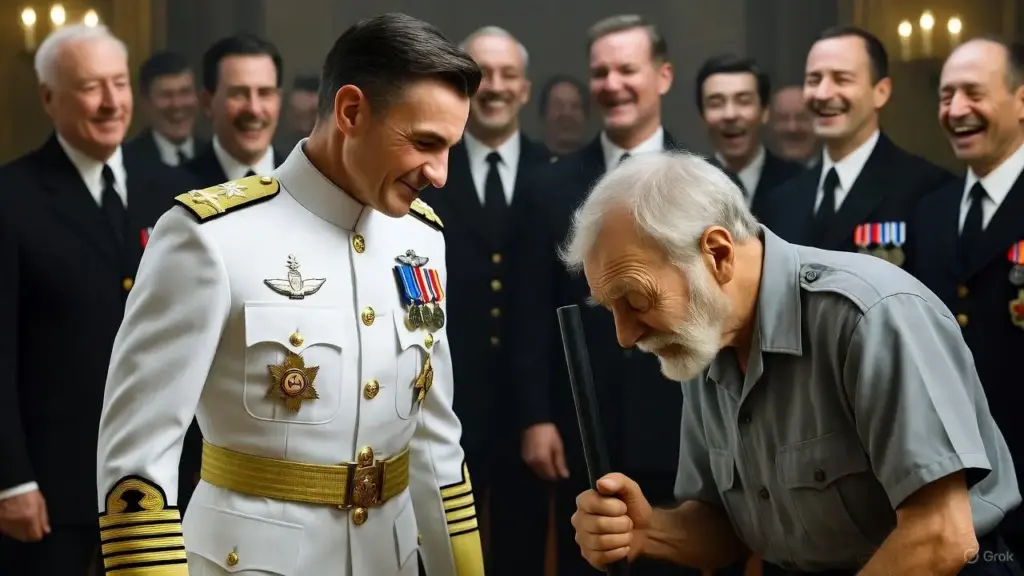
Tonight, the club was alive, celebrating a successful NATO logistics exercise. Laughter, light and brittle, echoed off the vaulted ceilings as young officers orbited the gravitational center of the room: Brigadier General Marcus Thorn. Thorn was a man sculpted from ambition.
His jaw was sharp, his gaze was sharper, and his uniform was a work of art, defying the very concept of wrinkles. He was a master of supply chains, a prodigy of procurement, a man who could move mountains of material across continents with a flurry of keystrokes. But the terrain of the human heart was foreign to him, and the dirt of a real war had never touched the soles of his immaculate boots.
His authority was derived not from shared hardship in the field, but from the unyielding enforcement of regulations. He saw the world as a grand checklist, and his primary duty was to find and publicly admonish any box left unchecked. His gaze, sweeping the room with an almost predatory sense of ownership, snagged on a discordant note in his symphony of perfection.
In a corner, almost lost in the long shadows cast by a towering bookshelf of military history, a man was cleaning. An old man, probably nearing 70, whose gray janitorial jumpsuit seemed to absorb the opulent light of the room and radiate a quiet humility. This was Arthur Jenkins.
His movements were slow, deliberate, marked by a slight limp that favored his left leg. He polished the brass nameplate on a display case containing a Vietnam-era flight helmet, with a reverence that seemed entirely out of place for his station. He was a ghost at the feast, a necessary but invisible functionary whose presence was to Thorn an affront.
Leaning toward a trio of sycophantic captains, Thorne lowered his voice to a conspiratorial murmur. «Gentlemen, a teachable moment,» he began, a cruel smirk touching his lips. «The chain of command is not just a diagram; it’s a representation of value.»
«At the top, decision-makers. At the bottom,» he gestured with his chin toward the old janitor. «Look at that. Notice the lack of bearing, the casual disregard for the decorum of this institution.»
«Such things, if left unaddressed, are like rust. They corrode the very structure of our discipline.» The captains nodded eagerly, their eyes reflecting their general’s casual disdain.
Emboldened by his captive audience, Thorne set his scotch down with a decisive click and strode across the Persian rug, his polished shoes making no sound on the thick pile. The ambient chatter of the room seemed to follow his progress, conversations faltering as dozens of pairs of eyes locked onto him. They sensed a spectacle was imminent.
Thorne stopped directly behind Arthur, who was now carefully wiping down the glass of the display case, his reflection a stooped, blurry figure against the history preserved within. «Attendant,» Thorne’s voice was like a whip crack in the hushed room. «This is a restricted function for commissioned officers and their invited guests.»
«Your duties were to be concluded before 1800 hours. Explain your presence.»
Arthur finished a long, smooth wipe before straightening up, a slow and painful process that caused his back to emit a faint popping sound. He turned, his face a complex map of wrinkles etched by time and hardship. His eyes, a pale and washed-out blue, held a profound weariness. But they met the general’s gaze without flinching.
«My apologies, General,» he said, his voice raspy with age. «The event supervisor requested I remain on standby in case of any spills. Just trying to keep the place looking its best for you, gentlemen.»
Thorne let out a short, sharp huff of derisive air. «‘Looking its best?’ Your very presence here detracts from the atmosphere. This club is a monument to warriors, to pilots who faced down MiGs over Hanoi, to strategists who outmaneuvered the Soviets.»
«It is a sacred space. It is not a utility closet for you to loiter in.» He ran a critical eye over Arthur’s worn jumpsuit, the faint stains of bleach and cleaning fluid on the knees. «Frankly, it’s an embarrassment.»
The insult, so personal and so public, hung in the air like poison gas. The room had fallen into a deep, uncomfortable silence. This was no longer a simple correction. It was a public shaming.
Arthur’s weathered face remained impassive, a mask of practiced neutrality. «I understand, sir. I’ll gather my things and leave you to your event.»
But Thorne hadn’t squeezed all the juice from his pathetic little power play. He took a step closer, lowering his voice to a tone of feigned curiosity that was somehow more insulting than his previous outburst. «Tell me, old man, since you seem so comfortable in this hall of heroes, did you ever do your part? Did you ever wear a uniform? Or has your entire contribution to this nation been waged with a mop and a bucket?» He looked back at his captains, a self-satisfied arch to his eyebrows.
The weight of every stare in the room pressed down on Arthur. He looked at the floor for a long moment, at the intricate patterns of the rug, before his pale blue eyes lifted to meet Thorne’s again. There was a flicker of something ancient in them, a spark of a long-banked fire.
«Yes, General,» he said, his voice quiet but carrying the unmistakable density of truth. «I served.»
Thorne’s smirk widened. «Oh, you served?» he exclaimed with theatrical joy. «Wonderful! Do tell us all. I’m fascinated.»
«Were you a clerk? A typist pushing papers at some forgotten records facility in Fort Dix? Perhaps a cook’s assistant, ensuring the officer’s gravy was never lumpy? There’s no shame in it, of course,» he added, the lie thick in his mouth. «Every cog in the machine has its purpose, no matter how small or insignificant.»
As Arthur bent down to place a bottle of polish back into his cart, the cuff of his jumpsuit rode up his forearm, revealing a piece of skin that hadn’t seen the sun in 50 years. There, faded to a blurry greenish-gray, was a tattoo of a snake, coiled and ready to strike. Thorne’s eyes, trained to spot any detail out of place, locked onto it.