


Is this some kind of joke, Colonel? The words, sharp and laced with disbelief, cut through the oppressive heat shimmering off the flight line. Chief Warrant Officer Evans, his face a mask of professional frustration, stared not at his commanding officer but at the old man standing beside him. The old man, Theodore Brewer, seemed unfazed by the heat, the roar of distant jets, or the scorn in the young officer’s voice.
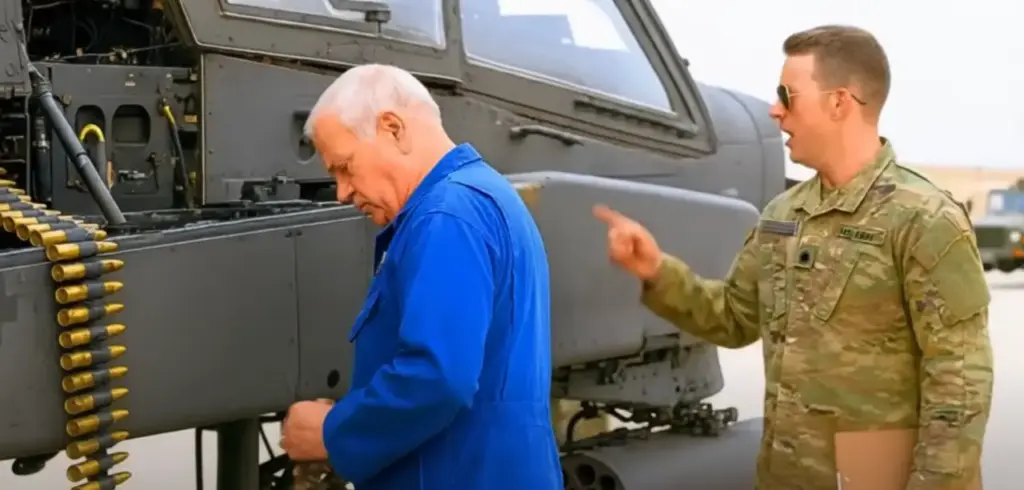
He was a relic, clad in faded, grease-stained coveralls that had seen better decades. His hands, thick with calluses and mapped with the fine lines of a thousand repairs, hung calmly at his sides. He simply looked at the silent beast before them, an H-64 Apache, the apex of modern aerial warfare, rendered as inert as a museum piece by a ghost in its own machine.
Colonel Davies sighed, the sound barely audible over the whine of a C-130 taxiing in the distance. Chief, this is Mr. Brewer. He’s here to offer a second opinion.
Evans let out a short, incredulous laugh. A second opinion? Sir, with all due respect, my team has been over this bird for seventy-two hours straight. We’ve run every diagnostic known to man.
We’ve swapped the FADEC, borescoped the turbine, checked every millimeter of the fuel lines, and replaced half the sensors. The digital logs are clean. The machine says there is nothing wrong with it, yet the port T-700 engine won’t cycle past fifty percent on spool-up.
We have engineers from General Electric on a video link. What we don’t need is… He gestured vaguely at Theodore, analog assistants. Theodore’s gaze never left the Apache.
He was eighty-something years old, his face a testament to a life lived under harsh suns and immense pressure. His eyes, though clouded slightly with age, possessed a focus that was unnerving. They weren’t just looking at the helicopter, they were studying its posture, the way it sat on its landing gear, the subtle sheen of its composite skin.
He was listening to its silence. A small crowd of younger mechanics had gathered at a respectful distance. They were the best of the best, digital natives who could interface with a billion-dollar weapons system through a ruggedized laptop.
They had been defeated by this enigma. Their confidence eroded with every failed engine test. Now they watched this strange tableau, a mixture of curiosity and the same derision their superior officer was so openly displaying.
Whispers rippled through them. Who was the old man? Some retired legend the Colonel knew? A good luck charm? Let him look, Chief, Davies said, his voice now carrying a hard edge of command that Evans could not ignore. Evans gritted his teeth and stepped back with a flourish of theatrical defeat.
Fine. The flight line is yours, Mr. Brewer. Just, please, try not to touch anything.
It’s a very sensitive piece of equipment. Theodore gave the Colonel a slow, deliberate nod of thanks and began to walk. He didn’t head for the open-engine cowling where Evans’ team had been focused.
Instead, he started at the tail, his gnarled fingers gently tracing the line of the stabilator. He moved with a slow, shuffling grace, a man completely at home in this world of jet fuel and hydraulic fluid. His every movement was economical, his attention absolute.
He circled the Apache, his head cocked as if listening for a secret. The young mechanics exchanged smirks. He looked like a farmer checking his prize bull, not a technician diagnosing a turboshaft engine.
He finally arrived at the port side, stopping below the engine that had tormented the base’s finest for three days. He didn’t look up at the complex array of tubes, wires, and blades. He knelt down, his old knees cracking in protest, and looked underneath, at the place where the engine housing met the fuselage.
Flashlight, he said. His voice was gravelly, unused. A young sergeant, eager to break the tension, scrambled to hand him a high-powered LED torch.
Evans rolled his eyes, crossing his arms. Sir, we’ve had military-grade imaging equipment in there. I assure you a flashlight isn’t going to reveal anything we missed.
Theodore ignored him. He took the light and played its beam across the underbelly of the aircraft. He wasn’t just looking.
He was observing how the light reflected, how it caught the edges of rivets and seams. He laid one hand flat against the metal skin of the helicopter, closing his eyes. The mechanic saw an old man touching an airplane.
Colonel Davies saw a master communing with a machine. He had heard the stories, whispers from old-timers about a man they called the Ghost, a mechanic from the Vietnam era who could feel a hairline fracture through three inches of steel. He had made the call to bring Theodore here as a last resort, a desperate prayer to a forgotten god of the flight line.