


She looked like any normal kid: messy braids, a cartoon shirt, and coloring books scattered around seat 12F. When their airplane started falling from the sky, nobody expected help from an 11-year-old. Then, F-22 fighter jets called out, «Thunder,» over the radio. Every passenger stared at the little girl.
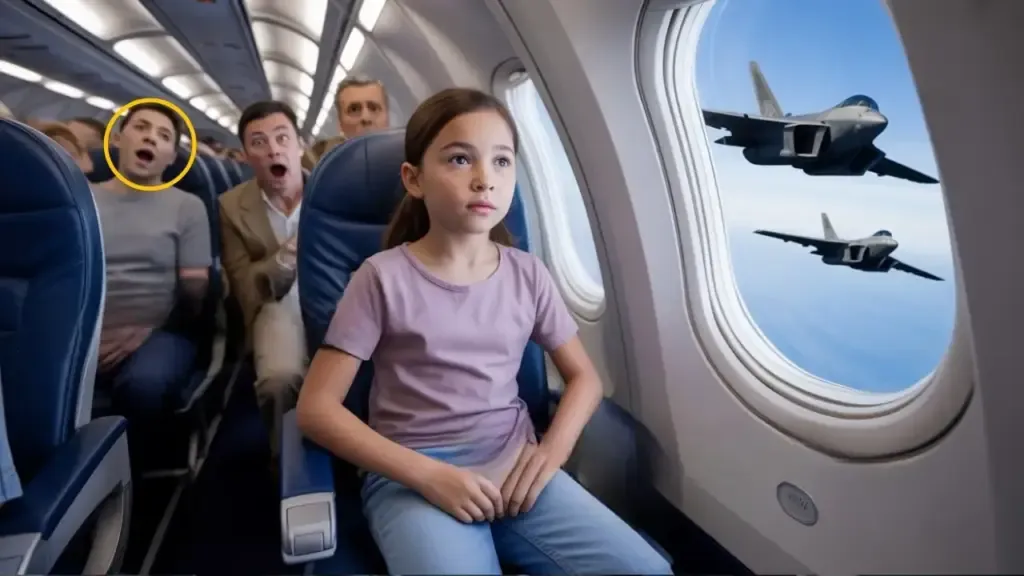
11-year-old Alex «Thunder» Williams sat in seat 12F of United Airlines flight 1847, looking exactly like what everyone expected to see: a kid traveling alone. She had messy blonde hair tied in two braids, wore a faded purple T-shirt with a cartoon character on it, and carried a small pink backpack covered in sparkly stickers. Her legs barely reached the floor, and she was reading a children’s book about dragons while quietly sipping apple juice.
The flight attendant, Mrs. Rodriguez, checked on her every few minutes. «Are you doing okay, sweetie? Do you need anything?»
«I’m fine, thank you,» Alex replied politely in the high, sweet voice that adults expected from children. «My grandma is picking me up in Chicago.»
Other passengers smiled at the well-behaved little girl traveling by herself. A businessman in 12E offered her his extra bag of peanuts. An elderly woman in 12D asked if she wanted to see pictures of her own granddaughter. Everyone treated Alex exactly like what she appeared to be: an innocent child on her first solo flight.
What none of them knew was that Alex Williams held one of the most classified positions in the United States military. At 11 years old, she was the youngest person ever to receive pilot training, and she had been flying experimental aircraft since she was nine. Her small size and young age made her perfect for testing tiny unmanned combat vehicles that adult pilots couldn’t fit inside.
Alex’s call sign, «Thunder,» had been earned when she successfully completed a test flight that had killed three adult pilots before her. Her reflexes were faster than any grown-up, her fear responses were different, and her brain processed flight information in ways that amazed military scientists. But Alex’s work was so secret that even her own family didn’t know what she really did.
To them, she was just a smart kid who went to a special boarding school for gifted children. Only a handful of people in the entire military knew that America’s most advanced combat aircraft were being tested by a sixth grader who still lost teeth and loved cartoon movies.
Captain Sarah Chin had been flying commercial airplanes for 12 years, but she had never experienced anything like what happened at 1:30 p.m. over Iowa. United Flight 1847 was cruising peacefully at 38,000 feet, carrying 156 passengers from Denver to Chicago, when Captain Chin felt something that made her blood run cold.
«Mike,» she said to First Officer Mike Torres, «are you feeling that vibration?»
First Officer Torres immediately noticed what Captain Chin was talking about. The airplane was shaking in a way that wasn’t normal, and the vibration was getting worse every minute.
«That’s not good,» Torres said, checking the engine instruments. «Engine No. 2 is showing abnormal readings.»
But before they could figure out what was wrong with Engine No. 2, Engine No. 1 started having problems too. Warning lights began flashing on the instrument panel, and alarms started going off in the cockpit.
«We’ve got major engine problems,» Captain Chin announced. «I’m declaring an emergency.»
«Chicago Center, United 1847 declaring emergency,» she transmitted to air traffic control. «We have engine failures and are requesting immediate assistance.»
«United 1847, Chicago Center copies your emergency. What are your intentions?»
«We need vectors to the nearest suitable airport. We may not be able to maintain altitude much longer.»
As Captain Chin and First Officer Torres worked through their emergency procedures, the situation got much worse. Both engines were losing power, and the airplane was becoming harder and harder to control.
In seat 12F, Alex felt the changes in the airplane’s movement immediately. Her training had taught her to recognize the sounds and feelings of aircraft in trouble, and she knew that Flight 1847 was in serious danger. But Alex’s orders were clear: Never reveal her identity, never let anyone know what she could do, never break her cover no matter what happened. Too many secret projects depended on people believing she was just a regular kid, even if it meant letting 156 people die.
When United Flight 1847 declared an emergency over Iowa airspace, the North American Aerospace Defense Command (NORAD) immediately began tracking the situation. A commercial aircraft with engine failures was automatically flagged for military attention, especially when it was flying near sensitive military installations.
«Sir,» reported Major Lisa Rodriguez to Colonel James Parker at NORAD Command, «we have a commercial emergency aircraft that may need to make an emergency landing at Offutt Air Force Base.»
«What’s the situation?» Colonel Parker asked.
«United 1847, 156 souls on board, experiencing multiple engine failures. They’re requesting emergency landing clearance.»
«Scramble F-22s immediately,» Colonel Parker ordered. «I want that aircraft escorted and monitored. If they need to land at a military base, we need to be ready.»
Within minutes, two F-22 Raptor fighters from the 55th Wing at Offutt Air Force Base were climbing rapidly toward the emergency aircraft. Major Kevin «Shark» Thompson and Captain Jennifer «Viper» Williams were experienced pilots who had performed civilian aircraft escorts before.
«Chicago Center, Raptor 1 and Raptor 2 airborne and climbing to intercept United 1847,» Major Thompson transmitted.
«Raptor flight, United 1847 is at flight level 380 with engine problems. Provide escort and assessment.»
As the F-22s approached their target, they prepared for what they expected to be a routine escort mission. But routine was about to become impossible.
As the F-22 Raptors took position alongside United Flight 1847, NORAD Command was reviewing the passenger manifest as part of standard security procedures. What they found made Colonel Parker reach for his secure phone immediately.
«Sir,» reported Technical Sergeant Maria Santos, «you need to see this passenger list.»
«What is it?»
«Passenger in seat 12F is listed as Alex Williams. But when I ran that name through our classified databases, I found something that doesn’t make sense.»