


10:45 a.m., Memorial Hospital, San Diego. A young doctor stands in the director’s office, tears streaming.
«You performed surgery without authorization. You’re fired.»
Her voice trembles. «I did it because the patient was dying.»
The director’s tone is ice-cold. «Leave before I call security.»
She walks into the hallway, head down. Colleagues watch with regret.
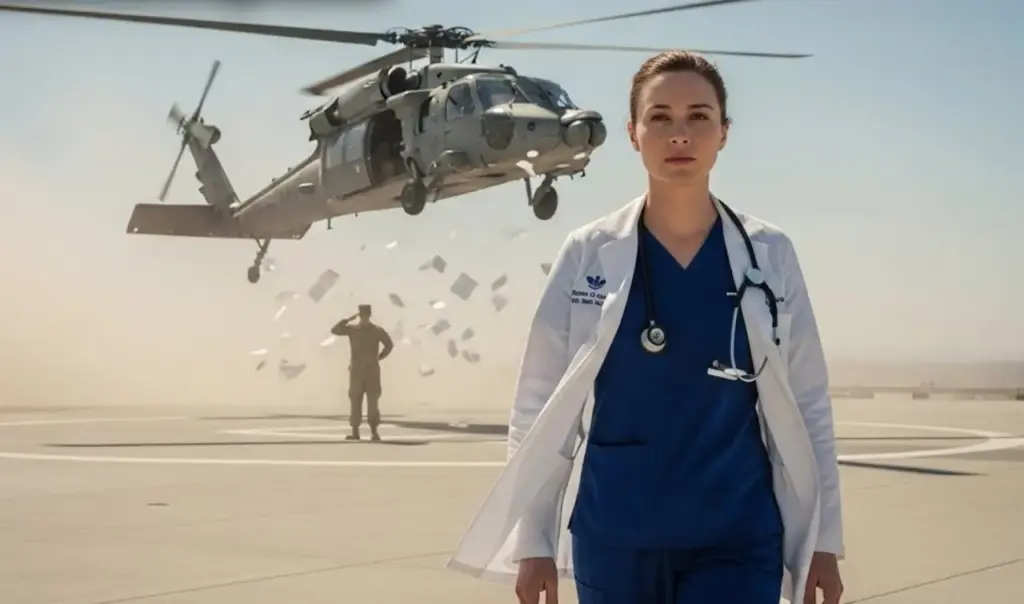
But five minutes later, rotor blades shake the entire building. Everyone looks up; a Navy helicopter is landing on the roof. An officer steps out, shouting, «I need Dr. Amelia Grant immediately!»
The entire hospital falls silent.
Dr. Amelia Grant, 32 years old, is a young resident physician. A former Navy Corpsman, she is now working civilian duty at Memorial Hospital.
Dr. Richard Owens is the hospital director, rigid and inflexible, who believes that protocols matter more than people.
Lieutenant James Miller, 38, is a Navy SEAL officer and Amelia’s former patient, who survived on the battlefield because of her.
Amelia used to be an emergency combat medic serving at Kandahar Air Base in Afghanistan. After an explosion injured dozens of soldiers, she performed surgery on James Miller herself without a supervising physician present.
When she returned home, she left military service, wanting to start fresh as a civilian doctor. But hospital environments were different from battlefields.
Everything was bound by protocols, paperwork, and hierarchies. Her colleagues constantly judged her as impulsive and disrespectful of the system.
One morning during an emergency shift, an elderly patient suffered cardiac arrest. The attending physician hadn’t arrived yet. Amelia saw the pulse stop.
She immediately decided to perform open-chest cardiac massage, a procedure rarely permitted without authorization. The heart started beating again; the patient lived.
But Dr. Owens looked at her with fury in his eyes. «You just violated protocol.»
«I just saved a life.»
«Nobody asked you to do that.»
That afternoon, he signed her termination papers.
She packed her belongings without saying a word. Her hands moved mechanically, placing the stethoscope in her bag and removing her name badge from the lanyard.
A young intern approached her. «Dr. Grant, what you did was amazing. That man is alive because of you.»
«And I’m jobless because of it,» she replied with a sad smile.
«That’s not fair.»
«Fair doesn’t exist in bureaucracy. Only rules do.»
She walked through the emergency department one last time. Patients she had treated over the past year waved goodbye; some didn’t even know she’d just been fired.
In the locker room, she sat alone for a moment, staring at her white coat hanging on the hook. It was the coat she’d worn with pride, the coat that represented everything she’d worked for since leaving the military.
Her phone buzzed. It was a text from her mother: «How’s your day going, honey?»
She typed back, «Just another day in paradise.» She couldn’t tell her yet, not until she figured out what came next.
As she walked toward the exit, Dr. Owens appeared in the hallway, flanked by two administrators. «Dr. Grant, I want to be clear: this isn’t personal. It’s about maintaining standards.»
She stopped and turned to face him directly. «Standards or control? Because from where I stand, those look very different.»
«You can’t just do whatever you want whenever you see fit.»
«And you can’t let people die while waiting for permission to save them.»
His face reddened. «This conversation is over.»
She nodded. «Yes, it is.»
Outside, rain began to fall. She stood under the awning, watching ambulances come and go. This was her world: the chaos, the urgency, the split-second decisions that meant life or death. And she’d just been kicked out of it.
A security guard she knew approached. «Doc, I’m sorry about what happened.»
«Thanks, Marcus.»
«That guy you saved this morning… he’s my wife’s uncle. You gave our family more time with him. That matters more than any rule.»
She smiled through her tears. «Tell him I said to take care of himself.»
«I will. And Doc? You’re one of the good ones. Don’t let them make you forget that.»
She walked to her car, sat in the driver’s seat, and finally let herself cry. It was not from sadness but from exhaustion, from years of fighting to prove she belonged, only to be told she didn’t.
Her military dog tags hung from the rearview mirror, clinking softly in the breeze through the open window.
She whispered to them, to the memory of who she used to be, «Did I make the right choice leaving?»
The rain intensified, drumming on the roof of her car. She sat there for ten minutes, letting the weight of the day settle on her shoulders.
Her phone rang—an unknown number. She almost didn’t answer, but something made her pick up. «Dr. Grant?» a woman’s voice asked, shaking with emotion.
«Yes?»
«This is Margaret Chen. You saved my husband this morning, the cardiac arrest patient.»
Amelia’s breath caught. «How is he?»
«He’s awake. He’s talking. He asked me to find you and say thank you.» The woman’s voice broke. «You gave me my husband back. You gave our children their father. I don’t care what anyone says, you’re a hero.»
Amelia closed her eyes, tears flowing freely now. «Tell him to rest. Tell him to follow his doctor’s orders.»
«I will. And Doctor? Thank you. Thank you for being brave.»
The call ended. Amelia sat in silence, those words echoing in her mind: «Thank you for being brave.»
According to witness testimony, a nurse later said, «She left quietly, only carrying her name badge. No crying, no arguing. She just bowed her head and said, ‘I hope they survive.’ That’s all she cared about.»
It was a decision to save lives, and the courage that shakes an entire system.
When Amelia walked through the hospital gates, the rain soaked through her scrubs. She sat on the steps outside, her hands still stained with dried blood from the morning’s procedure. «Maybe I don’t belong anywhere anymore,» she thought.
Suddenly, the sound of helicopter blades roared overhead. A gray UH-60 Black Hawk descended toward the hospital rooftop. Security guards scattered; everyone looked up in shock.
From the aircraft cabin, James Miller, now a Lieutenant in the Navy SEALs, stepped out with two other officers. He shouted into his radio, «Is Dr. Amelia Grant here?»
Doctors pointed frantically. «She was just fired!»
He barked back, «Then get her back here! Now!»
When Amelia was escorted to the roof, she stood frozen in disbelief. «James, what’s happening?»
«A helicopter went down at sea. The pilot has broken ribs and severe chest trauma. We need a combat medic who’s worked in the field, and I only know one person who qualifies.»
Owens’s voice crackled over the radio from his office: «She is no longer employed here.»
James responded firmly, «Sir, this is a military requisition. Dr. Grant is being activated under emergency Navy protocols.»