


Picture this: you’re standing on the deck of America’s newest aircraft carrier, the sun’s barely up, 5,000 sailors watching from every corner, every doorway, every window they can find. And in the middle of it all, a woman, standing perfectly still while an admiral tears the rank off her uniform like she’s nobody. Commander Astria Hale didn’t flinch, didn’t cry, didn’t even blink. She just saluted and walked away. Here’s the thing nobody knew that morning: six hours later, alarms were going to scream across that carrier, a nuclear submarine was going to break the surface, and it was going to refuse every single order except hers.
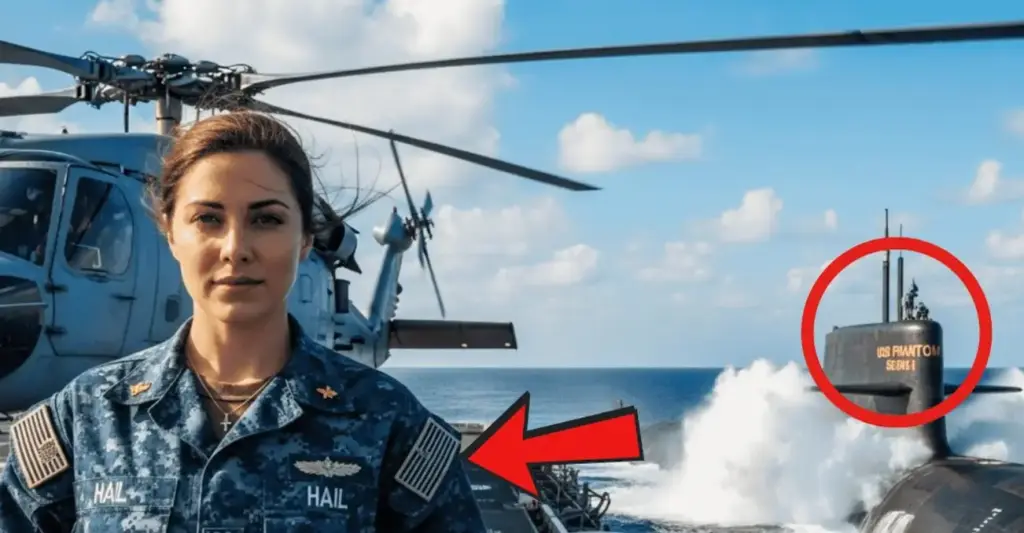
The admiral thought he’d ended her career. He had no idea what he’d just started. Let me take you back a bit. Astria Hale wasn’t some rookie who screwed up.
Fifteen years in the Navy, three combat citations, the kind of officer other officers looked up to. She’d been promoted faster than almost anyone in her class, and there was a reason for that. She was brilliant at something most people don’t even know exists: undersea warfare, the deep, dark, classified kind.
But on that morning on the USS Everett, none of that mattered. Admiral Malcolm Whitcroft stood in front of her with a face like stone and a voice that carried across the entire flight deck. «Commander Hale,» he said, loud enough for everyone to hear.
«You’ve been accused of sharing classified information with a foreign military, unauthorized communications, endangering this battle group and every sailor on it.» Behind him, a screen lit up with her service record: every achievement, every mission, every sacrifice. All of it now stained.
And Astria? She just stood there, jaw set, eyes forward, silent. The Admiral wasn’t done. «Fifteen years of service mean nothing,» he said, stepping closer, «when weighed against treason.»
That word hung in the air. Treason. You could feel the crew shift.
Some looked away; some stared harder. Everyone knew what was coming. «Do you have anything to say for yourself, Commander?»
Astria’s voice came out calm, too calm. «Permission to review the evidence, sir.»
«Denied.»
Wait, what? Even some of the officers standing nearby glanced at each other. You don’t deny an accused officer the right to see the evidence. That’s basic. That’s protocol.
But Whitcroft didn’t care. He reached forward, grabbed the insignia on her collar—the rank she’d earned over a decade and a half—and ripped it off. Not unpinned, not removed with respect. Ripped. «Leave my ship.»
Here’s where it gets interesting. Astria turned toward the helicopter waiting at the edge of the deck. The rotors were already spinning, kicking up wind that whipped her hair loose from its bun. She started walking.
And then, one by one, something happened. A young ensign, barely visible in a doorway, lifted his hand, saluted her. Then another. Then another.
Junior officers. Enlisted crew. People who knew that saluting her right then, in front of the Admiral, was basically career suicide. But they did it anyway. Because respect doesn’t disappear just because someone rips off your rank.
Astria never looked back. She climbed into that helicopter, and it lifted off into the gray morning sky. And that’s when most people thought the story ended. They were wrong.
As the helicopter flew away from the carrier, Astria’s hand drifted to her wrist. There used to be a watch there, a tactical chronograph she’d worn during the Kandahar extraction. She’d left it behind when they reassigned her to the Everett. But touching that spot brought it all back.
The heat. God, the heat in the Syrian desert was like breathing fire. Her lungs burned with every inhale. Gunpowder. Dust. Sweat.
The encrypted radio on her vest crackled to life, a voice cutting through the chaos. «Shadow Protocol is active. Phantom is yours, Commander. Radio silence until mission complete.»
Three years. That’s how long she’d spent building that submarine. Not just commanding it. Designing it. Training the crew. Writing the security protocols herself.
And she’d written them for one reason: so that submarine would answer to nobody but her. Not the Joint Chiefs. Not Pacific Command. Her.
The memory faded as the helicopter landed at Naval Base Kitsap. Astria was escorted off. No ceremony. No explanation. Just a holding facility and the end of everything she’d worked for. Or so they thought.
Meanwhile, four hundred miles away, something was happening on board the USS Everett. «Admiral,» the tactical officer’s voice cut through the bridge like a knife. «Unidentified submarine contact. Nuclear class. Surfacing off our starboard bow.»