


«Go on then, start her up.» The voice was slick with the kind of condescending amusement that only a young officer convinced of his own importance could muster. Captain Davis gestured with a dismissive flick of his wrist toward the A-10 Thunderbolt II, its bulky, pugnacious form sitting squat on the hot tarmac. «Show us how it’s done, old-timer.»
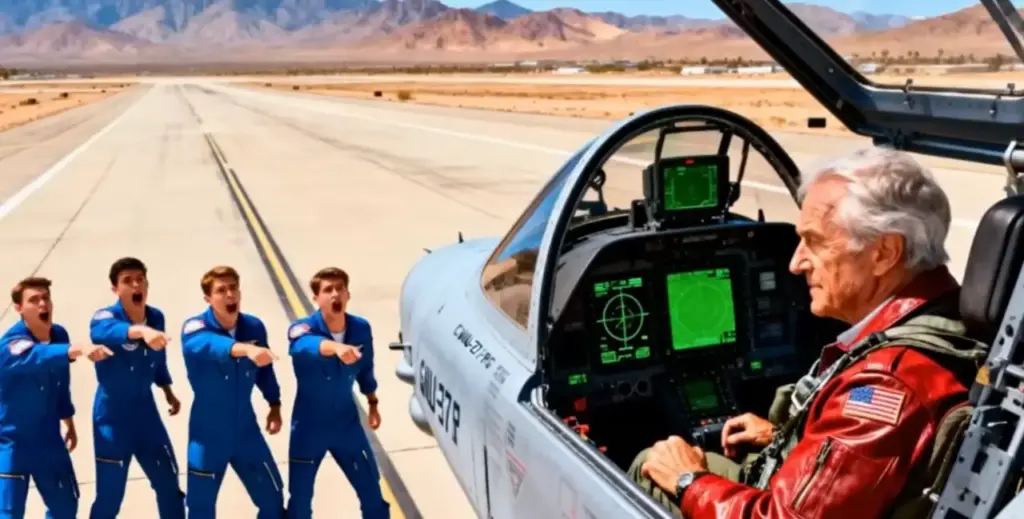
Roger Bentley, 82 years old, said nothing. He stood beside the aircraft’s enormous front landing gear, his hand resting lightly on the cool rubber of the tire. The sun beat down on the flight line, making the air shimmer over the concrete.
He wore a faded leather jacket, cracked and worn in the way that only decades of use can achieve, despite the sweltering heat. A small crowd of young airmen, on break from their duties during the base’s annual family day, had gathered.
They exchanged uncertain glances, caught between the discomfort of witnessing a senior citizen being mocked and the ingrained reluctance to challenge a captain. Davis smirked, playing to his small audience.
«Come on now, you were telling my guys here all about the good old days, how you used to fly these things by the seat of your pants. Surely you remember how to flip a few switches?» He pointed a manicured finger at the complex array of instruments visible through the A-10’s bubble canopy. «Or is all that newfangled glass a bit too much for you?»
Roger’s eyes, the color of a faded sky, remained fixed on the aircraft. He wasn’t looking at the cockpit. He was looking at the nose, just below the canopy, where the paint was slightly more weathered.
He was looking at the massive seven-barreled maw of the GAU-8 Avenger cannon that defined the plane, a weapon he knew more intimately than he knew the faces of some of his own relatives. He could feel the familiar bone-jarring vibration of it firing, a memory that lived not in his mind but in his bones.
«Captain,» one of the younger airmen started, a hint of protest in his voice.
«Maybe we should just stay out of it, airman,» Davis snapped, not taking his eyes off Roger. «The man wants to tell war stories, he should be able to back them up. What’s the matter, Grandpa? Forget which key goes in the ignition?» He chuckled at his own joke.
A few of the others shifted their feet, the silence growing heavier than the humid air. The captain stepped closer, his shadow falling over Roger. He jabbed a thumb toward a worn patch on Roger’s jacket, a crudely drawn scorpion in a circle of sand. «What’s that supposed to be? Your VFW bingo team?»
Roger’s gaze finally shifted from the plane to the captain. He didn’t look angry. He didn’t look humiliated. He looked tired.
He looked at the captain’s polished boots, his crisply ironed flight suit, the silver bars on his collar that gleamed in the sun. He saw a man who wore a uniform but had no concept of what it could cost, a man who saw a legend in front of him and perceived only a nuisance.
«The Auxiliary Power Unit requires a ground check before ignition sequence,» Roger said, his voice a low, gravelly rasp, not in response to the captain but to the plane itself. «Hydraulic pressure needs to be stable at three thousand PSI. You don’t just turn a key.»
The technical accuracy of the statement seemed to momentarily throw Davis off balance. He recovered quickly, his smirk returning. «Oh, we’ve got a real expert here. Look sir, this is a restricted area. The aircraft is a static display for the event. I’m going to have to ask you to please step away and let my people get back to work.»
He changed his tone, adopting the loud, slow cadence of someone speaking to a child or a person they believe to be senile. «This is a very expensive, very dangerous airplane. We can’t have civilians climbing all over it.»
Roger’s hand dropped from the tire. His posture didn’t change, but a stillness settled over him, the kind of absolute calm that precedes a storm. He had been a guest of the base commander, invited to the family day as one of the wing’s original pilots.
He had wandered out to the flight line simply to be near the machine that had been his partner, his shield, and his weapon through the most harrowing days of his life. He hadn’t spoken to anyone until Davis’s young airman had approached him with genuine curiosity, asking about his jacket. It was Davis who had interrupted, his ego bristling at the sight of his subordinates giving their attention to a relic.
«I’m not a civilian,» Roger said quietly.
Davis let out a short, incredulous laugh. «Right, and I’m the chief of staff of the Air Force. Sir, I’m not going to ask you again. My patience is wearing thin. Show me your visitor pass, and then please head back to the public area.»
The demand was an undisguised insult, a clear implication that Roger was an unescorted wanderer who had somehow found his way onto the active flight line. The crowd was larger now. Families and other personnel, drawn by the confrontation, stood at a respectful distance watching the drama unfold. The scene was stark: the young, preening captain, all sharp angles and polished metal, and the old man, weathered and worn as the leather on his back, standing before the deadliest ground attack aircraft ever built.
Davis was enjoying the attention. He saw this as a simple matter of enforcing regulations, of putting a confused old man in his place. He had no idea he was standing on consecrated ground in the presence of one of the gods of this particular church of steel and fire. He saw an old man, not the ghost of a twenty-something major who had wrestled this very plane through skies thick with anti-aircraft fire, his hands steady on the controls while the world outside erupted in flame and thunder.
«You want to see my credentials?» Roger asked, his voice still low, but with a new edge of steel in it.
«That’s exactly what I want,» Davis said, crossing his arms. «Let’s see some ID. Let’s see the pass that allows you to be this close to a United States Air Force asset.»
Roger slowly reached into the inner pocket of his jacket. His movements were deliberate, unhurried. He wasn’t reaching for a wallet. Davis’s smug expression began to falter, replaced by a flicker of uncertainty.
What could this old man possibly have in his jacket that could change this situation? For a moment, a wild, paranoid thought flashed through the captain’s mind. Was this some kind of security threat? He instinctively put a hand on his hip, closer to where a sidearm would be if he were security police.
«Empty your pockets, slowly,» the crowd murmured. The situation had escalated from casual mockery to a tense standoff.
The young airman who had tried to intervene earlier now looked pale. This was going too far, and he knew it. This was spiraling out of control.
As Roger’s hand came out of his jacket, Davis’s eyes were fixed on it. But it was the patch on the jacket, the one he had just mocked, that held the key. The faded scorpion. The sand-colored stitching seemed to blur for a moment.
In Roger’s mind, the oppressive heat of the tarmac was replaced by the biting cold of a high-altitude cockpit. The murmuring of the crowd faded, replaced by the high-pitched whine of two General Electric turbofan engines and the crackle of the radio in his helmet. The world wasn’t a peaceful airbase. It was a chaotic desert valley, a killbox crawling with enemy tanks.
He could see them through his targeting pod: Republican Guard T-72s, dug in and waiting to ambush a column of American Light Infantry. The radio was screaming. A young voice, panicked and desperate. «Any air support in the area? This is Ranger 6 Actual. We are pinned down. Taking heavy fire. We are being overrun.»
Roger’s thumb had depressed the trigger stud on his control stick. The world outside had dissolved into the singular, violent roar of the Avenger cannon. A solid stream of 30mm depleted uranium shells, a fire hose of incandescent metal, had slammed into the earth.
The ground erupted. Tank turrets were ripped from their hulls.
The memory was not a picture. It was a physical sensation: the aircraft bucking, the acrid smell of burnt propellant filling the cockpit, the grim satisfaction of watching the threats to the men on the ground evaporate into fireballs of black smoke.
He remembered seeing the flash of a surface-to-air missile, the jolt of the impact against his right wing, the frantic dance on the rudder pedals to keep the crippled beast flying. That was the day he had earned the patch. It wasn’t a unit insignia. It was a gift, a blood debt, paid forward by a grateful Army captain who swore he owed his life, and the lives of his men, to the warthog that had descended from the sky like an angry god.