


«Hey Pop, what was your rank back in the Stone Age? Mess cook, third class?» The voice, slick with the unearned confidence of youth and peak physical conditioning, cut through the low hum of the mess hall. It belonged to Petty Officer Miller, a Navy SEAL whose neck was thicker than most men’s thighs. He stood with two of his teammates, their trays laden with the kind of high-protein, high-calorie fuel required to forge human weapons.
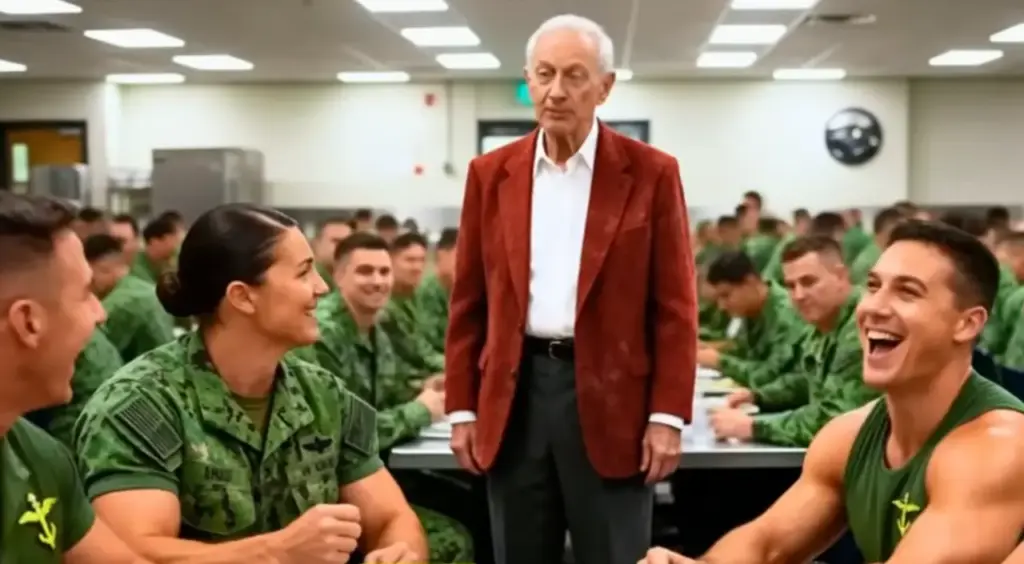
They formed a tight, intimidating triangle around a small square table where one man sat alone. George Stanton, 87 years old, didn’t look up from his chili. He brought a spoonful to his lips with a hand that was steady, a stark contrast to the wrinkled, liver-spotted skin that covered it.
He wore a simple tweed jacket over a white shirt, clothes that looked out of place and out of time amidst the sea of digital camouflage and navy blue uniforms. He chewed slowly, deliberately, his gaze fixed on a point somewhere beyond the far wall of the bustling Naval Amphibious Base Coronado Dining Facility. Miller smirked at his buddies, who chuckled in appreciation of their leader’s wit.
«I’m talking to you, old-timer. This is a military installation. You got a pass to be here?»
«Or did you just wander in from the retirement home looking for a free lunch?»
The mess hall, never truly quiet, began to change its tune. The cacophony of a hundred separate conversations began to falter. The clatter of forks and knives on ceramic plates became more distinct as other sounds faded.
Heads were beginning to turn. This was more than just a young buck being loud. It was a performance, and an old man was the unwilling centerpiece.
George finished his spoonful of chili. He placed the spoon down gently beside his bowl, the metal making no sound against the plastic tray. His movements were economical, devoid of any wasted energy.
He still hadn’t made eye contact with the SEAL looming over him. This placid refusal to engage seemed to fuel Miller’s arrogance. He leaned in, planting his massive, tattooed forearms on the table.
A clear invasion of the old man’s space. The table, bolted to the floor, didn’t so much as shudder.
«Look at me when I’m talking to you.»
Miller’s voice dropped from a mocking tenor to a low growl. «We have standards here. We don’t just let any civilian stroll in and take up a table.»
«So I’m going to ask you again. Who are you and what are you doing on my base?»
The possessive pronoun, «my base,» hung in the air, thick and odious. Several of the younger sailors at nearby tables shifted uncomfortably.
They knew Miller, knew his reputation. He was a phenomenal operator, a warrior of the highest caliber. But he carried his trident like a scepter and treated anyone outside his elite circle with a casual disdain that bordered on contempt.
George finally turned his head. His eyes, a pale, watery blue, seemed to hold a profound weariness, but underneath it, there was something else: a stillness, a depth.
It was like looking at the surface of a frozen lake, calm and reflective, hinting at the immense, cold pressure hidden beneath. He looked at Miller’s face, then at the gold SEAL trident pinned to his chest, and then back to his eyes. He said nothing.
«What, you deaf?» one of Miller’s friends chimed in, leaning over his shoulder. «He asked you a question.»
«Let me see some ID,» Miller demanded, straightening up. His hand gestured impatiently.
Now, this was a gross overstep of his authority, and everyone in the room knew it. A petty officer had no right to demand identification from a visitor in a common area.
That was the job of the Master-at-Arms, the base security. But no one was going to call out a SEAL in the middle of the mess hall. The social cost was too high.
It was easier to look away, to pretend you didn’t hear, to suddenly find your green beans intensely fascinating. George Stanton reached not for his wallet but for his cup of water. He took a slow sip.
The silence in the immediate vicinity of the table was now almost absolute. The tension was a living thing, coiling in the air. Miller’s face was flushing with anger.
His public challenge was being met with quiet, implacable indifference. And in the rigid hierarchy of military life, that was an intolerable sign of disrespect. He was being made to look foolish.
«That’s it,» Miller snapped. «You and me, we’re taking a walk to see the M.A.A. Get up. Now.»
He pointed to a small, tarnished pin on the lapel of George’s tweed jacket. It was a simple design, a pair of stylized wings with a small shield in the center, its details worn smooth with age.
«And you can explain what that cheap little trinket is.»
«You buy that at the surplus store to impress the ladies?»
As Miller’s finger jabbed dismissively toward the pin, the world around George seemed to momentarily recede. The smell of industrial-grade chili and bleach was replaced by the scent of ozone and damp earth.
The low murmur of the mess hall became the high-pitched scream of a diving Zero, the percussive thud of anti-aircraft fire echoing in his bones. He felt the phantom pressure of a hand on his shoulder—a young man’s hand, strong and sure—a voice barely a whisper over the roar of battle saying, «See you on the other side, Ghost.» The memory was a flash, a single frame of film from a lifetime ago, but it was as real as the table in front of him.
The pin on his lapel was not a trinket; it was a promise, a ghost of a memory, for the Ghost of Luzon. He blinked, and the mess hall solidified around him once more. Miller’s angry face was inches from his own.
Across the large room, working the serving line, was Seaman Apprentice Davis. At nineteen, Davis was still new to the Navy, full of idealistic notions about honor and respect that the reality of daily life was slowly sanding away. He had been watching the encounter with a growing sense of sickness in his stomach.
He’d seen his own grandfather, a proud Marine who fought at Chosin Reservoir, treated with similar casual dismissal by a world that had moved on and forgotten. Seeing it happen here, on a base, in a room full of service members, felt like a sacrilege. He saw the smug looks on the faces of the other SEALs.
He saw the averted eyes of the other sailors. He saw Miller’s hand move toward the old man’s shoulder, an act of aggression that was a point of no return. Davis knew he couldn’t step in.
He was a Seaman. Miller was a SEAL. Intervening would be career suicide.
But doing nothing felt like a betrayal of everything he was supposed to stand for. His eyes darted to the phone mounted on the kitchen wall. An idea, desperate and probably stupid, sparked in his mind.
He knew who to call. Not the M.A.A. They’d likely side with the operator over the old man.
He needed someone higher. Someone who dealt not just in rules but in history. Wiping his hands on his apron, Davis slipped back from the serving line into the clatter and steam of the main kitchen.
No one paid him any mind. He walked quickly to the wall phone, his heart hammering against his ribs. He dialed the extension for the office of the Command Master Chief, a man known throughout the base simply as «the Anchor.»
Master Chief Thorn was a living legend, a man who had forgotten more about naval tradition and history than most scholars ever learned. If anyone would understand, it would be him. The phone was answered on the second ring by a yeoman.
«Master Chief’s office.»
«I need to speak with him. It’s urgent,» Davis said, his voice a low, rushed whisper. He glanced over his shoulder through the service window, seeing Miller now placing a hand on the old man’s arm, trying to force him to his feet.
«He’s in a meeting, Seaman. I can take a message.»
«No, you don’t understand,» Davis insisted, his voice cracking with stress. «There’s a situation in the mess hall. A SEAL. Petty Officer Miller is harassing an elderly veteran. He’s putting his hands on him.»
The yeoman’s tone became bored, administrative. «File a report with the M.A.A., Seaman. The Master Chief doesn’t handle—»
«The veteran’s name is George Stanton,» Davis cut in, the words tumbling out. «He’s just sitting there, not doing anything. Miller is making a scene.»
There was a pause on the other end of the line. A long, profound silence. Davis thought he might have been hung up on.
Then he heard a muffled voice, the yeoman saying, «Master Chief, you need to hear this.»
A new voice came on the line, gravelly and hard as barnacles on a hull.
«This is Master Chief Thorn. What did you just say?»
«Master Chief,» Davis stammered, standing a little straighter even though no one could see him. «Seaman Davis, galley. Petty Officer Miller is about to drag an old man named George Stanton out of the mess hall.»
Another silence, but this one was different. It was heavy, charged with an energy Davis couldn’t comprehend. He heard a sharp scraping sound, like a chair being violently pushed back from a desk.
«Son,» Master Chief Thorn’s voice was dangerously quiet, stripped of all formalities. «You keep your eyes on George Stanton. You do not let him out of your sight. Help is on the way.»