


«You sure you’re in the right place, old-timer?» The voice was young, sharp, and laced with the kind of casual arrogance that comes from being very good at something very dangerous. It cut through the low murmur of the bar, the clinking of glasses, and the distant drone of a sports recap on the television.
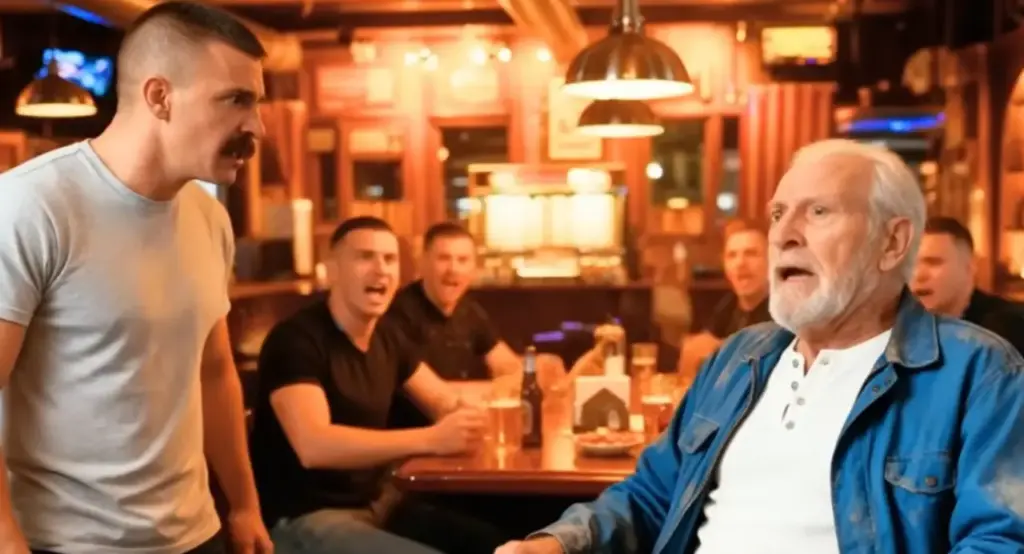
Gordon Hughes, 81 years old, didn’t turn his head. He kept his gaze fixed on the dark amber of the whiskey in his glass, the condensation tracing a slow path down the side. His hands, gnarled with age and speckled with liver spots, were steady around the tumbler. He had a slight permanent limp from a hip that never quite set right, and a hearing aid was nestled discreetly in his right ear.
To the world, he was just another old man nursing a drink at the end of a long day in a quiet, unassuming neighborhood bar.
The young man who had spoken, lean and coiled with muscle under a plain gray t-shirt, took Gordon’s silence as an invitation to press on. He and his four friends had taken over a nearby booth, their energy too large and restless for the sleepy establishment.
They were all in their late twenties or early thirties, with the close-cropped hair, neatly trimmed beards, and watchful eyes that marked them as something other than civilians. They were off-duty, dressed in jeans and casual shirts, but they carried an invisible uniform of discipline and confidence. They were Delta Force operators, though no sign on them would ever say so.
«I’m serious,» the man said, sliding onto the stool next to Gordon. His name was Jake. «This isn’t exactly the VFW.»
«You look a little lost.» Gordon finally turned his head, his pale blue eyes taking in the younger man. They were eyes that had seen too much sun, too much darkness, and held a weariness that went deeper than bone.
He offered a small, noncommittal shrug. «Just having a drink.»
Jake’s friends chuckled from their booth. They were enjoying the show. Their leader was bored and a little drunk, and he’d found a target for his amusement.
Jake’s eyes fell on the jacket Gordon had draped over the back of his stool. It was an old, faded field jacket, the kind you might find in a surplus store. On the sleeve was a patch, so worn and frayed that its design was nearly indecipherable. It was a dark, circular shape with what might have been a stylized skull or some kind of winged creature.
Jake pointed at it with a smirk. «What’s that supposed to be? You pick that up at a flea market. Trying to impress the ladies.»
Gordon’s expression didn’t change. He simply reached over and pulled the jacket closer to him, a gesture of quiet possession. «It’s just an old patch,» he said, his voice a low rumble.
This was the wrong answer. For men like Jake, men who had bled for the insignia on their own uniforms, even the unofficial ones, the idea of someone faking it was a profound insult. The suspicion of stolen valor, even in jest, was like a spark on dry tinder.
The mood shifted from casual mockery to something harder. «An old patch,» Jake repeated, his voice losing its playful edge. «What unit?»
«It was a long time ago,» Gordon said, turning back to his drink. He hoped the conversation would die. He hadn’t come here for this. He never came for this. He just wanted the quiet, the familiar scent of stale beer and old wood, the anonymity.
But Jake and his team were a force of nature. They were trained to probe weaknesses, to press until they got a reaction. Gordon’s evasiveness was a red flag.
One of the other operators, a broad-shouldered man named Coyle, left the booth and came to stand on the other side of Jake. «He doesn’t want to talk about it, Jake,» Coyle said, but there was a grin on his face. «Maybe it’s top secret.»
The sarcasm was thick. «Is that it, old man?» Jake leaned in closer, his voice dropping. «You part of some super-secret squirrel club. Tell us a war story. We’re all friends here.»
The bartender, a woman named Maria who had owned the place for twenty years, shot a worried glance from down the bar. She had seen Gordon come in three nights a week, regular as clockwork, for the better part of a decade. He always took the same stool, ordered the same whiskey, and never bothered a soul.
She knew he was a veteran, but he never spoke of it. She also recognized the coiled energy of the younger men. She’d seen it before from the nearby base.
It was a dangerous energy, a mix of pride and trauma and restless power that could easily boil over.
Jake wasn’t letting go. He saw the faded outline of a combat infantryman badge above the jacket’s pocket. He saw the way Gordon carried himself, a stillness that was different from an ordinary old man’s slowness. It was an economy of motion.
Part of him was genuinely curious, but the dominant part, fueled by whiskey and ego, wanted to expose a fraud. «Look,» Jake said, his patience finally gone. He jabbed a finger toward the patch again. «I’m not asking for state secrets, but men I know, better men than you or me, have died for the patches they wore. So when I see some old-timer in a bar wearing a piece of flair he can’t identify, it pisses me off. So one more time. What unit?»
The other operators were now all standing, forming a loose, intimidating semicircle around Gordon’s stool. The other patrons in the bar were starting to notice. Conversations faltered. People shifted in their seats, pretending not to watch, but every eye was on the confrontation brewing at the bar.
Gordon looked from Jake’s hardened face to the faces of his comrades. He saw their certainty, their judgment. He saw their youth. They were lions, proud and strong, and he was just an old man in their way.
He let out a long, slow sigh, the sound of a gate rusting shut. «It doesn’t matter anymore,» he said softly.
Jake scoffed. «That’s what they all say.» He gestured at the worn patch on Gordon’s jacket, its threads barely holding the image together. «This thing is a joke.»
As his finger touched the frayed fabric, the world seemed to warp for a moment in Gordon’s mind. The smell of whiskey and sawdust vanished, replaced by the hot metallic scent of blood and cordite. The low hum of the bar’s cooler became the deafening thwump-thwump-thwump of rotor blades beating against a dusty, ink-black sky.