


The fluorescent lights of the roadside diner buzzed with a low, irritating hum, the air thick with the scent of stale grease and brewing coffee. It was a quiet afternoon, the kind where time seems to stretch and sag, until a sharp, mocking voice sliced through the atmosphere like a serrated knife.
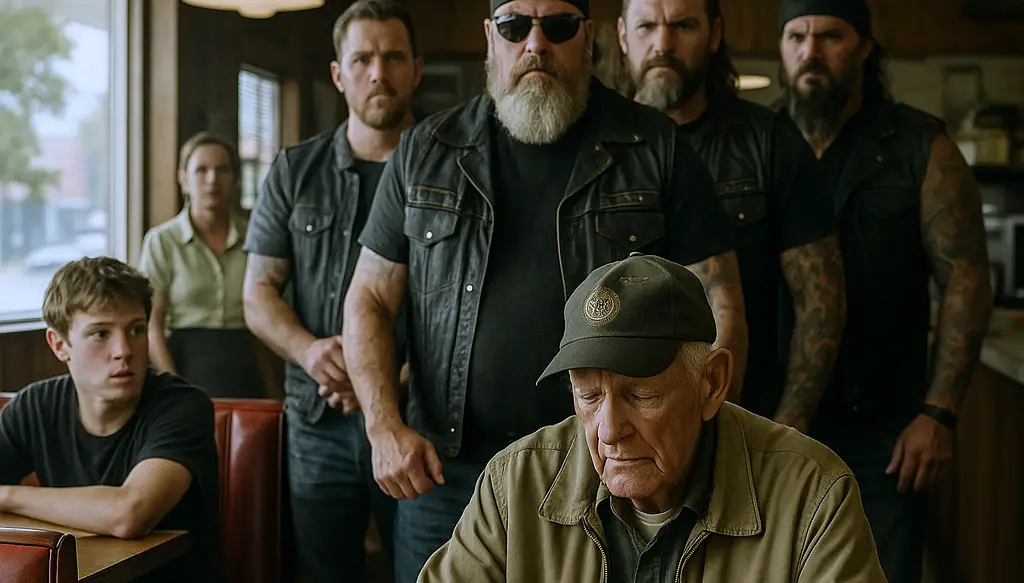
– Hey, Grandpa, you drop your dignity with your cane?
One of the teenagers, a lanky boy with a cruel sneer, let out a snort of laughter. With a casual, almost bored flick of his foot, he kicked the wooden walking stick. It clattered loudly across the checkered linoleum floor, skidding several feet away from the booth where the old man sat. The noise was jarring, causing the entire diner to freeze in an instant. Forks stopped mid-air, suspended halfway to open mouths. Ceramic cups paused just inches from lips, the steam curling up around wide, shocked eyes.
For a long, agonizing moment, the only sound in the room was the soft, rhythmic shuffle of worn boots against the floor tiles. The elderly man, his frame slight and seemingly fragile inside a faded, olive-drab military jacket that had seen better decades, pushed himself up from the booth. He moved slowly, every joint protesting.
He bent down painfully to retrieve the cane, his fingers trembling slightly as they closed around the smooth wood. He didn’t say a word to his tormentors. He didn’t even make eye contact. He simply gripped the handle, straightened his back with a grimace of effort, and hobbled back toward the counter with a quiet, dignified resolve. But the boys weren’t done with their entertainment.
– Bet he thinks he’s still in Vietnam.
Another teen laughed, the sound harsh and grating. He reached out and smacked the back of the old man’s head with an empty plastic ketchup bottle. It wasn’t a blow meant to injure physically, but the hollow thud echoed with a disrespect that was far more damaging.
– Wake up, Rambo, war’s over.
Gasps erupted from the few scattered patrons. A woman in the corner covered her mouth with her hand. But despite the collective shock, no one moved. Not the waitress, who stood frozen behind the counter clutching a pot of coffee like a shield. Not the manager, who watched from the kitchen pass-through with wide eyes. Not the handful of customers who suddenly found the contents of their plates incredibly interesting, pretending to be immersed in their meals to avoid intervention. Fear, or perhaps a deep, paralyzing shame, locked everyone in place.
The old man’s hand trembled visibly as he reached for his ceramic mug. The coffee inside rippled with his tremors. Still, he said nothing, and his silence was what made the scene truly heartbreaking. He didn’t defend himself, didn’t shout back, and didn’t even flinch at their taunts. It was as if he was used to being invisible, accustomed to being treated like a piece of furniture that had outlived its usefulness.
The teens, three of them in total, loud and brash in their ignorance, strutted back to their booth. They high-fived each other, grinning broadly like they had just won a championship trophy rather than humiliated a senior citizen. An hour dragged by.
The atmosphere in the diner remained heavy and uncomfortable. The old man sat quietly, nursing that same cup of coffee that had long since gone cold, holding onto it like it was the last thing tethering him to a world that no longer seemed to want him.
His watery eyes didn’t look at anyone; they were fixed on the swirling dark liquid in his mug. Yet, the set of his shoulders held a heaviness that spoke volumes, carrying the weight of a thousand unspoken battles and memories that no one in this room could comprehend. Then, the bell over the diner door jingled aggressively.
Heavy boots struck the floor. The creak of black leather filled the entryway. Beards. Chains. It was the kind of entrance that sucked the oxygen out of a room, making every head turn and every heart skip a beat. Five bikers walked in, their presence filling the narrow aisle. They were imposing figures, heavy with muscle and presence. One of them wore a leather vest with a patch that read «Blood Brothers, M.C.» across the back. Another had a tattoo winding up his forearm that said, «U.S.M.C. Semper Fi» in bold, dark ink.
They didn’t say a word at first. They just stood there, scanning the room with a predatory focus, assessing threats, until their gazes locked onto the solitary figure in the faded military jacket. The tension in the room spiked, but it was different now.
– What’s up, Sarge?
The tallest of the bikers broke the silence. His voice was a deep rumble as he strode over to the counter, ignoring everyone else. He reached out and clasped the old man’s frail hand with both of his large, tattooed hands, shaking it with genuine warmth and reverence.
– Didn’t know you were still in town.
The veteran looked up, startled from his reverie. A flicker of recognition lit up his tired face, and he smiled faintly, the lines around his eyes softening.
– Didn’t know you boys still remembered me.
– We never forget family.
That was when the energy in the room shifted completely. It was subtle at first, like the drop in pressure before a summer storm, but undeniable. The bikers weren’t here for burgers or fries. The one with the U.S.M.C. tattoo turned slowly, pivoting on his heel to face the booth where the three teens sat.
– You three got a problem with veterans?
The question hung in the air, heavy and suffocating. Silence descended again, but this time it was thick with dread. Then, a nervous, cracking laughter bubbled up from the booth.