


It happened during Thanksgiving dinner. My sister, Jenna, rose from her chair, took a dessert spoon, and gently tapped the rim of her water glass to command the room’s attention. She then made an announcement, her voice ringing out with the triumphant tone of someone accepting a prestigious award: “Mom and Dad are signing the house over to me. Emily gets absolutely nothing.”
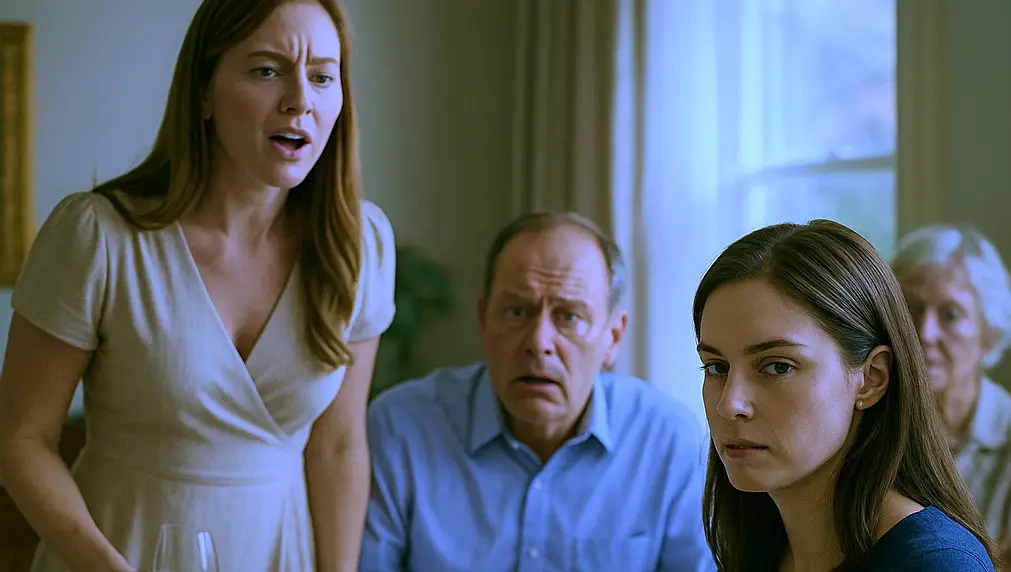
The room erupted immediately. A chorus of loud cheers, enthusiastic whistles, and even a shout of «About time!» washed over the dining room. I, however, didn’t join the applause.
I didn’t even flinch. I simply maintained a subtle, fixed smile—the kind of expression you wear when a sudden storm hits, but you’re completely dry because you already knew the roof was never yours to begin with. Slowly, deliberately, I placed my fork down on the linen napkin.
“Dad,” I said, speaking softly enough that the remaining noise immediately faded, “should I be the one to tell them, or would you prefer to?” His face instantly went pale, the color draining away as if pulled by a stopper. My sister froze mid-pose. And in that heavy moment of suspended animation, every person present realized, with a sudden, sinking feeling, that a terrible revelation was about to drop.
Before I plunge into the chaos that followed that silence, I have to ask: where are you listening from tonight? It genuinely helps to know there are people out there who’ve navigated the treacherous waters of families like mine. My name is Emily Nolan.
If you had encountered my family before that fateful Thanksgiving, you might have easily mistaken us for a close-knit unit. We looked like the typical Midwestern picture—the one people print on their holiday cards—all matching sweaters, wide smiles staged perfectly in front of a twinkling Christmas tree, all pretending that a loud word was never spoken in our home. But families like mine rarely shatter with a sudden, obvious crash.
No, they crack quietly, in the spaces between sentences, in the small, insidious choices about who gets a sympathetic ear and who is perpetually overlooked. For as long as I can recall, my life unfolded in that silent margin, a place where people only became aware of your existence when they were looking for a hand to hold. Jenna, my younger sister, never had to reside in that particular space.
She was the undisputed darling, the favorite child: vibrant, boisterous, brimming with an easy charm—the type of girl relatives instinctively gravitated toward at every gathering, calling her a “natural” and a true “spark.” I didn’t harbor any resentment toward her for it. I simply understood very early on that if I wanted a life, I would have to meticulously build it from the ground up myself, because nothing was ever going to be conveniently placed into my hands the way it was for her.
I spent my childhood watching my parents lavish attention on Jenna, nurturing her like she was a rare, tropical plant that demanded constant care: ballet lessons, expensive summer camps, private tutoring—all things I was told were financially out of reach when I inquired. Later, when I made the move to Chicago for a promising job, they dismissed it as “selfishness,” acting as if my choice to seek professional independence was tantamount to outright abandonment. Jenna, conversely, chose to remain nearby, visiting every weekend, effortlessly sliding into the perfectly tailored role they had always envisioned for her.
Nevertheless, I always made the effort to return for the major holidays. I did it mostly for my grandmother, Evelyn Nolan. She was silver-haired, possessed a remarkably sharp mind, and was the only member of the family who truly looked at me with genuine, undisguised pride.
When she wrapped me in a hug at the front door, it never felt like a compulsory gesture. It felt like a profound act of being recognized. She would lightly tap my cheek and murmur something cryptic like, “You are so much stronger than they give you credit for,” before retreating quietly to her armchair, as if she hadn’t just provided me with enough spiritual sustenance to see me through another calendar year.
This particular Thanksgiving felt odd before the first guest had even arrived. The very air inside the house felt different—thick with anticipation, heavy, as though everyone had been let in on a private, thrilling secret that I was deliberately excluded from. Mom flitted nervously through the kitchen, wearing that forced, strained smile she always puts on when she is actively concealing something substantial.
My father avoided my gaze, unable to sustain eye contact for more than a second. Jenna was repeatedly dusting imaginary lint from her pristine dress, even though it was visibly spotless. And as I stepped into the dining room, I noticed one final, unsettling detail.
The empty chair that was supposed to be positioned directly next to mine was gone. Not merely shifted or temporarily pulled away. It was absent.
I should have taken that as the ultimate warning sign. You’d think an entirely missing chair would constitute a sufficient alarm, but in my family’s drama, the indicators are always subtle and quiet right before the inevitable explosion. I sat down anyway, carefully smoothing the napkin across my lap, making a deliberate effort to act oblivious to the way conversations immediately withered every time I approached.
The chatter would instantly fall flat for a moment, as if someone had abruptly hit the mute button, only to resume with overly enthusiastic, forced laughter the second I passed by. Jenna floated around the room, behaving like the undisputed star of her own personal show, meticulously adjusting the silverware, correcting the angle of the centerpiece, and whispering little, conspiratorial asides to Mom that always elicited a shared grin. Every now and then, she would look across at me with a thin-lipped, polite-but-hollow smile, treating me like a colleague she barely tolerated.
It hadn’t always been this way. For a significant period, Jenna and I were simply two ordinary kids, sharing a bedroom and furtively passing handwritten notes under the door when we should have been fast asleep. She used to beg me to braid her hair, constantly pilfered my favorite sweaters, and badgered me to chauffeur her everywhere once I finally earned my driver’s license.
But somewhere between the awkwardness of high school and the responsibilities of adulthood, an irreversible change occurred. She slid comfortably into the gilded role my parents had custom-built for her—the golden-girl, the perfect, compliant daughter—while I quietly and efficiently slipped right out of the frame. The entire property situation had been brewing for six months, long before her dramatic announcement on Thanksgiving Day.
It was a sweltering Saturday in June when Mom first called, requesting I come home for a matter she vaguely described as “important.” There were no specifics, no warning whatsoever. When I arrived, they immediately escorted me to the dining table—the very same table where, months later, everything would finally collapse.
My father had a thick folder laid out like a business proposal. My mother smiled unnaturally wide, as if the stretching had actually caused her facial muscles to ache. “Sweetheart,” Dad began, “we’re simply refinancing the house. It just requires a quick signature from you. It’s to secure much better rates, and you won’t have a single thing to worry about.”
Even at that moment, an innate, primal tension coiled inside me. My family never reached out to me for assistance unless they required a favor far more significant than they were prepared to openly admit. I leafed through the stack of papers, my heart pounding a steady rhythm as I struggled to decipher the dense figures. Something felt fundamentally wrong. There were too many pages. Too many financial figures blacked out or redacted. Too many rapid, vague explanations.
“Can I take these documents with me?” I asked, deliberately keeping my voice calm and measured. “My lawyer just needs a chance to review them.”
The ensuing silence was deafening and immediately told me everything I needed to know. Mom’s forced smile evaporated. Dad immediately snapped the folder shut with a loud sound, appearing to instantly regret that he had ever placed it in front of me at all. “It’s just a formality, Emily,” he insisted, a strained edge in his voice. “Why complicate a straightforward process?”