


The noise inside the forward operating base’s dining facility was never truly absent; the silence was just a thin illusion, a quick breather in the relentless, grinding hum of military life. It was a cacophony born of a thousand personnel refueling: the grating scrape of metal forks against standard-issue trays, the subdued murmur of conversations from people running on fumes, and the periodic, jarring burst of laughter that always seemed too loud for the setting. This space offered a temporary, unspoken truce, where the strict hierarchies of the operational battlefield were temporarily dissolved by the universally shared, unremarkable task of eating.
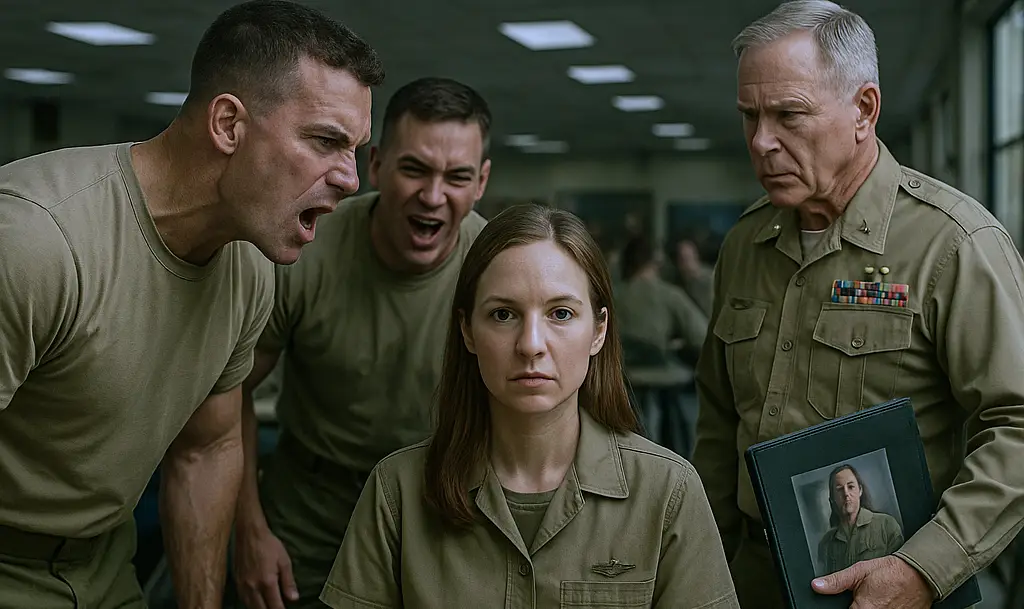
Commander Eva Rostova occupied a solitary seat at a modest four-person table, hugging the perimeter wall. Her uniform was conspicuously plain—navy blue coveralls that bore only her rank and name, noticeably lacking the vibrant, dense constellation of unit patches and specialized skill insignias that decorated nearly every other garment in the room. Her build was slender, making her an easy figure to miss amidst the overwhelming majority of broad shoulders and thick, powerful necks filling the facility.
She consumed her meal with a quiet, almost mechanical precision, her pale gaze sweeping the large room not with any hint of social curiosity, but with the impassive, data-gathering scrutiny of a sensor. She mentally logged the traffic flow, the way personnel clustered into groups, and the subtle shifts in physical posture that were dead giveaways for deep fatigue or, conversely, braggadocio. This latter trait arrived in a sudden, deafening wave of noise and unbridled testosterone: a Marine Force Reconnaissance fire team, fresh off a combat rotation and radiating the swaggering, cocksure energy of men fully convinced of their own legendary status, strode down the central aisle.
They navigated the room as a tight, cohesive pack. Their desert MARPAT fatigues were heavily adorned with embroidered patches, combat knives were prominently secured to their tactical vests, and they projected an air of self-appointed ownership that seemed to invite zero argument. Their leader, a staff sergeant whose square jaw was carved like a block of granite and who wore the name Gunn stitched above his breast pocket, instantly locked eyes on Rostova’s table. It was situated perfectly in what was clearly their preferred spot, affording an unobstructed, commanding view of the entrance.
He halted abruptly, and his entire team instinctively fanned out directly behind him, the maneuver effectively cornering the Commander. “Hey,” he barked, the aggressive sound shearing clean through the ambient noise, causing several nearby conversations to stutter and die.
“You’re in our seat.” Rostova calmly finished chewing the bite of grilled chicken she had taken. She lifted her head, her expression one of perfect neutrality.
Her eyes were a striking, pale gray, utterly dispassionate, like the winter sky over a vast, frozen ocean. She offered no verbal response. One of the team’s younger members, a corporal whose uniform read Diaz, allowed a cynical smirk to twist his mouth.
“You catch that, ma’am? Or is the Navy giving out tin cans for hearing aids these days?” Gunn leaned in aggressively, planting both his hands firmly on the table’s edge. His shadow fell over her half-eaten tray. “This is a recon table.”
“It has been for three rotations straight. We’d appreciate it if you’d find somewhere else to park your tray. Commander,” the way he deliberately stretched out and inflected the word “Commander” was a blatant, mocking insult, conveying a derisive deference that was sharper and more impactful than any outright curse word.
He was audaciously challenging her right to hold the rank, suggesting she was nothing more than a soft, rear-echelon paper pusher who had inadvertently strayed into a domain reserved for real warriors. Rostova’s professional expression did not waver an inch. She had navigated men like this—full of unwarranted bravado and institutional bias—for the past twenty years.
They were, to her, nothing more than a constant environmental factor, as unavoidable as heat or the pull of gravity. They took her modest stature, her serene demeanor, and her lack of decorative patches, and immediately constructed an inner narrative of fragility or ineptitude. They consistently confused disciplined calm for outright fear.
“Look, we’re not asking,” Gunn announced, his voice suddenly deepening into a threatening, low growl. “We’re telling you—move.” Diaz, instantly emboldened by her continued silence, reached out a hand and shoved her metal tray.
The plate scraped violently across the tabletop, instantly sending a scattering of lukewarm vegetables and her plastic cup of water clattering to the floor. The sound was sharp and definitive, an immediate and final rupture of the dining facility’s temporary truce.
A pocket of absolute silence expanded rapidly from their specific table. Every eye in the facility was now fixed on the scene. “Fuck off,” Gunn finished, his voice utterly flat and final.
It was delivered as a direct order, devoid of any hint of a request. Rostova’s eyes flicked methodically from Gunn’s face to Diaz’s, then took in the remaining two Marines. She was not registering men; she was logging threat indicators, cataloging angles of approach, and assessing states of physical readiness. Her mind, a finely tuned instrument of combat analysis, cataloged their muscle posture, the placement of their hands, and the slight tremor of adrenaline visible in Diaz’s fingers. She also registered the exact make and model of the CCTV camera mounted high in the room’s upper corner, its blinking red indicator light serving as a silent, impartial witness.
The entire confrontation, from Gunn’s opening word to the definitive splash of the spilled water, had taken less than fifteen seconds. Slowly, deliberately, she rose to her feet. The Marines tensed, bracing for the anticipated response: a shouted confrontation, a verbal retort, or an inevitable call for the military police.
They were mentally prepared for a physical or verbal fight that they were absolutely certain they would win. Instead, Rostova bent down with effortless, fluid grace. She picked up the plastic cup.
She gathered the spilled, scattered vegetables using a paper napkin. She deposited them neatly back onto her tray. She looked briefly at the minimal mess, then directly at Gunn’s expectant face.
Her own countenance remained a perfect mask of professional calm. She gave a single, almost imperceptible nod, an acknowledgment of the now-altered situation, but definitively not a concession. Then, without uttering a single word, she turned and walked away, carrying her soiled tray toward the disposal window.
The Marines immediately erupted in low, triumphant laughter. They had successfully asserted their perceived dominance, and the target, as far as they were concerned, had folded completely. Gunn casually pulled out the chair, spun it around, and straddled it, symbolically claiming his new throne.
To him, and to everyone else who had witnessed the event, the small, quiet Navy Commander had been thoroughly and publicly humiliated, retreating in what they interpreted as clear weakness. The incident, in their minds, was over and done with. For Commander Eva Rostova, however, it had merely been documented.
Her temporary quarters were a stark reflection of a life that had been meticulously distilled to its bare essentials. The room contained only a perfectly “made-up” rack (bed), a small desk furnished with a secured data pad, and a single metal footlocker. There were no photographs, no sentimental souvenirs, and absolutely zero personal touches. It functioned less as a home and more as a sophisticated charging station. She settled into the desk chair, the intense glow of the data pad screen illuminating her already impassive features. With swift, economical keystrokes, she initiated a new entry in a heavily encrypted log file.
The reporting format was rigid and absolutely unchanging:
Incident Report 2024-10-17-1805Z
Location: DFAC-01 FOB Peregrine
Personnel Involved: CDRE Rostova
Subject (Primary Antagonist): USMC SSGT Gunn
Subject (Secondary): USMC CPL Diaz
Subject (Unidentified): Two Unidentified USMC Enlisted
Narrative: At approximately 1805 Zulu, subject was approached by four USMC personnel at assigned seating. SSGT Gunn initiated verbal contact, claiming ownership of table. CPL Diaz escalated to physical contact, displacing subject’s meal tray. SSGT Gunn issued verbal directive, «Fuck off.» Action taken: Subject disengaged to de-escalate. Documented time, location, personnel, and verbatim quotes. Noted CCTV camera, SE corner, angle 45 degrees, operational status confirmed by indicator light. Disposition: Report filed for chain of custody. No further action requested at this time.
She meticulously saved the file. The entire process was performed with the same complete lack of emotion as if she were simply logging a routine fuel consumption report. It was data. The initial insult, the public mockery, the physical shove—none of these were categorized as personal attacks to be avenged. They were simply classified as serious breaches of protocol, damaging the vital fabric of good order and discipline. And breaches, by her code, were to be documented, analyzed, and, when absolutely necessary, corrected. She closed the data pad and rose to her feet.
Her body was like a coiled spring, yet the tension she exuded was not fueled by anger. It was the pure potential energy of readiness, a state she had rigorously maintained for two decades. She walked over to the footlocker and opened the lid.
Inside, carefully nestled within custom-cut foam, there was no clothing; only specialized equipment. A disassembled rifle, a highly compact satellite communications array, and a rebreather. She carefully lifted out the components of the rifle.
It was a .338 Lapua Magnum, a precision instrument designed for immense and precise power. She laid the components out methodically on a cleaning mat on the floor. The ritual began.
The sharp, distinct scent of solvent and gun oil quickly began to permeate the small room. Her hands moved with a surge of familiar certainty, meticulously stripping the bolt, cleaning the chamber, and running a patch down the rifled barrel. Every motion was deliberate, ingrained by thousands of previous repetitions performed in armories, temporary tents, and muddy holes across the globe.
This was her meditation. The cold, unyielding reality of the steel provided a strange comfort. It represented a system governed by pure physics—by cause and effect. There was no room for ego in the science of ballistics. There was only the data: windage, elevation, spin drift, temperature, barometric pressure. You were either perfectly right, or you were definitively wrong. The bullet simply did not care about your loud swagger or your unit patch.
As she worked, her mind drifted away from the insult she had endured in the dining facility. Instead, she thought of a different kind of quiet. She focused on the crushing silence 200 feet beneath the churning waves. The only audible sound there was the gentle hiss of her rebreather—the tell-tale bubbles being nonexistent. She contemplated the sheer weight of the water, a constant, impartial pressure exerted on every single square inch of her body. In that submerged world, there was absolutely no room for loud voices or aggressive posturing. There was only absolute discipline, meticulous control, and a profound, all-encompassing respect for the environment, which possessed the ability to kill you in a hundred different ways for even the slightest error.
She had spent many years in that world as a SEAL, a silent ghost moving through the dark depths. But her true, unique talent, the one that had elevated her above her peers, was not merely her physical endurance. It was her innate ability to detect patterns in the chaos, to discern the faint whisper of a hostile radio transmission inside a veritable hurricane of static noise. She had gradually become an architect of a new kind of warfare, one fought not with explosives and kinetic force, but with intricate frequencies and complex algorithms. Her unit’s unofficial insignia, which she wore discreetly only on her specialist gear, was a phoenix rising from a circuit board, its wings cleverly formed by swirling radio waves. The motto beneath it: $FIDE’s Antenebris—Faith in the Antennas.