


She slid the ceramic mug across the counter, placing it gently in front of the man with the service dog, right under the health inspector’s nose. Her boss didn’t scream. He didn’t throw a tantrum. He simply went cold, his voice dropping to a tone that felt like a gavel striking wood. «You’re done here, Grace.» Just like that, six years of grit and loyalty were wiped away.
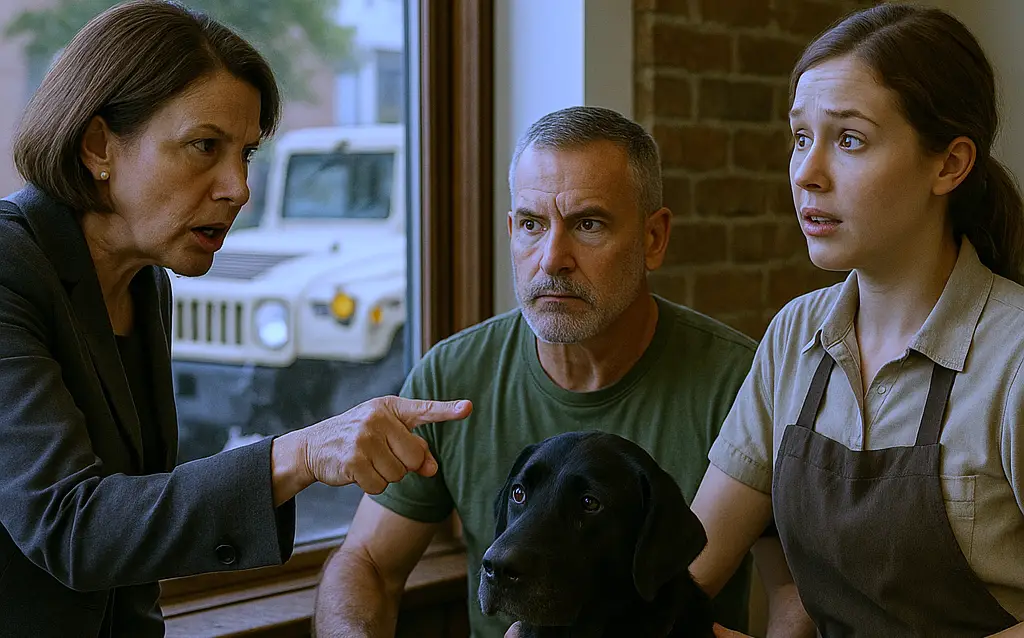
Grace didn’t let them see her cry. She just untied the strings of her apron with trembling hands, laid it down, and walked out the door. She hadn’t stolen anything; she hadn’t been lazy. She was leaving because she refused to turn her back on a veteran and his four-legged lifeline. What she didn’t realize was that a camera phone had been recording the entire standoff.
Before the morning rush had even begun to fade, the ground started to vibrate. It wasn’t an earthquake, but it felt like one. Four massive military Humvees rumbled into the parking lot, taking up space with an unapologetic presence. From the lead vehicle stepped a Marine Colonel in full dress blues, a man whose life was once saved by the very kind of people Grace had just sacrificed her job to protect.
That moment marked the shift. Grace Donnelly wasn’t the sort of person who commanded a room when she walked in, but she was the kind of person you never forgot once you met her. At thirty-five, she was the heart and soul of the Mason Mug, a cafe perched on the fringe of downtown Mason, Georgia.
The town was only a fifteen-minute drive from Fort Granger, one of the most significant Marine installations in the Southeast. Mason itself felt like a living postcard, something Norman Rockwell might have dreamt up—oak trees shading the sidewalks, the Stars and Stripes hanging from every third porch, and a hardware store that looked exactly the same as it did during the Reagan years. But stepping inside the Mason Mug was different. It felt warmer. It felt human.
That was entirely Grace’s doing. She didn’t manage the cafe like a profit margin; she managed it like a living room. It was a sanctuary where you could drop your guard after a brutal day or a long deployment and just breathe. The coffee wasn’t pretentious. You wouldn’t find espresso martinis or intricate foam designs there.
It was just strong, hot coffee with free refills, served against a backdrop of handwritten notes pinned to a corkboard. The secret ingredient of the Mason Mug wasn’t the beans; it was Grace.
She kept a mental catalog of names, birthdays, and the blackout dates for deployments. She knew exactly who preferred their eggs cooked hard and who hadn’t been able to stomach coffee since returning from Iraq. She created pockets of silence, honoring the quiet that veterans sometimes needed when they were carrying burdens heavier than a rucksack.
Every Wednesday at 9:00 a.m. sharp, she hosted «Heroes Hour,» a small gathering that had quietly evolved into a local institution. It began humbly with just three people: her father-in-law, Ben Donnelly, a retired Marine drill instructor; Ralph, a Vietnam vet who communicated mostly in nods but never missed a session; and Louisa, a former Army nurse whose laugh sounded like wind chimes in a breeze. Slowly, the circle expanded.
Veterans from Desert Storm, Iraq, and Afghanistan began to drift in, pulled not by the caffeine but by the woman pouring it. Grace always opened with the same sentiment. «This is a place to be seen, not fixed. To sit, not perform.» And they would relax, shoulders dropping an inch or two, swapping stories that ranged from hilarious to heavy, while some things remained unspoken, too sharp for words. Grace rarely talked about her own grief, but the town knew the shape of it.
Her husband, Staff Sergeant Michael Donnelly, had been killed in action six years prior in Helmand Province, Afghanistan. A photo of him hung above the register. He wasn’t in uniform in the picture; he was wearing jeans and a flannel shirt, holding a coffee mug right outside this very cafe, snapped just two weeks before he deployed for the last time.
He never came back. Grace never remarried, never even entertained the idea. She channeled all that sorrow into the cafe, using it not as a hideout, but as a foundation to build something that mattered.
The locals loved her for it, but the respect ran deeper than affection. Veterans addressed her as «Ma’am» without a hint of irony. Teenagers held doors open for her instinctively. Even the mayor made a point to visit monthly, thanking her for doing more to knit the town together than most government agencies. But Grace didn’t do it for the accolades. She did it for the mission—the quiet, medal-less mission that kept people going.
It was in every cup she poured for a vet too jittery for crowds. It was in every moment she stepped out from behind the counter to check on someone staring a little too blankly out the window. It was in every time she let a dog rest under a table without making a scene. It wasn’t policy. It was instinct. It was love.
That Wednesday morning, the day the world tilted, began like any other. The bell above the door chimed, and the regulars shuffled in. The aroma of brewing coffee filled the air, mixing with the low hum of chatter and the feeling of belonging. Grace had no idea that by sunset, this cozy corner shop would be the epicenter of a storm reaching all the way to Washington.
It all started with a man, a dog, and a woman who wouldn’t bend. The air outside was crisp, the sunlight looking brighter than it felt, steam rising from mugs like tiny spirits. Grace was at her station, sleeves rolled up and hair secured, greeting everyone with her signature warm nod. She had the dark roast ready for Heroes Hour and was arranging the special ceramic mugs she kept aside for the vets. The door opened, and Ray McMillan walked in, Shadow at his heel.
Ray was a newer addition, a man in his late fifties who had served in Marine Recon. He was a man of few words and brief visits, but his presence mattered. Shadow, a black Lab and German Shepherd mix, was glued to his leg. The dog wore a bright red vest emblazoned with white letters: «Service Dog. Do Not Pet.» Grace smiled at him.