


Imagine this: a nightmare scenario unfolding in real-time. Three hundred and eighty-one Navy SEALs were pinned down in a deep valley, their ammunition reserves dwindling to nothing, while the enemy tightened the noose from every surrounding ridge. High command had effectively given up, already mentally drafting the casualty notification letters. But in that bleak moment, when every protocol dictated a tactical withdrawal, a single pilot refused to fold. This is the story of Captain Delaney Thomas.
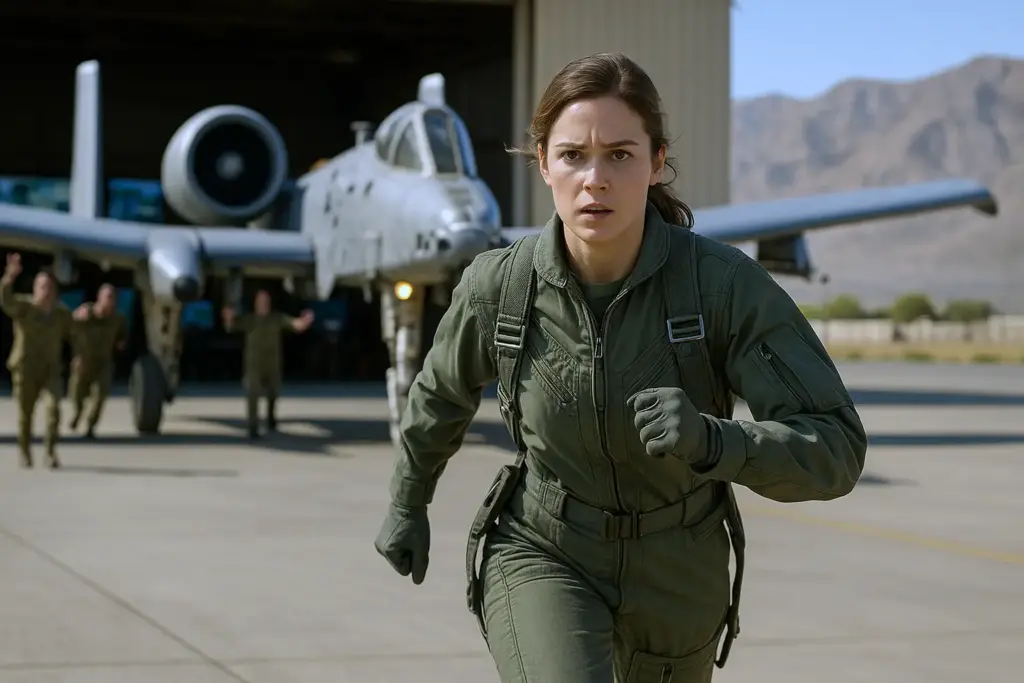
At twenty-six, Captain Thomas sat behind the controls of an A-10 Thunderbolt II. She was Irish by birth and labeled «too volatile» or «too untested» by the superiors who kept her relegated to logistics duties. Yet, when that valley turned into a graveyard waiting to happen, she redrew the map and brought every single man home alive.
The valley had become a textbook kill box. Rescue helicopters couldn’t penetrate the heavy wall of fire without being shredded. High-altitude F-16s were useless; they couldn’t drop heavy ordnance because the «danger close» margin was nonexistent—the enemy was practically on top of the Americans.
Command quietly began to prepare the loss report. Only one person refused to accept the inevitable: Delaney. She looked small standing next to the massive Warthog aircraft, but she understood that machine better than anyone on the roster. The A-10’s 30-millimeter GAU-8 cannon is a beast that can chew through steel, and in the right hands, it can thread a needle from thousands of feet up.
Her superiors claimed she didn’t possess those hands. At 06:30 that morning, with the Afghan heat already baking the tarmac, Major Sanderson had shut her down again.
«Formation work with the new kids,» he had ordered. «I need steady leadership.»
It was a polite way of saying: anyone but you.
Delaney swallowed the insult, nodded, and went back to work. For months, she had been doing the homework nobody assigned. She spent nights running simulations, memorizing ballistic tables until she could recite them backwards, and learning just enough Pashto to understand radio intercepts. She had hand-calculated backup targeting math in case her flight computer fried. She had mapped every valley and ridgeline, circling the kill zones where standard air support doctrine would fail. Nobody wanted her analysis, but she kept studying anyway.
In a briefing, she had asked a single, pointed question. «What if this movement isn’t preparation, but a trap designed to isolate us where air power can’t help?»
«Just track the equipment, Captain,» was the dismissive reply.
So she did. But she also broke into a locked simulator at night. She ran the nightmare scenario forty-seven times, practicing how to destroy Surface-to-Air Missiles while diving, and how to lay a surgical line of gunfire between friendly forces and the enemy. She practiced until her hands moved faster than her conscious thought.
At 1:47 in the afternoon, the base siren shattered the routine. The tactical displays in the operations center lit up with the jagged contours of the Korengal-style valleys she knew by heart. Radio chatter confirmed the worst: SEAL Team 7 and their detachments—381 men total—were encircled by nearly 800 fighters. Two confirmed SAM sites were active.
The enemy held three ridgelines; the friendlies were trapped in a natural bowl at the bottom. F-16s were roughly twenty minutes out. Their rules of engagement forbade shooting within 100 meters of friendly strobes. The SEALs had enemies within 50 meters.
Major Sanderson demanded options. The room offered him the rulebook. Delaney offered him the A-10.
«Denied,» Sanderson said flatly. «We are not risking an untested pilot.»
A communications technician cut through the tension. «SEALs report thirty minutes of ammunition remaining.»
Time had ended the debate. Doctrine hadn’t.
Delaney stepped out of the room, counted thirty seconds in the hallway to steady her breathing, and did the math. Ten minutes from locker to wheels up. Twelve minutes to the valley. That left a knife-edge window. She scribbled a one-line postscript on a letter she had kept in her locker for months.
«If you are reading this, I acted because 381 Americans were dying while paperwork argued with itself.»
Then she suited up.
Aircraft 297 was already fueled and armed. It carried a full drum of 30mm rounds, Maverick missiles, and rockets. She moved through the pre-flight checks on pure adrenaline. Oil, hydraulics, chaff, flares, pod, INS—ninety seconds later, the Hog was breathing fire.
On the tower frequencies, she said nothing. On the emergency Guard channel, she said everything.
«All stations, this is Thunderbolt 7, departing Kandahar, inbound Korengal. 381 Americans are about to be overrun. Breaking rules to save them.»
She went wheels up at 2:23 PM.
As she approached the valley, the radio traffic was going ragged. The SEAL ground force commander, callsign Trident Actual, kept his voice tight, but the cadence betrayed the reality: magazines were running dry. The F-16 lead checked in first.