


Linda Harrison sat with a practiced stillness on the aluminum bleachers at Naval Amphibious Base Coronado, her gaze fixed intently on the parade deck below. She watched her son, Tyler, as he made his final preparations to graduate from what was universally acknowledged as the most grueling, soul-crushing military training program on the face of the earth.
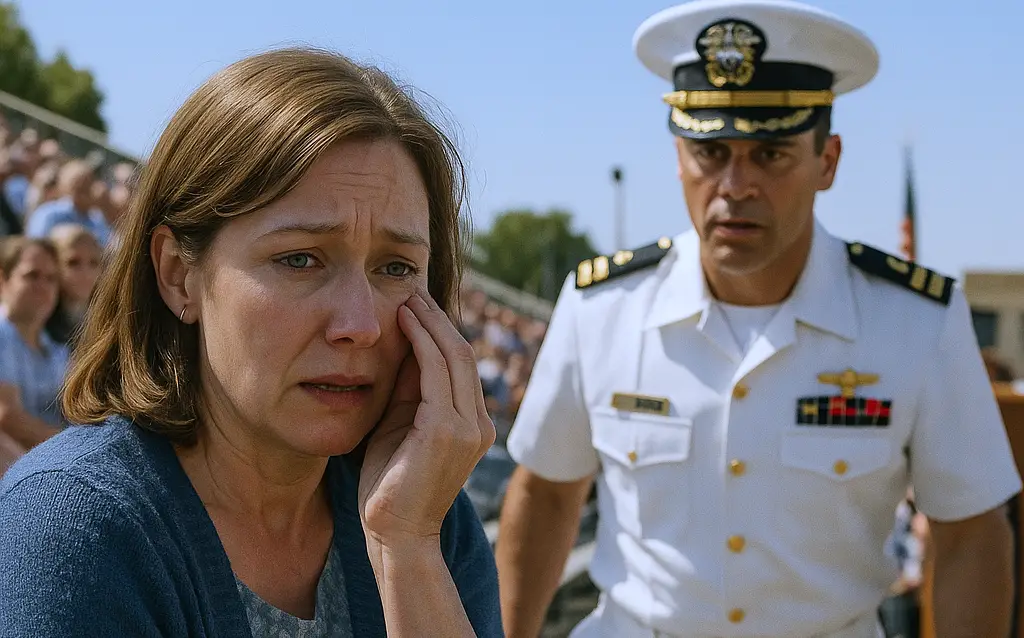
To anyone glancing her way, she looked like the quintessential proud mother—nervous energy radiating from her, eyes shimmering with a mix of excitement and unshed tears, fighting to keep her composure as she witnessed her boy transforming into a Navy SEAL. But the atmosphere shifted abruptly when Commander James Rodriguez, during his opening address, caught a fleeting glimpse of the faded ink etched into the skin of Linda’s forearm. He didn’t just pause; he stopped mid-sentence, his voice catching in his throat.
The markings that peeked out from her sleeve were not merely decorative or generic military tributes. The specific medical insignia, combined with the distinct unit markings, belonged unmistakably to «Doc» Harrison, the legendary Navy Corpsman who had literally saved his life and the lives of countless other SEALs during the darkest, most violent days of the Iraq War. The morning sun was climbing higher, casting long, dramatic shadows across the famous «grinder» at the Naval Amphibious Base, as families huddled together for one of the Navy’s most prestigious and solemn traditions. It was BUD/S graduation day, that pivotal moment when a select handful of survivors earned the right to wear the trident after enduring months of the most physically punishing and mentally shattering training the military had to offer.
Amidst the sea of assembled family members, Linda Harrison had found a modest spot in the third row of the bleachers, her fingers gripping a small, wooden-handled American flag with white-knuckled intensity as she tried to steady her breathing. At forty-eight years old, Linda possessed the weathered hands and the quiet, unassuming resilience of a woman who had scratched and clawed for every single thing she had achieved in life. She was dressed in a simple, nondescript blue dress paired with a cardigan that sensibly covered the length of her arms, allowing her to blend perfectly into the background with the other beaming, proud parents.
However, Linda Harrison was fundamentally different from every other mother sitting in those stands. Concealed beneath her unassuming, modest civilian exterior was a twenty-year history as one of the United States Navy’s most highly decorated combat medics. Her service jacket contained records that would have absolutely floored anyone who only knew her as the quiet single mom who raised Tyler while working exhausting shifts as a civilian nurse in San Diego.
What made this particular graduation ceremony truly extraordinary, bordering on the cinematic, was that Tyler had absolutely no concept of the sheer scale of his mother’s military pedigree. He was aware, in a vague sense, that she was a Navy veteran who had served as a hospital corpsman, but Linda had meticulously firewall-ed the gritty details of her combat deployments, her chest full of medals, and her almost mythical status among the SEAL teams. She had hidden this part of herself from her son throughout his entire childhood. Tyler Harrison, now a strapping twenty-two-year-old, was standing on the precipice of joining one of the world’s most elite fighting units completely blind to his own family legacy.
He had survived the hellscape of «Hell Week,» the bone-chilling underwater demolition training, the high-octane advanced combat courses, and every other sadistic trial designed to separate actual Navy SEALs from ordinary sailors. Out of his original class of one hundred and eighty hopeful candidates, only twenty-three men were left standing to graduate on this day. As Linda watched her son standing rigid in formation, shoulder-to-shoulder with his surviving brothers, she allowed herself a moment to reflect on the long, arduous journey that had carried them to this precise second in time.
Tyler had grown up knowing his father only through the static memories of photographs—Petty Officer First Class Michael Harrison had been killed in action in the mountains of Afghanistan when Tyler was merely a toddler of three. Linda had raised the boy entirely on her own, working brutal, long hours as a civilian trauma nurse to keep food on the table, all while keeping her own combat history strictly compartmentalized and separated from her identity as a mother. Yet, despite her silence, Tyler had always been magnetically drawn to the service, inspired by the sacrifice of the father he never knew and the quiet, unshakeable strength of the mother he did.
When he had first announced his intention to pursue a SEAL contract, Linda had been struck by a crushing wave of conflicting emotions—immense pride warring with terrifying dread. She knew, with a clarity that only experience can provide, exactly what SEAL operations entailed, having spent years embedded directly alongside those teams as their primary medical support. She understood the visceral dangers, the physical breakage, and the heavy psychological toll that Tyler was volunteering to shoulder.
But deep down, she also knew that Tyler had inherited the same iron determination and moral courage that had driven both of his parents to serve in the military’s most demanding roles. As the ceremony officially commenced, Linda tried to tunnel her focus solely onto the pride she felt watching Tyler achieve his lifelong dream. Yet, she couldn’t quite shake the ghosts; being back at this base brought the memories flooding back with startling clarity.
Naval Amphibious Base Coronado had been her home base in the lull between deployments, the very ground where she had trained with SEAL teams, maintained her rigorous medical certifications, and prepared for missions in some of the most dangerous combat zones on the map. Hospital Corpsman First Class Linda «Doc» Harrison had served four distinct deployments to Iraq and Afghanistan between the years of 2003 and 2012, embedded with SEAL teams conducting direct-action raids, deep reconnaissance operations, and high-stakes counterterrorism missions. Her medical skills hadn’t been tested in a sterile classroom, but in the dirt—treating catastrophic wounds while taking effective enemy fire, performing emergency surgery in primitive field conditions, and making life-or-death triage decisions with limited resources and the clock ticking down.