


A motorcycle gang terrorized a quiet diner owner, assuming the elderly black man would be an easy target for extortion. They didn’t know they had just threatened a decorated special forces instructor who had trained elite soldiers for two decades. The afternoon sun cast long shadows across the cracked parking lot of Mason’s Diner. A small establishment that had anchored the corner of Route 9 and Maple Street for nearly 15 years, the building itself was modest. It featured a weathered brick facade and a faded red awning that had seen better days.
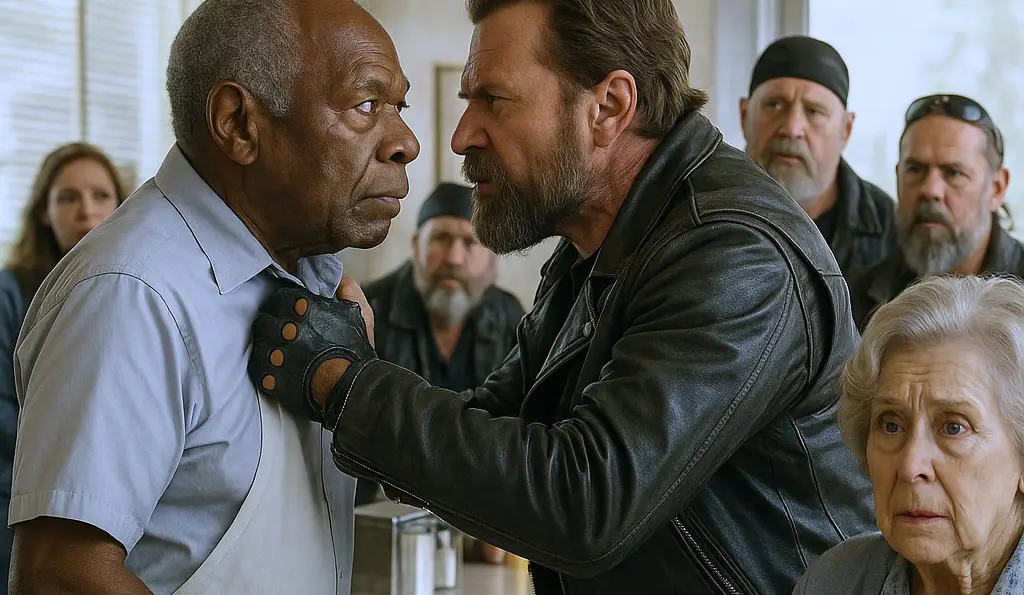
The windows caught the light in a way that made the interior glow warm and inviting. The smell of fresh coffee and grilled onions drifted out whenever someone opened the front door, mixing with the late October air that carried the first hints of coming winter. Inside, Robert Mason moved with the quiet efficiency of someone who had performed the same motions thousands of times.
At 63, he was lean and upright. His movements were precise as he wiped down the counter with a clean cloth. His dark skin showed the fine lines that come with age, particularly around his eyes.
However, there was something in his posture, a straightness to his spine, and a deliberateness to each gesture that suggested a discipline deeper than what running a small-town diner required. He wore a simple white apron over a blue button-down shirt, sleeves rolled to his elbows. This revealed forearms that were still corded with muscle despite his age.
The lunch rush had ended an hour ago, leaving only two customers in the diner. Mrs. Henderson, a regular who came every Thursday for pie and coffee, sat at her usual table. A young couple passing through town sat by the window, sharing a plate of fries.
Robert appreciated these quiet hours. They gave him time to think, to remember, and to simply exist in the peaceful routine he had built for himself after retiring from a life that had been anything but peaceful.
«Fifteen years,» he thought, running the cloth along the chrome edge of the counter. Fifteen years of peace.
He glanced at the photographs lining the wall behind the register. There were pictures of satisfied customers, local Little League teams he had sponsored, and the ribbon-cutting ceremony when he first opened. Mixed among them were a few older photographs, carefully placed but not prominently displayed.
They showed a younger version of himself in uniform, standing with groups of serious-looking men. They were all carrying equipment that most civilians wouldn’t recognize. Those photos drew occasional questions from observant customers, questions he usually deflected with a modest smile and a change of subject.
The bell above the door chimed. Robert looked up, his practiced smile already forming, but it faltered slightly as six men walked in. They moved in a way that immediately changed the atmosphere of the room.
They were loud and purposeful, taking up more space than necessary. All wore leather vests over denim, their motorcycle club patches visible even in the dimmer interior light. The largest one, a man with a thick beard and arms covered in faded tattoos, seemed to be the leader.
His eyes swept the diner with an appraising look that Robert recognized instantly. Assessment. Territory. Dominance. The thoughts came automatically, trained responses from another life that never quite went away, no matter how long he spent frying eggs and pouring coffee.
«Afternoon, gentlemen,» Robert said, his voice even and welcoming, despite the tension he felt gathering in his shoulders. «Grab any seat you’d like. I’ll be right with you.»
The men didn’t sit. Instead, they spread out. Three moved toward the counter where Robert stood, and two positioned themselves near the door.
One, a wiry man with a shaved head and a scar running down his left cheek, walked slowly along the wall. He examined the photographs with exaggerated interest. Mrs. Henderson’s coffee cup clinked against her saucer, the sound too loud in the suddenly quiet diner.
The young couple by the window had stopped eating, their conversation dying mid-sentence.
«Nice place you got here,» the bearded leader said, moving up to the counter. His voice was rough and gravelly, the kind that came from years of cigarettes and shouting over motorcycle engines. «Real nice. Family business?»
«Just me,» Robert replied, keeping his hands visible and relaxed. «Can I get you gentlemen something to eat? Coffee?»
The man didn’t answer. He was looking at Robert in a way that made his intent clear. This wasn’t a customer’s appraisal. This was something else.
«Just you,» the man repeated, glancing at his companions. «Hear that, boys? Old man runs this place all by himself.»
He turned back to Robert, leaning against the counter with deliberate casualness. «That’s hard work. Lot of responsibility. Lot of things that could go wrong.»
Robert’s hands stilled on the counter, but his expression remained neutral. He had played this scene before, in different countries, different languages, and with different stakes. The script was always fundamentally the same.
«I manage,» he said simply.
The man with the scar had stopped in front of the military photographs. «Hey, Cutter,» he called to the bearded leader. «Check this out. Old man’s a veteran.»
Cutter’s eyes narrowed slightly, studying Robert with renewed interest. «That right? You serve?»
«Long time ago,» Robert said. He moved slowly, deliberately, reaching for a pot of fresh coffee. «Can I pour you something while you’re here?»
«Long time ago,» Cutter repeated, mimicking Robert’s even tone mockingly. «Well, that’s real nice. Thank you for your service and all that.»
He straightened up, and the pretense of casual conversation dropped away. «Here’s the thing, old man. This is a nice place. Real nice. But it’s in our territory now.»
He leaned closer. «And businesses in our territory? They need protection.»
«Protection from what?» Robert asked, though he knew the answer.
«From things going wrong,» Cutter said, spreading his hands. «Accidents, break-ins, windows getting smashed, equipment breaking down. You know how it is. Small business like this? One bad week and you’re finished.»
He leaned forward again. «But we’re reasonable men. Five hundred a week, and you won’t have to worry about any of that.»
Robert set the coffee pot down carefully. In his peripheral vision, he could see Mrs. Henderson clutching her purse, her elderly face pale with fear. The young couple had their phones out under the table, probably trying to call the police.
The nearest sheriff’s station was fifteen minutes away on a good day.
«I appreciate the offer,» Robert said, his tone remaining level. «But I’m not interested in protection services.»
Cutter’s smile faded. «I don’t think you heard me right, old man. This isn’t an offer. This is how things work around here now.»
«I heard you fine,» Robert replied. «And my answer is no.»
The temperature in the room seemed to drop. The other bikers shifted, their casual stances becoming more alert, more predatory. The man with the scar moved away from the wall, his hand dropping to his belt, where Robert could see the outline of something metallic tucked under his vest.
Cutter’s face darkened. «You don’t want to make this difficult. We’re being nice right now, but nice has limits.»
«I’m sure it does,» Robert said. His heart rate hadn’t increased. If anything, he felt calmer now, the old training taking over.
«But I’ve been running this diner for fifteen years without protection, and I’ll keep running it the same way.»
«Fifteen years,» Cutter repeated, his voice dropping to something more dangerous. «You think fifteen years of frying bacon means something? Old man, I’ve been riding these roads for twenty-five years.»
He pointed a finger at the counter. «I know every business, every sheriff, every judge in this county. And when I say you need protection, you need protection.»
One of the other bikers, a younger man with multiple piercings and a manic energy, grabbed a salt shaker from the nearest table and casually swept it onto the floor. The glass shattered, white crystals spreading across the worn linoleum.
«Oops,» he said, grinning. «See how easy accidents happen?»
Mrs. Henderson made a small sound of distress. Robert glanced at her, then at the young couple, his mind calculating. Three civilians, six hostiles, limited space, multiple exit points.
The assessment came automatically, unbidden.
«I’m going to have to ask you gentlemen to leave,» Robert said quietly.
Cutter laughed, but there was no humor in it. «You’re going to ask us to leave? Old man, you’re not hearing me. Let me spell it out real clear.»
He slammed his palm down on the counter hard enough to make the register rattle. «You pay, or this place becomes a memory. We’ll start with the windows, then maybe a small fire in the kitchen. Electrical problems happen all the time.»
He let the threat hang in the air. «And if you still don’t get the message, well…»
Another biker picked up a menu holder and dropped it, the plastic cracking against the floor. The one by the door pushed over a coat rack with a loud clatter.
«Stop,» Robert said, his voice still quiet, but with an edge now that made Cutter pause. «You need to leave. Now.»
«Or what?» Cutter leaned across the counter, invading Robert’s space. «What are you going to do, old man? Call the cops? We’ll be gone before they get here.»
He sneered. «And we’ll be back tomorrow. And the day after. And the day after that. This ends one way: with you paying, or with you picking up pieces of what used to be your business.»
The wiry man with the scar had moved behind the counter now, standing close to Robert. «Maybe he needs a demonstration,» he said to Cutter. «Show him we’re serious.»
Robert’s eyes moved to him, then back to Cutter. His hands were still on the counter, relaxed, but every muscle in his body was coiled, ready. The civilians needed to get out first.
That was priority one.
«Mrs. Henderson,» Robert said calmly, not taking his eyes off Cutter. «Take the young couple and go out the back. Through the kitchen. Now.»
«Robert, I can’t just…» Mrs. Henderson started.
«Now,» Robert repeated, firmer.
The elderly woman understood something in his tone. She grabbed her purse and hurried toward the young couple, ushering them up. One of the bikers by the door moved to block them, but Robert spoke again.
«Let them go. Your problem is with me.»
Cutter studied Robert for a long moment, then nodded to the biker. «Let the sheep run. Ain’t interested in them anyway.»
The three civilians hurried through the kitchen door, their footsteps echoing in the sudden silence. A moment later, Robert heard the back door slam. Now it was just him and six men who had come to destroy everything he had built.
«Smart,» Cutter said. «Now, let’s talk numbers. Five hundred a week is a bargain, considering what we’re offering.»
«You’re not offering anything,» Robert said. «You’re extorting.»
«Call it what you want,» Cutter shrugged. «End of the day, you’re going to pay. Question is whether you do it the easy way or the hard way.»
The wiry man behind the counter grabbed Robert’s shoulder. It was a mistake. In a movement so fast it seemed almost casual, Robert’s hand came up, gripping the man’s wrist, his thumb finding the pressure point with practiced precision.
The biker gasped, his grip releasing instantly as pain shot up his arm. Robert twisted, using the man’s momentum against him. In less than two seconds, the biker was bent forward over the counter, his arm locked at an angle that made any movement agonizing.
The other bikers froze, their brains trying to process what had just happened. Robert still looked calm, almost bored.
«I asked you to leave,» he said quietly.
Cutter’s face went dark red. «You just made the biggest mistake of your life, old man.»
Three of them came at once. The young one with the piercings grabbed a chair, swinging it wildly. Another pulled a chain from his belt. Cutter reached for something in his vest.
Robert released the wiry man, letting him slump to the floor, and reached down to his apron. With one smooth motion, he pulled it over his head and tossed it aside. The bikers stopped again, staring.
Covering both of Robert’s forearms were tattoos that anyone with military knowledge would recognize instantly. On his right arm, the Special Forces insignia was surrounded by scrolls listing deployments: Afghanistan, Iraq, Syria, Somalia. Names of operations that were still classified.
On his left, he bore the distinctive symbol of Fort Bragg’s Special Warfare Center, where the most elite soldiers in the U.S. military were trained. The LOIT. Instructor 1983-2003.
But it wasn’t just the tattoos. It was the way Robert stood now, the apron gone. His posture had shifted subtly, feet positioned for maximum balance and mobility.
His weight was on the balls of his feet, hands loose and ready. Every movement of his body spoke of decades of training, of muscle memory so deep it was instinctive.
Cutter’s eyes widened slightly. «Special Forces,» he said slowly. «Well, ain’t that something? Still six of us and one of you, old man. Tattoos don’t mean much against those odds.»
«They mean I’m giving you one last chance to walk out that door,» Robert said. His voice was different now, harder, carrying the authority of someone who had commanded men in situations far more dangerous than this. «Take it.»
«Rush him!» Cutter ordered.
They came from three directions simultaneously. The young one with the chain swung it in a wide arc. Robert ducked under it, stepping inside the man’s guard, and drove his palm into the biker’s solar plexus.
It was a precise strike that stopped the diaphragm and left the man gasping for air on the floor. The second attacker, the one who had broken the salt shaker, had a knife. He lunged forward.