


The snow was falling with such intensity that evening that the streetlights were reduced to glowing hazes, surrounded by ghostly halos in the white darkness. It was only two days before Christmas, and the entire city had been caught completely off guard by a blizzard that had swept in with a ferocity no one had predicted. The streets were already smothered under several inches of fresh powder, and a biting wind whipped the snow into swirling, hypnotic patterns that reduced visibility to a mere few feet.
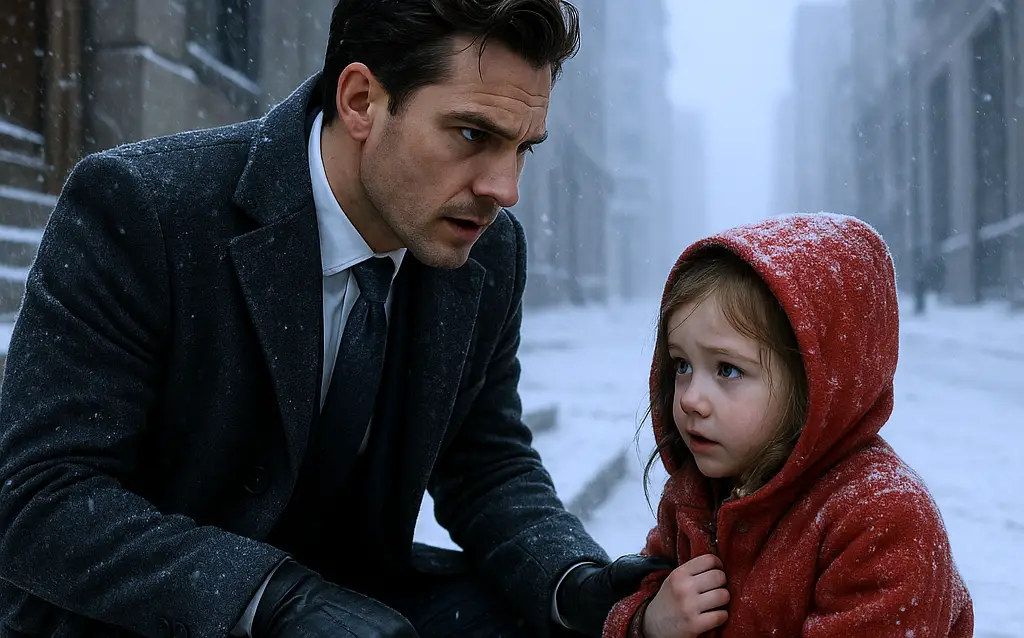
Marcus Callahan stepped out of the heavy glass doors of his office tower and immediately braced himself against the storm, pulling the collar of his dark cashmere overcoat tighter to shield his neck. He was thirty-six years old, with dark hair meticulously styled back and wearing a bespoke suit that whispered of significant wealth and an obsession with detail. As the CEO of Callahan Industries—a technology empire his father had founded and which he had aggressively expanded into a multimillion-dollar giant—Marcus was a man accustomed to absolute control.
He was a man who planned for every contingency, anticipated every market fluctuation, and solved complex problems with ruthless efficiency. However, he had not planned for this blizzard. His personal driver had phoned an hour prior with the bad news: the city’s grid was locked down, and the roads were rapidly becoming impassable. rather than sit and wait in the lobby, Marcus had made the executive decision to walk the eight blocks to his downtown penthouse.
He had grown up in this city, after all. He had navigated these very streets as a child long before he became a CEO. A little snow was not going to stop him. As he began his trek, he passed a luxury Range Rover abandoned at the curb, buried under a drift. He knew it belonged to one of his senior executives who had wisely abandoned the vehicle earlier in the day to take a taxi home.
Marcus passed the silent car without a second glance, his expensive leather dress shoes crunching loudly in the fresh, packing snow. He began walking down the desolate street. Most businesses had shuttered their windows hours ago, sending employees home early. The few pedestrians who had dared to brave the weather had already hurried to safety.
The city felt utterly abandoned, wrapped in a suffocating white silence that was broken only by the mournful howling of the wind between the skyscrapers. He had walked perhaps two blocks, head down against the gale, when he saw her. At first, she appeared to be nothing more than a shapeless mound on the stone steps leading up to an aging brownstone building.
Marcus might have walked right past, his mind already calculating tomorrow’s schedule, assuming the shape was merely a pile of discarded clothes or trash bags left behind by a tenant. But then, the shape moved. It shifted slightly, and with a jolt of genuine shock, Marcus realized he was looking at a human being. It was a child. A little girl, likely no more than four or five years old, was sitting completely alone on the snow-covered steps.
She was wearing a pink coat that was woefully too thin for freezing temperatures, and her blonde hair was pulled back in a messy braid that was slowly coming loose in the wind. Her small feet, encased in worn gray shoes, swung slightly above the ground, dangling over the frozen slush. She stared straight ahead with an expression that was far too serious and stoic for such a young, soft face.
Marcus stopped in his tracks, his analytical business mind momentarily stalling as it tried to process the data before him: a solitary child, a dangerous blizzard, the center of an empty city. Where were her parents? Why was she sitting here like a statue? He approached her slowly, careful not to make sudden movements that might frighten her.
«Hello?» he called out gently, raising his voice just enough to be heard over the whistling wind. «Are you all right?»
The little girl turned her head to look at him. Marcus saw that her cheeks were chapped bright red from the bitter cold, and her eyes were glassy with unshed tears. Yet, she did not recoil or look frightened of him. Instead, she studied his face with an intensity and focus that was almost unsettling coming from a toddler.
«Are you Marcus Callahan?» she asked. Her small voice was high and fragile, but it cut through the storm with surprising clarity.
Marcus felt his heart skip a beat in his chest. «Yes, I am. How do you know my name?»
«My mom showed me your picture,» the girl explained, her teeth beginning to chatter. «She said… she said if I saw you, I should tell you that we need help. She said you are the only one who can help us.»
Marcus ignored the wet snow soaking into the knees of his tailored trousers and crouched down so he was directly at her eye level. «Where is your mother, sweetheart?»
The little girl’s lower lip finally began to tremble, her composure cracking. «She is at home. She is sick. She sent me to find you because she said you would be leaving your building around now. She told me you always leave at six-thirty on Wednesdays.»
A cold chill ran down Marcus’s spine that had absolutely nothing to do with the freezing wind. «How does your mother know when I leave my building?»
«She used to work there,» the girl said simply. «Before she got sick.»
Marcus’s mind raced, cycling through faces and names. He employed nearly three hundred people in his headquarters alone. Without a name or a department, he couldn’t possibly identify who this child’s mother was.
«What is your name?» he asked, his voice softening.
«Lily,» the girl said. «Lily Foster.»
Foster. The name sparked a faint glimmer of recognition in Marcus’s memory, though he couldn’t quite grasp the full context yet.
«And your mother’s name?»
«Amanda Foster,» Lily said. «She was your secretary before Miss Helen.»
Suddenly, the tumblers clicked into place. Marcus remembered. Amanda Foster had been his executive assistant three years ago. She was a quiet, diligent woman in her late twenties who had been incredibly efficient and professional. She had left the company rather abruptly, Marcus recalled. She had given only two weeks’ notice, mumbling something about family obligations and needing to relocate.
He had been disappointed to lose such a capable employee, but he had respected her decision and hired Helen to replace her.