


They thought she was just another F-16 trainee: quiet, ordinary, easy to overlook. But when 18 enemy jets tore across the border and the sky turned into a battlefield no one was prepared for, she revealed the truth she’d been hiding her entire life. They said Lt. Alara Quinn was the kind of pilot you never noticed. Not because she lacked talent, but because she refused to shine where others demanded attention. At RAF Lossiemouth, a windswept stronghold on the northern edge of Scotland, fighter pilots were carved from the North Sea wind and the roar of afterburners.
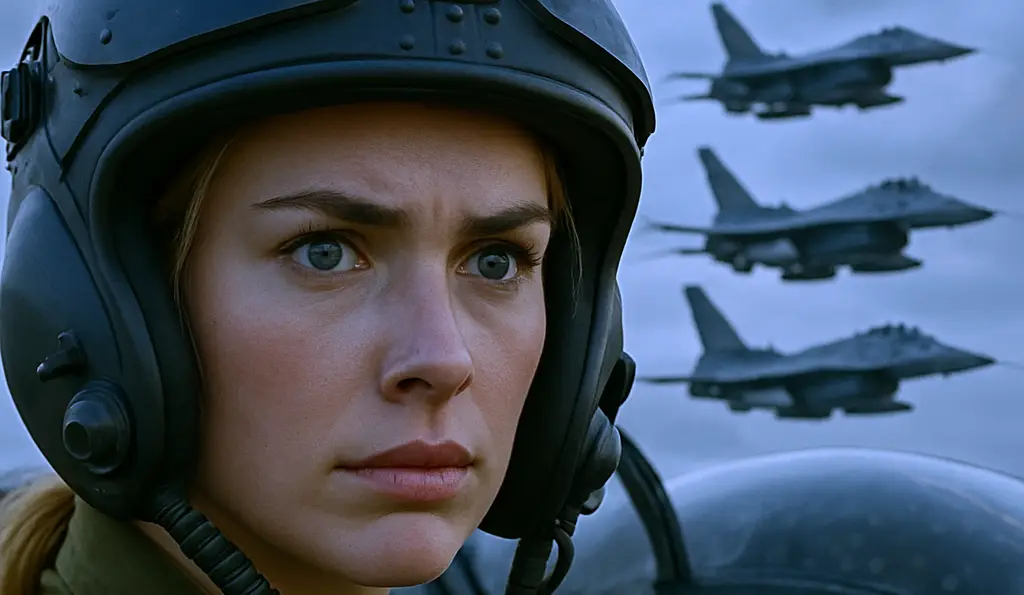
Most wore their confidence like a badge. Most wanted to be seen. Alara wasn’t one of them.
At 5’3″, with quiet posture and a gentle, deliberate way of moving, she looked more like an engineer than a fighter pilot. She didn’t slam locker doors, boast about barrel rolls, or laugh loudly at the bar the way the others did. She kept her dark auburn hair braided tight, her flight suit immaculate, and her conversations brief.
Her presence rarely filled a room. She slipped through it like a shadow that no one bothered to chase.
«Quinn flies clean—too clean,» one instructor remarked during an evaluation. «A safe pilot. Good technique, but lacking combat instinct.»
They were wrong, but they had no way of knowing that. Alara had spent years perfecting the art of not being seen. Her childhood was nothing like theirs.
While most pilots had grown up on adventure stories and sports scholarships, Alara grew up in the hangars of naval bases, sitting beside her father, Commander Nolan Quinn, one of the most decorated F-18 pilots in U.S. Navy history.
She learned about thrust curves before multiplication tables. She memorized radar signatures before learning state capitals. She could diagram a high-G vertical loop before she could drive a car.
But Commander Quinn’s greatest lessons weren’t about machines. They were about survival.
«Kiddo, anyone can fly fast,» he would say. «Anyone can make noise. But a real warrior knows when to stay unseen, unreadable, unpredictable.»
She absorbed every word. And when he died in a training accident over the Adriatic Sea, Alara built a shell around herself so tight that no one could see the fire inside. She stopped pushing. She stopped revealing.
She stopped showing promise beyond what the Air Force asked of her. She followed the book. She flew within limits. She never, ever let anyone see what she was truly capable of.
Because her father had warned her: «Never show your full hand until the sky turns hostile.»
At Lossiemouth, the others simply assumed she was ordinary. The quiet one. The predictable one. The harmless one.
They couldn’t have been more wrong on the morning everything changed.
The airfield was wrapped in a muted gold haze. The sun had just breached the horizon, scattering soft light across the runway, turning the dew on the tarmac into tiny mirrors. The North Sea wind carried the scent of salt and cold iron.
Alara walked with her helmet tucked under one arm, her checklist under the other. She always moved with intention, every step part of a rhythm she’d lived her entire life.
Her F-16C Fighting Falcon, tail number Q-423, sat waiting on the ramp, the morning light sliding across its surface like liquid gold. She placed her hand on the aircraft’s nose, a ritual she performed before every flight.
«Morning, girl,» she whispered. «Let’s keep each other alive.»
Captain Rowan Beck, her wingman for the day, jogged across the tarmac with all the subtlety of a marching band. Loud, confident, always ready to show off.
«Quinn!» he shouted, already smirking. «Try not to fly like an accountant today, yeah?»
Alara gave him a polite, unreadable nod. «Try not to scare the refuel crew again,» she replied calmly.
It was going to be a simple patrol. Routine, predictable—the kind of mission where nothing ever happened. They would fly north toward the Icelandic Air Defense Identification Zone, sweep for suspicious radar activity, and return before lunch.
She liked missions like that. They didn’t force her to reveal anything.
Inside the cockpit, she moved with an elegance that didn’t draw attention but was impossible to replicate. She strapped in, ran her hands over switches she had memorized long before flight school, and listened as the engine came to life with a deep, familiar rumble.
As the canopy lowered, she caught a reflection in the glass: calm, focused, controlled—exactly the pilot she wanted others to see.
«Falcon 2-1, taxi to runway 0-6,» the controller called.
«Copy,» Alara answered, her voice steady and neutral.
Beck’s voice came through next. «Try to keep up, Quinn.»
She didn’t bother responding because she already knew something Beck would never expect. Today would not be routine. Today the sky would demand everything she was hiding. Today the world would finally learn who she really was.
And no one, absolutely no one, was ready for the storm she was about to unleash.
The patrol started quietly—too quietly for a region where tensions simmered like a storm beneath the sea. Lieutenant Alara Quinn kept her F-16 steady at 28,000 feet, the coastline of northern Scotland curving beneath her like a jagged blade.
Captain Rowan Beck flew loosely off her right wing, tapping the top of the speed envelope the way he always did.
«Falcon 2-1, radar looks clean. You got anything?» Beck asked.
Alara scanned her multi-function display. Nothing but the normal heartbeat of civilian flights and distant maritime patrols.
«Negative,» she replied, her voice calm. «Sector is clear.»
But something in her chest felt wrong. A heaviness, a pressure she had learned to trust over the years. Her father used to call it the «Sky Whisper»—the soundless warning before a battle you couldn’t yet see.
She checked her instruments again. Still nothing. Then the whisper became a shout.
A tone erupted in her cockpit: sharp, unfamiliar, urgent. Multiple long-range radar contacts, high speed, high altitude, closing fast.
«Alara, you seeing this?» Beck’s voice had lost its swagger.
She didn’t answer; she didn’t need to. She could already read the threat geometry forming on her screen. Contacts fanning out, maintaining combat spacing, descending across a line they had no right to cross.
Before she could radio control, the emergency frequency lit up.
«Falcon 2-1, Falcon 2-2, be advised, we have unknown aircraft entering UK airspace. Count… standby… count 18. Repeat, 18 aircraft. You are to investigate. Do not provoke.»
Eighteen. Not two, not four, not a probing test run by a foreign patrol. This was a strike group.
Beck cursed under his breath. «Who sends 18 fighters into British territory?»
Alara didn’t reply. She was already analyzing their signatures: high-energy climbing arcs, aggressive vectoring, formation discipline that suggested well-trained combat pilots.
As they descended through 38,000 feet, the silhouettes resolved clearly on her radar: Su-27 Flankers. And not the export versions—full combat spec. This wasn’t an intrusion; it was an incursion.
«Lossiemouth Control, Falcon 2-1,» Alara transmitted. «We have positive ID on 18 hostile aircraft. Su-27s, full loadout. They’re penetrating the ADIZ at speed. Requesting immediate reinforcement.»
The reply was clipped, strained. «Reinforcement scrambled. ETA nine minutes. Avoid engagement unless fired upon.»
Nine minutes. In air combat, nine minutes was a lifetime and a death sentence all at once. Because the Su-27s had already changed formation—they were hunting.
Beck’s breathing was audible through the radio. «Quinn, if they lock us up…»
«I know.» Alara’s tone was controlled, but her pulse hammered.
They were two jets. Two against eighteen high-performance fighters designed explicitly to dominate the skies. And not even Lossiemouth knew the truth: they were depending on a pilot they believed was average.
Alara toggled her left display. Threat lines converged. Altitude dropped. The lead element angled directly at them.
«They see us,» she said quietly.
A second later, her RWR shrieked. Missile lock.
«Break!» Beck shouted.
But Alara was already moving. She threw her F-16 into a violent Split S, ripping downward with a maneuver that would have blacked out most seasoned pilots. The G-forces clawed at her vision, but she held the pressure perfectly.
Muscles tightening, breath controlled, mind razor-sharp. Commit completely. The enemy hesitates; you do not.Her father’s voice.
When she leveled out, the missile streaked overhead, too high now to correct.
Beck’s voice cracked with disbelief. «Quinn! They fired! They actually fired!»
Which meant the rules of engagement had changed. Alara toggled to the tactical net.
«Lossiemouth Control, Falcon 2-1. We are now under attack. Repeat, under attack. Permission to defend?»
The reply came instantly. «Falcon 2-1, you are cleared. Defend the homeland. Weapons free.»
Something inside Alara shifted. Something she had kept caged for years. The shadow stepped aside; the fire stepped forward.
«Copy,» she said, her voice turning cold and absolute. «Weapons free.»
Beck tried to stay with her, but Alara was already accelerating. Her F-16 carved upward through a tight spiral climb that defied how the aircraft was supposed to behave. She knew the manuals; she just didn’t obey them.