


Late night outside St. Helena Hospital, Nurse Avery Brooks clocked out, her exhaustion mirroring her cheap, worn jacket. A colleague snickered dismissively, «Just a mediocre nurse, as always.» Avery pulled her jacket tighter, accustomed to the contempt that masked her true identity. Suddenly, the silence was shattered as a thunderous UH-60 Black Hawk helicopter slammed down before the emergency entrance. Special Forces soldiers jumped out, focused and deadly. One shouted urgently, «We are looking for Lieutenant Commander Avery Brooks, NOW!»
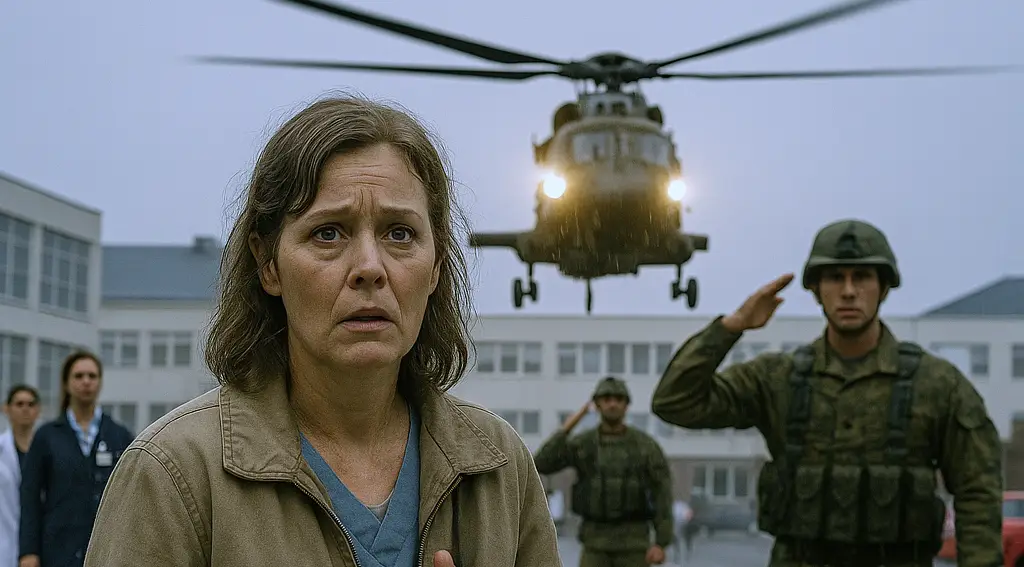
The tired nurse stood frozen. That was her forgotten rank and the name of a hero she had tried to bury. Avery Brooks was twenty-nine, an emergency room nurse with a gentle, soft-spoken demeanor. She deliberately kept a low profile, always standing back from the spotlight.
This quietness was misinterpreted as weakness or inexperience by her colleagues, who craved drama and recognition. Her history was a ghost she tried to outrun. She had been a U.S. Navy combat medic, serving as the indispensable medical expert for a high-tier support unit known as Raven 7.
Her competence was legendary, her decisions split-second and flawless. But the legend ended in a disastrous, high-profile extraction mission in Kandahar two years prior. Avery managed to save her commanding officer, Captain Hale, but a bureaucratic blunder—a failure to authorize critical air support due to a delayed code clearance—resulted in the loss of three of her closest teammates.
That loss, that systemic betrayal, broke her. She carried deep psychological scars, the kind that don’t show on the surface, which fueled her desire for a calm, predictable civilian life. She saw the military system as tragically flawed, a machine designed to save itself, not its people.
She requested an honorable discharge, sought the anonymity of a major metropolitan hospital, and deliberately falsified her civilian file to read only «Registered Nurse Trainee.» This understatement was her shield, meant to keep her far from high-stakes decision-making and the risk of catastrophic failure. The deception worked too well.
Her colleagues, led by the arrogant chief resident, Dr. Miles, habitually dismissed her. «The new nurse knows nothing about high-stakes trauma,» they would snicker, or, «She’s always so quiet, zero initiative. You need loud confidence in the ER, not silent study.» They valued visible swagger over quiet, relentless preparation.
Yet Avery’s actions consistently contradicted their scorn. She was always the first to comfort a crying child patient, the one who patiently cleaned and dressed the neglected wounds of an elderly, difficult patient. She had an uncanny ability to spot distress before the monitors did, a skill honed by years of reading nonverbal cues in combat zones.
One evening, Dr. Miles criticized her slow processing time during a routine check. Moments later, that patient went into severe, rapidly progressing anaphylactic shock. While Dr. Miles fumbled with his prescription pad, paralyzed by the sudden shift, Avery calmly grabbed the epinephrine pen.
She confirmed the dosage, delivered the shot in the correct quadrant, and managed the airway, all within the critical sixty-second window. She saved the patient, but the reaction was chilling. «Lucky guess, Brooks. You got extremely lucky.»
«But next time, you wait for a physician’s explicit order,» Miles snapped, his face contorted by suppressed panic and envy. She didn’t argue. She simply whispered, «I apologize, Doctor,» which only reinforced their belief that she was meek and easily intimidated.
She continued her quiet ritual. Every night, Avery lingered in the staff lounge, pulling a worn canvas backpack onto her lap. Inside, she kept military field manuals, specifically documents on advanced combat trauma, austere surgery techniques, and high-pressure wound management.
She studied them not to practice for the ER, but to maintain the quiet, razor-sharp edge that civilian life threatened to dull. She knew that edge was the only thing that kept the nightmares away. The day’s shift had been pure bedlam.
Three high-impact vehicle accident victims arrived simultaneously. Dr. Miles, overwhelmed and screaming orders that conflicted with one another, created a paralyzing chaos. «Brooks, stand aside. You’re just getting in the way!» he bellowed when he saw her approaching a victim who was rapidly losing color.
But as the physician team frantically tried to intubate incorrectly, Avery smoothly intervened. With a gentle but firm motion, she secured the necessary instruments and performed a textbook emergency cricothyrotomy, a complex, high-risk procedure to open the airway. The patient’s oxygen levels immediately stabilized.
No one offered praise. The consensus was, «She got lucky again. She must have studied that specific technique last night, but she still failed to follow the proper patient identification protocol.» The procedure had saved a life, but the paperwork was wrong, and for St. Helena, bureaucracy always superseded blood pressure.
As the department calmed down, Avery, exhausted but meticulous, stayed late to clean the trauma bay herself. She mopped up blood, changed linens, and wiped down every single surgical instrument. She treated the room as if it were a sterile, clean operating theater in a war zone.
Every detail mattered because every detail was a potential failure point. Outside, the rain began to fall, cold and heavy, mirroring the weight of the military past she desperately tried to suppress. As she prepared to leave, she quietly retrieved a small, faded item from her locker.
It was a worn fabric patch. It read: US Navy Combat Medical Response. She tucked it into her pocket, needing the solid, physical presence of the relic. The patch was the last remaining tangible link to her three dearest teammates who had died on the Kandahar mission.
She carried it as a quiet promise: I will never fail to act, and I will never let a protocol kill a patient again. The instant Avery stepped out of the hospital doors, the harsh white glare from the Black Hawk’s spotlight hit her directly. Dust, water, and debris flew everywhere.
Pedestrians screamed, scattering across the street, and vehicles screeched to a halt. The air was thick with the smell of kerosene and raw military urgency. It was a scene of total military-grade disorder imposed upon a quiet civilian night.
A special operations officer, built like a brick wall and radiating immediate authority, bounded out of the helicopter. He was yelling into a tactical headset, his voice raw with urgency. «Has anyone seen Lieutenant Commander Avery Brooks? Answer me! This is a medical emergency! We have no time.»
The hospital’s security guard, a man named Ted who had often seen Avery cleaning up late, pointed a trembling finger at the small figure standing in the doorway. «That’s her. She just finished her shift, but she’s just a nurse, a new one.»
The entire SEAL team, a group of silent, intense operators, instantly turned their attention to Avery. Their eyes swept over her exhausted face, her cheap jacket, and her worn shoes. Then, the collective shift happened.
Their guarded professional intensity instantly dissolved into profound, almost ceremonial respect. This wasn’t a search; it was a recovery. The lead officer, a man named Miller, strode purposefully toward her, stopping three feet away.
He clicked his heels together in a perfect, rigid attention. «Ma’am, our team needs you. We have a Code Zero critical casualty.» Avery stepped backward, her civilian facade cracking.
Confusion and panic wore in her eyes. «Sir, you… you have the wrong person. I’m just Avery Brooks. I’m a nurse here.»
«We are not mistaken, Lieutenant Commander. Captain Mason Hale is dying, and he specifically requested you.» The name was a thunderclap. Mason, the Captain.
The man who had been her commanding officer, the one who had survived the blast in Kandahar. The one who had physically pulled her out of the flaming wreckage and forced her to seek help. He was the only one who knew the full, terrible extent of her training and the pain she carried.
He was now staking his life on her competence. The officer, seeing her distress, continued urgently, lowering his voice to cut through the rotor wash. «He sustained massive internal trauma from an IED blast. His pressure is plummeting.»
«The base physician cannot locate the bleed source. It’s too complex. It’s a crush injury to the thoracic wall, coupled with a specific deep laceration to the intercostal artery. The injury profile is unique.»
«But why me?» she pleaded, the fear of returning to that life clutching at her. «You have military surgeons. They have better equipment.»
«Because, Ma’am,» the SEAL replied, his voice dropping to a desperate low, «he said two things. First: ‘She thinks faster than a scalpel.’ And second: ‘Only she knows where my other scar is.'»
«He says the new trauma is adjacent to an old wound only you touched, the one near the fifth rib, lateral margin. He said, ‘It needs the Brooks touch.'» Avery felt a cold dread wash over her.
It was true. Years ago, under heavy fire, she had performed an emergency thoracic patch on Hale. It was a procedure so precise and unconventional that only she would know the exact anatomical coordinates of the compromised tissue and its current structural weakness.
Mason was counting on her unique, dangerous knowledge to navigate the impossible complication. The Black Hawk’s rotor wash roared, impatient for her departure. The pilot flashed the external lights, the universal signal for «time is up.»
Then, from the emergency room entrance, Dr. Miles and two other nurses appeared, drawn by the commotion and the lights. Dr. Miles saw the entire scene—the soldiers, the helicopter, the spotlight—and his jaw dropped. But his arrogance immediately resurfaced.
He saw a chance to assert his fading authority. He shouted over the blades, «Soldiers, you have the wrong woman! She’s a mediocre civilian nurse. You need a real doctor. Her certification is limited. This institution disavows any claims of her surgical ability.»