


It was raining relentlessly, a torrential downpour that didn’t just fall but seemed to assault the earth. It was the kind of storm that soaked straight through heavy denim in seconds and turned the headlights of oncoming cars into smeared, watery blurs that looked like weeping eyes. Grace Bennett gripped the steering wheel, her knuckles white. She had absolutely no plan to stop.
She didn’t know his name. She didn’t ask what tragedy had befallen him. All she saw was a solitary man, limping heavily, his body hunched beneath the crushing weight of a drenched backpack, walking alone down the winding, treacherous two-lane road just outside Maple Hollow.
She could have kept driving. Most people would have. In fact, everyone else had. But something deep inside her chest tightened, refusing to let go of the sight—a soldier’s silhouette being slowly swallowed by the stormlight.
Her daughter’s voice echoed suddenly in her memory, clear as a bell. “Why do people walk alone, Mama?”
And Grace heard her own heart answer, the same way she had answered her child years ago: “Because sometimes, baby, no one stops.”
That night, she did.
She didn’t ask for his life story. She simply offered him hot tea, a dry blanket, and a place on her couch. She gave him a sanctuary to rest his head, demanding nothing in return.
By morning, the house was silent. He was gone. There was no note scrawled on a napkin, no spoken goodbye. There was only a neatly folded towel and a Purple Heart medal left deliberately beside the kitchen sink.
Weeks bled into months. The silence returned to the house, but it was heavier now. Bills mounted on the counter like snowdrifts. The foreclosure papers arrived, thick and terrifying. The world grew quiet and crushing again, until the evening there was a knock at the door.
Standing there wasn’t the bank. It wasn’t pity.
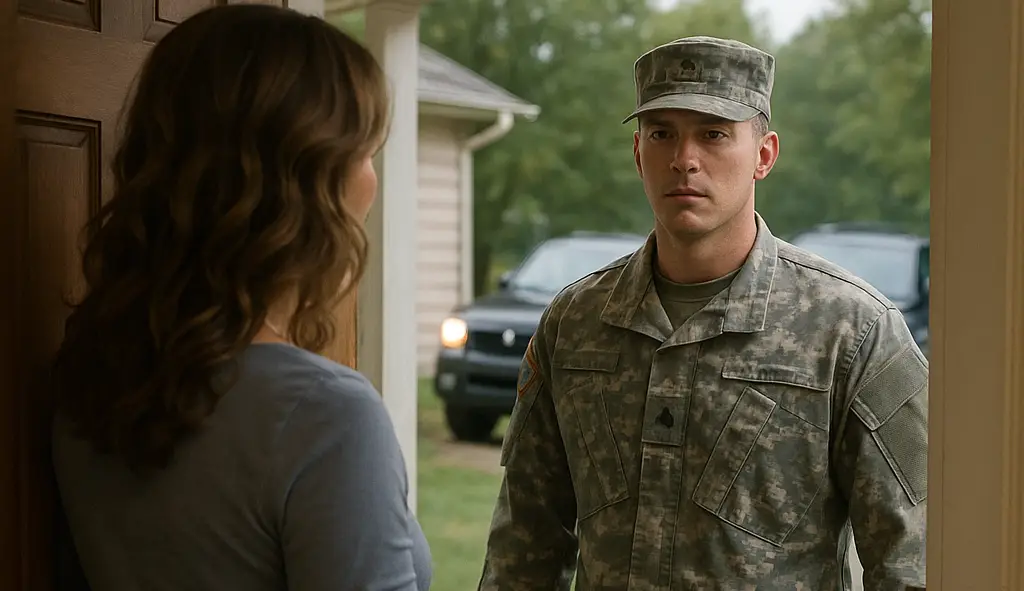
It was him. But this time, he wasn’t alone. And what he carried with him would rewrite everything Grace thought she knew about the debt of kindness and what it truly means to be seen.
Before we dive in, ask yourself: have you ever done something kind and never looked back? What if one day, that kindness came back looking for you? Because for Grace Bennett, it did. And nothing was ever the same again.
The rain had been falling for hours, soaking the narrow backroads outside Maple Hollow in cold, unforgiving silver sheets.
Grace Bennett gripped the steering wheel of her old, teal pickup truck. Her eyes squinted through the blurry windshield, watching the wipers struggle rhythmically to keep up with the deluge.
It was nearly 8:00 p.m. She should have been home hours ago. Mia, her daughter, would be waiting in her pajamas with her favorite stuffed bear and a mug of warm milk, wondering where her mother was.
But the bakery van had broken down again. Grace had stayed late, standing in the freezing rain to help her boss tarp it before the storm turned worse.
She never complained. Not when the heater wheezed and died in the trailer. Not when the lights flickered threateningly during storms. Not even when the bills came in thicker than the paycheck. She didn’t live for «more.»
She lived for «enough.» And that night, «enough» looked like a warm blanket, a truck that started, and a road that led her home.
Until she saw him.
He was a figure walking slowly on the narrow shoulder, head bowed low against the wind, his clothes clinging to his frame like a second, freezing skin. He limped badly, his body leaning heavily toward one side with each agonizing step.
His backpack sagged heavily behind him, dragging him down. Grace’s breath caught in her throat as she passed him. A large part of her—the sensible, tired part—wanted to keep driving.
That voice in her head, the one shaped by years of cautionary tales and warnings, screamed at her not to stop. You don’t pick up strangers in the dark, Grace. Especially not alone.
Especially not now.
But another voice, quieter, older, surfaced from the depths of her memory. It was her father’s voice, spoken decades ago in the same kind of relentless rain: “If nobody else stops, Gracie, maybe it’s because you’re supposed to.”
She eased her foot onto the brake pedal.
The man didn’t look up. Maybe he didn’t expect help anymore. Maybe he thought she was just slowing down to turn or stopping for herself.
But when she lowered her passenger window and leaned over the bench seat, pitching her voice to be heard over the drumming rain, he finally turned.
— Hey, — she called out gently. — You all right out here?
He paused. The hood of his jacket fell back slightly, revealing a face shadowed by deep fatigue and rain. And a scar.
It was long, jagged, running from his temple down his jawline like something burned into him by fire, not by time.
— I’m not looking for trouble, — he said. His voice was low, rough like gravel, but controlled.
— I didn’t say you were, — Grace replied evenly.
They held eye contact for a long moment, stranger and stranger. Two lives caught in the downpour. And then, she reached over and pushed the passenger door open.
— I’m heading past the old base road, — she said. — I can drop you off at the gate.
He hesitated, looking at the warm cab, then slowly nodded.
— Thanks.
As he climbed into the truck, the cab filled with the smell of wet canvas and something metallic. He winced slightly as he sat, favoring his right side. His jacket was torn in places, stained with mud and oil. Grace noticed the old army insignia on his sleeve, half-faded but still visible.
— You in the service? — she asked gently, turning the wheel to get back onto the slick road.
— Was, — he corrected, staring straight ahead. — Just discharged.
She glanced at him sideways.
— Honorable?
A flicker of a sad smile crossed his cracked lips.
— Is there any other kind?
They drove in silence after that. No radio music, no idle chatter about the weather. Just the steady rhythm of rain hitting the metal roof and the gentle, wheezing hum of a heater doing its best to warm them.
She caught more details at each red light. His hair was cropped tight, military style. The scar trailed past his collarbone, disappearing beneath his shirt. He looked young and old all at once.
— You from around here? — she asked, breaking the quiet.
— No, — he said. — Just passing through. Trying to get to Wilton.
— That’s over twenty miles, — she said, surprised.
— On foot, — he shrugged, a small movement. — Didn’t have many options.
She clenched the steering wheel tighter, the physical ache of his words settling deep in her chest.
— What about the V.A.?
He let out a short, humorless laugh.
— They helped me out the door.
Ahead, the rusted sign for the old military turn-off came into view through the rain. She slowed the truck, her eyes scanning the dark, muddy entrance.
— I can let you off here.
But he didn’t move to open the door.
— I don’t have I.D., — he said quietly, almost to himself. — Lost my wallet when I got discharged. They said my docs would come in the mail.
Grace frowned.
— You mean they let you out with no I.D., no transport?
— I didn’t say it was a good system.
She pulled to the side of the road, put the truck in park, and then paused. Her fingers hovered above the steering wheel. The words came before she had time to second-guess them.
— Do you have somewhere to go tonight?
He met her eyes with the same guarded look she’d seen in customers who were counting pennies but didn’t know how to ask for help.
— I’ll find somewhere.
— That’s not what I asked.
Ten minutes later, he was sitting at her kitchen table, dripping rainwater onto a folded towel she had placed on the floor. She handed him a mug of steaming tea and showed him where the coffee canister would be in the morning.