


The desert night was restless, alive with a tension that felt heavy enough to crush a man’s chest. Inside the perimeter of the forward operating base, the air hung thick and stagnant, carrying the acrid perfume of settling dust, burnt diesel fumes, and the sharp, metallic tang of gun oil. The base itself wasn’t much to look at—just a haphazard scattering of concrete bunkers and hastily erected sandbag walls surrounding a runway that was barely long enough for a supply plane to touch down without running into the sand.
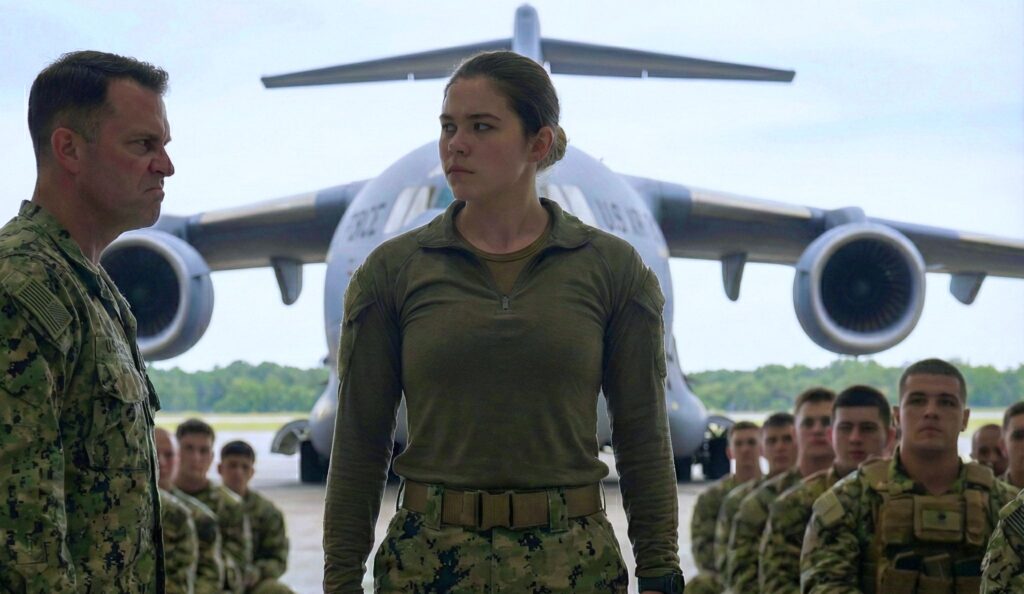
But tonight, this desolate patch of ground had become the only sanctuary for a Navy SEAL team that was bleeding, utterly exhausted, and dangerously close to being wiped off the map. They had returned from a mission that had spiraled violently out of control. What was planned as a surgical extraction had devolved into a chaotic nightmare.
They had fought their way through a gauntlet of ambushes, improvised explosive devices, and a relentless enemy pursuit that seemed to anticipate their every move. By the time the survivors staggered back through the heavy gates of the base, they were running on fumes. They were down to their last magazines, their uniforms torn and stained. Some men carried wounded teammates, their boots dragging in the gravel, while others were simply too drained to speak. Their eyes, wide and hollow in faces smeared with camouflage paint and grime, told the entire story: the fight was far from over.
The enemy was regrouping out there in the dark, and everyone knew it was only a matter of time before the hammer fell on the base itself. Deep inside the dimly lit command bunker, the atmosphere was suffocating. The SEAL captain stood hunched over a folding table cluttered with tactical maps and squawking radio equipment. His face was a mask of hard lines, worn down by years of combat, but the deep creases around his eyes revealed something more than just age; they betrayed the crushing weight of command, the heavy burden of knowing that every decision he made tonight was tied directly to the pulse of his men.
Around him, his operators shifted uneasily in the shadows. They checked their weapons with jittery hands, exchanged hushed whispers, and tried to mask the bone-deep fatigue that threatened to pull them under. The captain knew exactly what they were thinking because he was thinking it too: they could not hold out much longer without air support. On the ground, a SEAL platoon could fight, maneuver, and improvise against almost anything, but when the numbers were this lopsided, when the enemy had heavy vehicles, mortars, and wave after wave of fighters, courage alone wasn’t enough. They needed the sky on their side.
He straightened his back, wincing slightly, his voice cutting through the heavy silence of the room.
— Any combat pilots here?
It wasn’t a question he expected to yield a result. This was a forward operating post for special operations, not an air wing base with a roster of aviators. His men were trained for underwater demolition, direct action raids, and silent insertions, not for piloting aircraft. But desperation forced the words out of his mouth. The room rippled with restless movement. The operators looked at one another, shaking their heads, some lowering their eyes to the concrete floor, the hopelessness of the situation settling in like a cold fog.
Nobody spoke. The silence that followed was answer enough, heavy and final. Then, from the far end of the room, the sound of a metal chair scraping lightly against the concrete floor shattered the quiet.
Heads turned, and eyes fell on someone few of the SEALs had paid much attention to during their time at the outpost. She was young, perhaps in her mid-thirties, but she carried herself with a profound stillness that demanded attention once the spotlight found her. She wasn’t dressed like them; she wore no combat kit weighed down with ceramic plates and ammunition. Instead, she was in standard fatigues, smudged with dust and streaked with grease from long hours spent repairing the base’s generators and vehicles.
Her sleeves were rolled up to her elbows, revealing forearms stained with oil, and her hair was pulled back tight in a no-nonsense bun. An Air Force patch clung to her shoulder, faded from the sun but unmistakable. Slowly, deliberately, she rose to her feet.
— I can fly, — she said.
The words were calm, unshaken, yet they hit the room with more force than a gunshot. Several of the SEALs frowned, exchanging glances that ranged from confusion to open doubt. It wasn’t hostility, exactly. They had seen enough combat to know better than to judge a book by its cover, but skepticism was a survival instinct in their world. Trust wasn’t given lightly to strangers, and a statement as bold as hers demanded proof.
The captain’s gaze fixed on her, intense and probing. He didn’t speak at first, just studied her expression—the way her eyes didn’t flicker under the pressure, the way she stood perfectly straight despite the weight of every stare in the room pressing down on her. She didn’t waver.
— What do you fly? — he finally asked, his voice low, testing the waters.
— A-10 Thunderbolt, — she replied without a nanosecond of hesitation.
The reaction was immediate. Some of the SEALs muttered under their breath. Others looked at her with something approaching surprise. The A-10 was no ordinary aircraft. It wasn’t a sleek, supersonic jet designed for dogfights. It was the «Warthog,» a flying tank built for one specific purpose: to protect troops in the mud. Its cannon, the monstrous GAU-8 Avenger, could shred enemy armor and infantry alike in seconds. Ground operators swore by it. When the Warthog was overhead, you lived.
The captain’s expression shifted almost imperceptibly. He wasn’t a man given to showing emotion, but the faint narrowing of his eyes suggested that, for the first time in hours, he saw a sliver of possibility in the darkness.
— You’re telling me you can get one of those in the air? Here? — he pressed.
She nodded once, a sharp, confident movement.
— There’s one on the strip. Grounded, but intact. I can bring it up.
The room went quiet again, but this time the silence wasn’t born of disbelief. It was calculation. The SEALs glanced at their captain, waiting for him to weigh the risk. If she was telling the truth, she might be the only chance they had to survive the night. If she was wrong, or unprepared, or simply delusional, then sending her up meant losing precious time and lives they couldn’t afford to waste.
One of the younger SEALs leaned against the peeling paint of the wall, muttering just loud enough to be heard.
— She’s not even flight-suited. What’s she gonna do? Duct-tape that bird together and hope?
But his voice carried less bite than he intended. Doubt was normal in a situation this dire. Hope, on the other hand, was dangerous.
The captain raised a hand to silence the murmurs. His gaze never left the pilot’s face.
— You realize what you’re saying, — he said, his tone hovering somewhere between a challenge and a dire warning. — If you’re wrong, if you’re not what you claim, men die tonight.
She didn’t flinch.
— I know what’s at stake.
Her voice carried no arrogance, no defensiveness, just a chilling certainty. Something shifted in the air then. The men in the room might not have known her history, but they recognized that tone. It was the same tone their captain used when he gave an order no one dared question, the same tone seasoned operators carried when they volunteered for impossible missions. It was the voice of someone who understood consequences and accepted them fully.
For the first time, a flicker of respect passed between them. The captain exhaled, long and slow, and gave a curt nod.
— Show me.
The room broke into movement at once. Radios crackled to life, boots scraped against concrete, and men rushed to prepare for whatever came next. The SEALs weren’t a unit that dealt in hesitation; once a decision was made, they moved with lethal efficiency. Still, the energy was different now. Beneath the skepticism and the bone-crushing fatigue, something else stirred: the possibility of survival.
She followed the captain out into the night air, the desert wind pulling at her loose sleeves. The runway lay ahead, faintly lit under scattered halogen lamps, a dark silhouette of an aircraft hulking at its edge. The A-10 waited like a beast in slumber, its gray paint chipped and scoured by sandstorms, its frame battered, but its presence was undeniable. For a moment, the pilot slowed her steps, letting her hand brush across the rough metal of a nearby Humvee. It had been years since she’d flown in combat, years since she’d heard the thunder of the Avenger cannon beneath her feet. But the memory was etched into her bones.