


9:22 a.m. Riverside Union Medical Center. The trauma bay was chaos when the Navy SEAL coded on the table. Bullets, twenty of them, had torn through him in a firefight nobody would talk about. The surgeon was stuck off-site. Everyone was screaming, except her. Eva Weston, a quiet trauma nurse with steady hands and a past no one here knew, stepped into the vacancy the moment the monitors flatlined. Her movements were too sharp, too confident, too military. In minutes, she pulled him back from the edge.
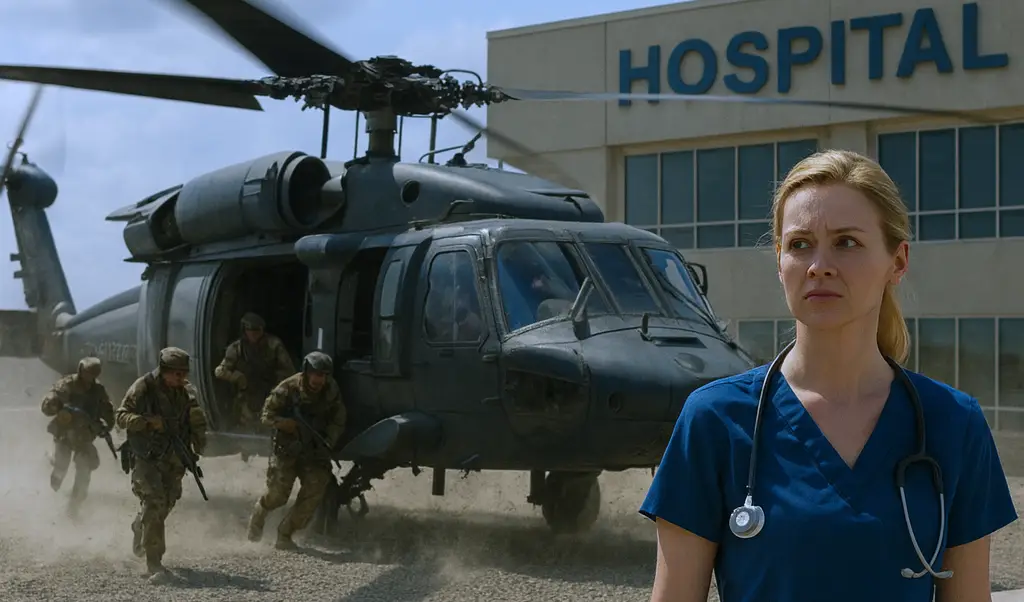
But the moment the SEAL opened his eyes, everything changed. His lips trembled, his pupils focused, and he whispered, «Eva? You? How are you still alive?»
The room froze. The director’s face went pale, and Eva’s heart stopped cold. Because that wasn’t a patient recognizing a nurse. That was a soldier identifying a ghost.
She was fired on the spot. Protocol violation. Unauthorized procedure. Badge stripped.
But eleven minutes later, the hospital windows began to shake. People ran to the roof. A Navy helicopter was landing hard, soldiers jumping out before the rotors even slowed.
Not for the wounded SEAL. Not for the hospital. They came for Eva Weston.
The entire hospital froze. The director turned pale. Because only now did they realize they didn’t fire a nurse. They fired the only combat medic in the building.
Before we begin, take one second to comment, I’m watching, and hit subscribe. It tells the algorithm you want more stories about the heroes nobody sees coming.
9:22 a.m., Riverside Union Medical Center. The trauma bay smelled of blood, burned fabric, and adrenaline. Nurses shouted vitals. Carts slammed into walls, and the monitor, beating with alarms, blinked red with ruthless consistency.
A Navy SEAL lay on the table, chest rising in weak, uneven jerks. Twenty bullet wounds, some stitched in the field, some still oozing. A body that had survived hell and was now losing the last fight inside a civilian hospital.
«Where’s the surgeon?» someone yelled.
«Ten minutes out!»
«We don’t have ten minutes!»
Another wave of panic, but one person didn’t move. Eva Weston stood at the foot of the table, her gloves trembling only slightly as she scanned the damage. A quiet trauma nurse, always efficient, always composed, never dramatic.
But her eyes, they weren’t civilian eyes. They were calculating damage patterns, entry angles, exit wounds. Eyes that had seen this exact type of carnage before, in a place she never talked about.
And when the monitor flatlined, she didn’t flinch. She stepped forward.
«Get me a thoracostomy tray, suction, and pressure packs. Now.»
The other nurses paused, confused. Eva’s voice wasn’t timid or hesitant. It was commanding, too commanding.
«Eva, wait,» someone tried.
But she was already cutting through the last field dressing, already sliding her hand beneath the SEAL’s ribs, already performing the kind of emergency extraction that only combat medics learned under fire. The staff watched in stunned silence as she worked like a machine: quick, precise, fearless.
She improvised clamps out of tubing, sealed a lung with battlefield efficiency, and stabilized a failing artery with a maneuver none of them recognized. For a moment, the chaos faded. For a moment, everyone forgot who she was.
A quiet nurse with a clean but unremarkable resume. For a moment, she was exactly what she used to be: a SEAL Team Six combat medic. And then a sudden gasp erupted from the patient.
His eyelids fluttered, his pupils sharpened, and he whispered, voice cracked and horrified, «Eva? You? How are you still alive?»
Every sound in the trauma bay died. The nurse beside her froze mid-step. The tech holding the suction tube let it rattle to the floor. Even the ventilation hummed quieter, like the building itself was listening.
The director, who had walked in moments earlier, went pale. He stared at Eva like she had just risen from the dead. Because to this SEAL, she did.
«Eva Weston!» the director snapped suddenly, grasping for authority. «Step away from the table right now.»
She obeyed slowly, her heartbeat thundering in her ears.
«You performed an unauthorized surgical procedure,» he continued, voice shaking, «in the absence of a licensed surgeon. You are relieved of duty, effective immediately.»
A security guard stepped toward her. She barely reacted when the director ripped the badge from her scrubs.
«Nurse Weston, you’re fired.»
Gasps, whispers. Someone muttered, «She moved like a soldier.»
Another said, «Where did she learn that?»
The director wasn’t finished. «You will leave the premises immediately. Before I call the police for impersonating medical authority.»
Eva stared at him, numb. He had no idea who he was threatening. But she didn’t argue. She just nodded, picked up her small bag, and walked toward the staff exit.
The moment she disappeared behind the double doors, the entire hospital seemed to exhale in confusion. Eleven minutes later, the windows began to vibrate. Softly at first, barely noticeable, then harder.
Clipboard stands rattled. IV poles trembled. Ceiling panels quivered in their brackets.
«What the hell?» a resident whispered.
Someone ran to the nearest window. «Oh my God, is that a helicopter?»
Nurses rushed to the stairwell. Doctors jogged behind them. Security tried to push through the crowd.
On the rooftop, a massive Navy helicopter descended fast, kicking dust, loose papers, and rooftop gravel into a violent spiral. The rotors thundered against the concrete, sending shockwaves through the entire building. Before the blades even slowed, armed personnel jumped out.
Not medics. Not investigators. Special Operations. They moved with purpose, scanning every doorway, securing exits, forming a perimeter.
Then the Admiral stepped off. Marcus Reddington, a living legend in the Navy. A man whose presence silenced entire rooms. The director stumbled forward, shaking.
«Sir, if this is about the SEAL, we have him stab—»
The Admiral didn’t even glance at him. «Where’s Eva Weston?» he barked.
The hallway behind the rooftop door froze. Staff stared at each other in horror and dawning realization. The director’s voice broke.
«We just fired her.»
The Admiral’s jaw tightened, not in anger, but in fear. «You what?»
He pushed past the director so hard the man crashed backward against the doorframe.
«You sent her out alone?»
«Sir, she violated protocol.»
«She was a SEAL Team Six medic!» the Admiral snapped. «She saved my son’s life in Afghanistan. And now that the wrong people know she survived? She’s the most hunted person in this city.»
Whispers exploded. Faces drained white. Dozens of staff realized the truth. They didn’t fire a nurse. They fired a ghost.
A soldier. A survivor of a mission the world wasn’t supposed to know existed. The director tried to speak, but no sound came out.
The Admiral turned to his team. «Find her. Now. The hunters will come before we do.»
The soldiers sprinted toward the elevators. The staff watched them disappear. Eva Weston. Alone. Outside. Defenseless.
And the people coming for her had already killed three survivors of that mission. The Admiral clenched his fists.
«They’ll know she was fired,» he whispered. «They’ll think she’s unprotected.»
He looked at the director with cold, furious disbelief. «You just made her the perfect target.»
The entire hospital stood frozen in horror because none of them knew. Eva wasn’t just being hunted. She was being used as bait, and the hunters were already inside the city.
A radio crackled in the Admiral’s hand. «Sir. Rooftop camera shows unknown van pulling up to the south entrance. Four men exiting, armed.»
The Admiral’s face hardened. «It’s too late.»
The south entrance camera flickered, and everyone in the rooftop hallway leaned closer as the grainy image sharpened. A dark van idled beside the emergency ramp, its windows tinted, its plates removed, its engine far too quiet for a civilian vehicle. Four men stepped out, each carrying duffel bags that sagged in a way no gym bag ever would.
The Admiral’s eyes hardened. «Gear up. They’re here for her.»
Inside the hospital, tension snapped like a wire stretched too thin. Security radios erupted with overlapping warnings. Nurses clustered around the nurse’s station, whispering frantic questions.
The director stood rigid, unable to decide whether to hide or deny everything. And in all of that noise, one truth pulsed beneath every heartbeat. Eva was out there, alone, thinking she’d been fired.
But she wasn’t alone. Not really. She just didn’t know the trap had already begun.
Eva walked down the quiet back corridor behind the ambulance bay, the cold October wind cutting across her exposed neck. Her hands trembled as she tucked her badge—well, her former badge—into her pocket. Her body still vibrated with adrenaline from the SEAL’s whisper, from the director screaming, from the humiliated walk out of the hospital she’d once called home.
She didn’t hear the van’s engine. She didn’t see the men watching her. But she felt something. A weight, a shift, a familiar disturbance, like the desert wind before mortar fire.
She paused. The parking lot looked normal. Orderly. Silent. Too silent.
Then her gaze drifted toward the rooftop, where dust spiraled into the sky, pushed by a helicopter she hadn’t realized had landed. A Navy helicopter. Her breath hitched.
No. It couldn’t be for her. Why would it be? She blinked, and a silhouette appeared at the rooftop edge, scanning the parking lot through binoculars.
Someone was looking for her. Her heart kicked, but before she could process it, a shadow slipped in behind her reflection in the glass door. A man.
Tall. Wearing hospital scrubs, but wrong. His stance wrong. His shoes wrong. His posture too alert.
He followed the rhythm of someone who had held weapons all his life. Eva didn’t turn around. She didn’t breathe. She simply whispered to herself, «You’re not alone. Think.»
And then movement flashed behind her. She stepped aside just as the man swung. His gloved hand grazed her shoulder instead of landing the chokehold he intended.
Eva bolted. Her footsteps hammered the pavement, heart battering against her ribs as she sprinted toward the loading bay. Shouts erupted behind her, three more men emerging from the van.
Their strides were too synchronized to be anything but trained. They split into two groups, attempting to corner her between the dumpsters and the ambulance dock. She didn’t run blindly.