


«Why so many tattoos, old man? Did you run out of paper, or did you just lose a lot of bets in port?» The question hung in the air of the briefing room like the smell of ozone before a lightning strike. It came from the back row, delivered with a smirk by Ensign Miller, a 23-year-old specimen of physical perfection who had just graduated top of his BUD/S class. He was sitting with his arms crossed, biceps bulging against his crisp uniform, surrounded by twenty other fresh-faced SEAL candidates who looked like they could chew through steel cable.
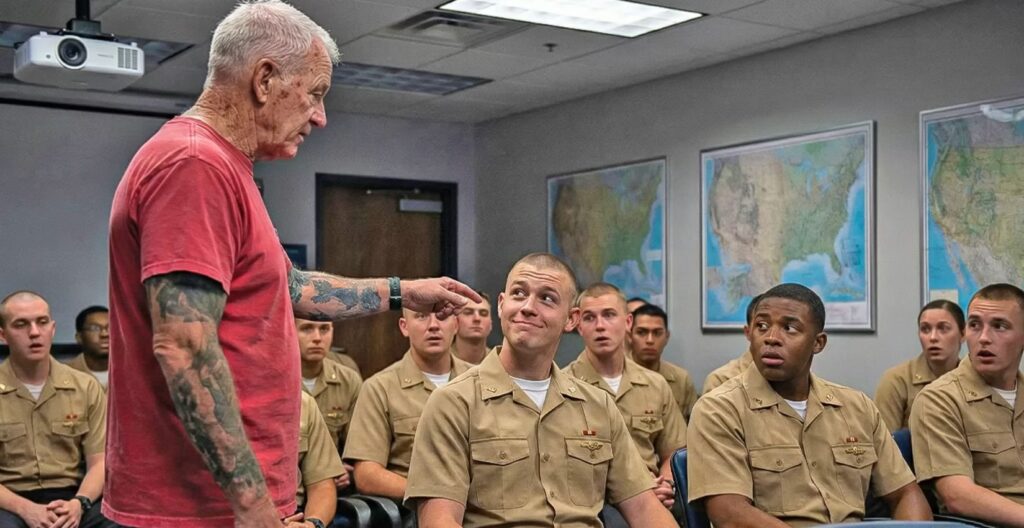
At the front of the room stood the man he was addressing, a 60-year-old guest instructor named Elias. Elias didn’t look like a warrior; he looked like a drifter. His hair was thinning and gray, and his face was a roadmap of deep, weathered lines. He wore a simple black T-shirt that exposed arms covered in faded, dark, chaotic ink.
To Miller, this guy looked like a relic, a biker who had wandered onto the base by mistake. But Miller was about to learn that there are predators in the deep ocean that don’t need to look pretty to kill. If you believe that wisdom is earned through blood, and that we should respect the warriors who paved the way, stop what you’re doing, hit the like button, and type «respect» in the comments right now.
Let’s see who understands the true cost of freedom. The briefing room at the Naval Special Warfare Center in Coronado was usually a place of high-tech strategy and cutting-edge warfare. The air conditioning hummed a low, constant note, keeping the temperature at a crisp 68 degrees to counteract the San Diego heat outside.
The walls were lined with digital maps, satellite imagery, and the ethos of the teams: The only easy day was yesterday. The men sitting in the tiered seats were the new breed. They were faster, stronger, and smarter than any generation before them. They had trained with drones, advanced ballistics, and digital comms; they felt invincible.
Then Elias had walked in. He carried no laptop, no PowerPoint clicker, no stack of manuals. He carried a paper cup of coffee and a battered notebook that looked like it had been soaked in salt water and dried in the sun a dozen times.
He walked with a slight limp, a hitch in his left side that he didn’t try to hide. He placed his coffee on the podium and stood there, silently scanning the room for a full minute. His eyes were the color of slate, flat and unreadable.
That was when Miller had spoken up. The recruits were restless. They had expected a Tier One operator, someone straight from the sandbox with a beard and a loadout of stories about taking down high-value targets with suppressed carbines. Instead, they got a guy who looked like he fixed HVAC units in the 1980s.
Miller’s question was meant to break the tension. It was a little alpha dog flex to show the room he wasn’t intimidated by the silence. A few of the other guys chuckled, a low rumble of agreement.
The ink on Elias’s arms was ugly. It wasn’t the artistic sleeves you see today. It was dark, blotchy, and looked painful. There were jagged lines, coordinates, and crude symbols that blurred into one another.
Elias didn’t flinch at the insult. He didn’t even look angry. He slowly took a sip of his coffee, set it down, and looked directly at Miller. The silence that followed stretched out, becoming uncomfortable, and the chuckles died away.
«You like the artwork, son?» Elias asked. His voice was soft, sounding like tires rolling over gravel.
Miller shrugged, leaning back in his chair, confident in his status as the new elite. «Just curious. Usually, we keep it professional. That looks chaotic, like a scrapbook with no order.»
Elias nodded slowly. He stepped away from the podium. He walked down the center aisle, moving closer to the recruits.
As he got closer, the men could see the texture of his skin. It wasn’t just ink. Beneath the tattoos were ridges, scars, and burn marks that the ink had been used to color over.
«Chaotic,» Elias repeated. «That’s a good word for it. War is chaos. You boys train for the grid. You train for the plan, but the plan is the first casualty of contact.»
He stopped right in front of Miller’s desk. Miller sat up a little straighter, his arrogance flickering for a split second as he realized the old man’s eyes were devoid of fear. They were the eyes of a shark, dead calm and utterly focused.
«You asked why so many,» Elias said. He rolled his left shoulder forward, pointing to a faded, jagged black line that wrapped around his forearm like a snake. «You see this one? It looks like a mistake, a bad line drawn by a drunk artist.»
Miller looked at it. «Yeah, what is it? A river?»
«It’s a timeline,» Elias said. «1989, Operation Just Cause, Panama. We were tasked with securing Paitila Airfield. The intel was wrong.»
«We weren’t walking into a lightly guarded strip. We were walking into a meat grinder. We were pinned down on the tarmac, no cover, taking heavy machine gun fire from three sides. My swim buddy, a kid named Joey, took a round to the femoral artery in the first thirty seconds.»
The room went quiet. The air conditioning seemed to get louder.
«I dragged him behind the landing gear of a private jet,» Elias continued, his voice devoid of drama, just stating facts. «I put a tourniquet on him, but the fire was too heavy. We were trapped for four hours.»
«This tattoo? I did it myself with a needle and India ink three days later. It traces the path of the blood that ran across the tarmac. It reminds me that plans fail, and when they do, you don’t panic. You hold the line.»
Miller swallowed. He didn’t say anything.
Elias rolled up his other sleeve. He pointed to a cluster of three stars on his right bicep. They were uneven, the points dull.
«How about these? You think these are for style? Maybe I wanted to look like a general.» No one laughed.
«1993, Mogadishu,» Elias said. The word hit the room like a physical weight. Every SEAL knew the entire history, but reading about it in a book and standing in front of a ghost who was there were two different things.
«We weren’t supposed to be the main effort. We were support. But when the birds went down, everything shifted. We moved through the city on foot. It was a 360-degree ambush.»
«We ran out of water. We ran out of ammo. We almost ran out of blood.» He tapped the stars.
«Three men in my squad didn’t make it back to the hangar. I put these here to cover the shrapnel scars I took in my arm pulling a Ranger out of a burning Humvee. Every time I lift something heavy, the scar tissue pulls.»
«It hurts, and I’m glad it hurts. Because the pain reminds me that I’m still here, and they aren’t.» Elias took a step back, addressing the whole room now.
The recruits were leaning forward, their eyes wide. The arrogance was gone, replaced by a dawning realization of who they were sitting in the presence of.