


There are moments in life that change us forever, moments that divide everything into before and after. For me, that moment happened in the cold hallway of a hospital in New York, under flickering fluorescent lights, while nurses hurried past without even glancing at me. That night, I realized that the most painful words aren’t shouted in anger; they’re the quiet ones, whispered with indifference in front of strangers pretending not to listen.
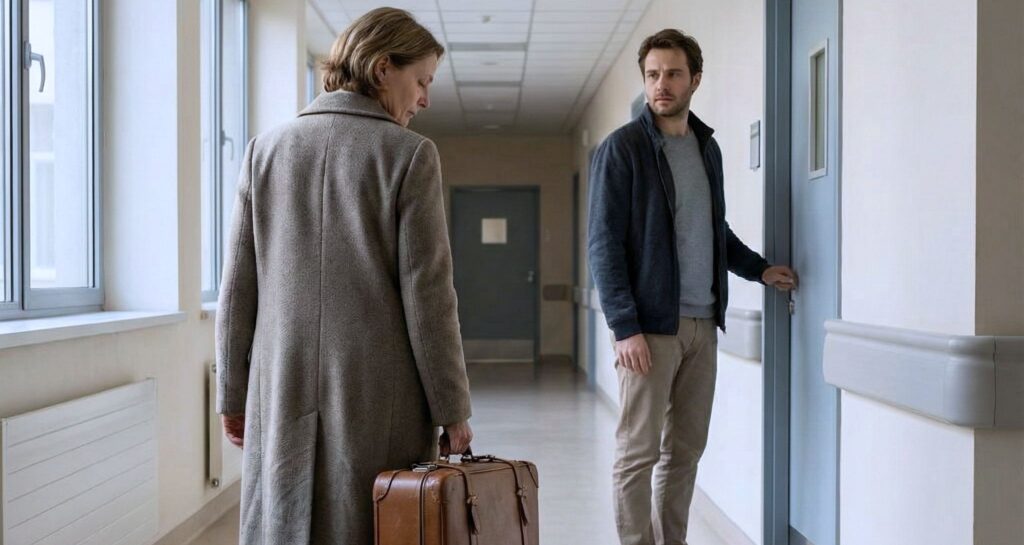
«Mom, Valerie just wants her immediate family here.»
My son’s voice sounded distant, even though he stood only a few steps away. I searched for his eyes, the same eyes I saw open 32 years ago, the eyes that once shone with love when he was little. Now, those eyes avoided mine, filled with shame. As if I were something to be hidden.
And just when I hoped to find a trace of regret, a flicker of the boy who once adored his mother, Daniel, my son, finished the sentence that broke my heart.
«Please don’t push, Mom. She’s never liked you.»
The world went silent. The hospital noises faded, and footsteps became distant echoes. I stood frozen, feeling something inside me shatter. I had just spent 12 hours on a long-distance bus, sitting on a hard seat that smelled of oil and old food.
I had spent 12 hours staring through a fogged window, watching towns, mountains, and endless roads pass by, imagining the moment I’d finally meet my grandson. I had planned every detail of that meeting. I pictured holding the baby for the first time, his tiny warmth, the soft scent of his hair, the smooth skin against my cheek.
I imagined Daniel’s proud smile as he introduced his son to me. I imagined his wife, Valerie, tired but happy, allowing me to help. I had imagined everything except this.
Never did I think my son would look at me like a stranger, like a problem to be managed, like a burden to be removed. The sound of my grandson’s first cry came from behind a closed door. I stood outside, a silent outsider, forbidden to step in.
I remembered all the nights Daniel cried as a baby, and how I carried him in my arms till dawn, pacing barefoot across the cold floor, humming songs I made up, promising him everything would be okay. His father slept soundly, and I held that child until his cries turned into steady breaths.
I remembered the fevers, the rushed trips to the hospital, the quiet fears only a mother understands. And now, that same child I once protected told me I wasn’t welcome in one of the most important moments of his life.
My name is Amy Carter. I’m 61 years old. I was born in Nashville, in a small house with a wide yard and an old apple tree. I grew up helping my mother cook, learning to bake apple pies, listening to her lessons about life and love.
I married at 22, a kind, hardworking man named Robert. He wasn’t talkative, but he had the warmest heart. We had Daniel when I was 29, and from that moment on, my life revolved around him.
When my husband died suddenly of a heart attack, Daniel was 15. Robert left quietly, like a door closing without a sound. From then on, it was just the two of us, me and my son, trying to survive.
I sold our small shop and took any job I could find. At night, I cleaned dental offices, my hands reeking of disinfectant. In the afternoons, I worked as a receptionist, returning home with aching feet and a sore back. But I always smiled at Daniel because he was my reason for everything.
And now, that same son looked at me with eyes full of distance. I stayed silent. Not because I had nothing to say, but because there were too many things that didn’t need to be said.
I wanted to scream that I’d traveled 12 hours for him. I wanted to remind him of every sacrifice I had made. I wanted to ask when he had turned into this cold stranger. But I didn’t.
Because my mother once told me, «Sometimes silence is dignity.»
I nodded, swallowed the burning tears behind my eyes, and refused to let them fall. I wouldn’t let anyone see me break. I picked up my old dark brown leather purse, the one my mother gave me when I turned 30.
She said, «Carry this with you during the important moments of your life.»
And she was right. That purse had been with me when Daniel was born, when he graduated, when he moved to New York to start his career, and now again, witnessing my humiliation. I turned away without saying goodbye, without congratulations.
I simply walked down the long corridor of St. Mary’s Hospital. The lights flickered above me. The air smelled of antiseptic. I passed crying babies, families laughing, new grandparents taking photos.
I saw mothers and grandmothers holding newborns, tears of joy shining in their eyes. And I kept walking. When I stepped outside, the February wind hit my face.
I stood on the sidewalk watching cars go by, people coming and going from the hospital, life continuing as mine seemed to collapse. I didn’t know where to go. The bus home wouldn’t leave until the next day.
I hailed a cab to a cheap hotel I found nearby, a small room with thin walls and a squeaky bed. Laughter and television echoed from the hallway. I sat at the edge of the bed and finally let the tears fall.
I cried harder than I had since the day Robert died. I cried for every broken expectation, for the grandson I hadn’t met, for the son who once said, «I love you, Mom.» I cried for the teenager who wept in my arms the night his father passed, and for the man who had promised to always be there for me.
Where was my son now? When did he become this stranger? That night, I couldn’t sleep. I stared at the ceiling, listening to the hum of the city outside, thinking about everything I had lost.
In the morning, I took a long, hot shower, trying to wash away the grief. I wore the navy blue dress I’d brought for the occasion and put on light makeup, even though no one would see me, because I didn’t want to look defeated. I went down for breakfast, wheat coffee and a stale pastry, but I couldn’t eat.
I spent the whole day wandering around the city, walking past shop windows, sitting on park benches, watching families stroll by. I watched mothers holding hands with their children, grandmothers laughing with grandkids, while I felt completely hollow.
By evening, I went to the bus station and sat waiting. Everyone there had someone picking them up. I had only an empty house waiting for me in Nashville. The bus pulled away. Twelve more hours.
But I didn’t stare out the window, dreaming of joy. I only saw my own reflection: a tired, sixty-one-year-old woman, worn down and alone. I wondered if Daniel even realized I was gone. Did he feel regret? Did he think, «I should have treated my mother better»?
Deep down, I knew the answer: probably not. He was likely happy with his new family, while I had become an uncomfortable memory.
When I arrived home, dawn was breaking. Everything was exactly as I’d left it: the unwashed coffee cup, yesterday’s newspaper, and silence. Once, that silence meant peace. Now it meant loneliness.
I set my suitcase down, hung the leather purse on the hook, made a cup of coffee, and sat at the kitchen table where Daniel once did his homework while I cooked dinner. Now, it was just me. The house felt heavier than ever.
But the silence pushed me back into the memories of how everything began. Sometimes we trust the wrong people, and the price is a broken heart. Have you ever been disappointed by someone you love? Tell me your story.
There are memories we keep like perfect photographs, frozen moments from a time when life was simpler, when love hadn’t yet hurt us, when motherhood felt natural and pure. Daniel was born on a July morning 32 years ago. That night, it stormed so hard that thunder shook the windows.
I lay in bed, clutching my stomach as the contractions came faster. Robert rushed around the room, fumbling for the car keys and hospital bag, trying to stay calm even as his hands trembled.
I kept breathing and said, «Calm down, Robert, we still have time.»
But we didn’t. The contractions grew stronger, closer together. My body knew it was time, even if my mind wasn’t ready. Robert helped me down the stairs. The rain drenched us within seconds.
He drove faster than ever, eyes locked on the road, hands gripping the wheel, wipers working at full speed through the downpour.
«Hang in there, honey, we’re almost there.»
I sat in the back seat, breathing steadily as I’d learned in class, counting between the waves of pain. Through the rain-covered window, the city blurred, and all I could think was, soon I’ll meet my child.
We reached the central hospital at dawn. The nurses greeted us with kindness and professionalism. They helped me change, attached monitors, and checked the baby’s progress.