


On a tranquil Sunday morning in the quiet town of Elm Grove, the world seemed to move at a leisurely pace, yet the atmosphere inside the local diner was about to shift irrevocably. An eighty-two-year-old African American veteran of the Navy SEALs made his way into the crowded establishment, carrying nothing more than a plastic tray holding cold eggs and the weight of decades of memories.
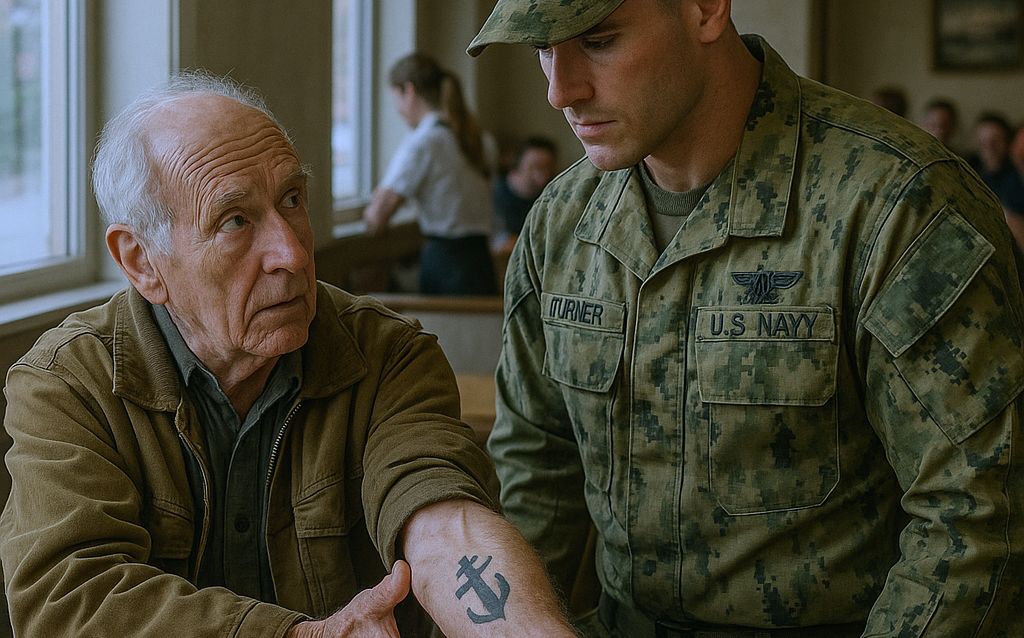
On his wrist, a faded tattoo told a story no one cared to read, and his presence alone was enough to have him dismissed, judged, and ultimately asked to leave for the crime of making the other guests uncomfortable. He said nothing in his defense, simply nodding with the grace of a man who had seen worse, but then a young, active-duty Navy SEAL stepped into the room, saw the ink on the old man’s skin, and stood at a rigid, trembling salute.
The bustle of the diner died instantly, replaced by a heavy silence as forgotten memories and realized shame flooded the room, ensuring that the old man would never be invisible again. Before we delve into the heart of this story, we invite you to share where you are joining us from today. We would love to hear your thoughts and read your comments below.
It was precisely ten o’clock on a crisp Sunday morning when Franklin Doyle pushed open the heavy glass door of the Green Fork Diner in Elm Grove, Oregon. The establishment was alive with a chaotic symphony of noise, featuring the clinking of heavy ceramic dishes, chairs scraping harshly against the tile floor, and a low, steady hum of conversation that sat beneath the twang of a country ballad drifting from an old speaker near the kitchen. Veterans Day specials had attracted a full house, and the windows were plastered with patriotic posters and «Thank You for Your Service» signs, yet Franklin knew from long, hard experience that such gratitude often evaporated the moment you walked in alone and didn’t look the part.
He paused just beyond the threshold, taking a moment to adjust his grip on the plastic serving tray. One of his hands balanced his modest breakfast, consisting of scrambled eggs, dry toast, and a paper cup of water, while his other hand tightly gripped the handle of his cane. His gait was uneven and painfully slow, a rhythm dictated by a body that had endured too much.
His left leg was a prosthetic, stiff with age and worn down just like every other part of him, but it held him up all the same. Franklin was eighty-two years old, and while gravity and time had slumped his shoulders forward, his frame still possessed a trace of the quiet, dangerous strength he had once commanded.
He was dressed in a brown canvas jacket that had seen better decades, zipped only halfway up, featuring a faded, unreadable patch near the chest pocket. His face was lean and sharp-boned, a map of wrinkles framed by thin white hair that he had combed back with meticulous neatness. However, the detail that stood out the most, had anyone bothered to look closely enough, was the tattoo etched onto the inside of his wrist: a black dagger driven through a heavy anchor.
Few people in the diner noticed him, except for a boisterous group of men dominating the center table. There were four of them, all appearing to be in their fifties, laughing loudly over platters of pancakes and grease-slicked sausages. One of the men wore a bright t-shirt that proclaimed «Proud to be an American» across the chest, though he had clearly never spent a day in a uniform.
— Check that out, — one of them said, jerking his chin toward Franklin with a smirk. — Bet that guy just came in here for the free food handouts.
Another man at the table leaned in, lowering his voice conspiratorially but not enough to be unheard.
— That tattoo looks like something he scratched on himself in the sixties, — he scoffed. — Probably never even served a day in his life.
Franklin caught every syllable. His hearing had faded significantly in his left ear over the years, but insults had a way of finding a path through the silence. He did not flinch, nor did he turn to glare at them.
He simply continued his slow trek toward a small, empty table near the back wall, the one furthest from the social center of the room where no one would be forced to look at him. He lowered his aching body into the wooden chair and set the tray down with deliberate care. His hands shook slightly, a tremor born not from fear of the men, but from the stubborn, uncontrollable vibration that accompanied his advanced age.
He managed to take only a single bite of the lukewarm eggs before a soft, hesitant voice interrupted his meal.
— Excuse me, sir.
A young waitress was standing beside his table, looking visibly nervous; she appeared to be in her early twenties, and her plastic name tag read «Rachel.» She shifted her weight uncomfortably from one foot to the other, her eyes darting around the room to avoid meeting his gaze directly.
— I am really, really sorry, — she stammered, her voice thin. — But someone complained that you might be making the other guests uncomfortable. The manager asked if you wouldn’t mind moving your meal to the outdoor patio area.
Franklin looked up at her, his expression unreadable. He wasn’t angry, just deeply, soul-weary tired. His eyes held no spark of fight, only a profound resignation to the way the world worked. He nodded once, uttered not a single word of protest, and reached out to pick up his tray again.
The metal fork clattered softly against the ceramic plate as he stood up, a lonely sound in the sudden quiet of his immediate vicinity. He steadied his balance with the cane and turned his body toward the side door. As he shuffled past the center table, one of the loud men leaned back in his chair, seemingly emboldened by the old man’s retreat.
— If he’s really a Navy SEAL, then I’m a four-star general, — the man announced loudly.
The entire table erupted in laughter. Franklin did not stop walking, nor did he speak; his mouth remained firmly shut, though the muscles in his jaw tightened visibly. He blinked once, a slow, heavy motion, and a single tear gathered beneath his lashes before dropping, unnoticed by the crowd, onto the cold tile floor.
A small boy standing in line with his father tugged on his dad’s sleeve and pointed.
— Daddy, why does that man walk so funny? — the child asked innocently.
His father lowered his voice, steering the boy’s attention away.
— Just a homeless guy, bud, — the father whispered. — Don’t worry about it.
Behind the counter, the manager stood watching the scene unfold with a passive expression. He hesitated for a fraction of a second, appearing to wrestle with a thought, before he turned away and pretended to be engrossed in reading a receipt.
Outside, the concrete patio was nearly deserted. The autumn air was crisp and biting, though not freezing, and sunlight spilled across the grey pavement in bright, indifferent pools.
Franklin located a small metal table near the edge of the patio, situated next to a low fence of manicured hedges. The chair legs scraped loudly against the concrete as he pulled it out. He sat down with agonizing slowness and let out a long, shuddering breath that seemed to empty his lungs.
The food on his tray was already losing whatever heat it had left, the eggs turning a pale, unappetizing yellow. He gazed through the plate-glass window at the people inside the diner, watching them eat, talk, and laugh in a world he was excluded from.
He was accustomed to this feeling, this profound sense of separation from the civilian world. It was not merely a physical distance. It was something far deeper.
It was an invisible wall that society built when they couldn’t see past a tattered canvas jacket or a distinct limp. Franklin bent his head, took another bite of dry toast, and chewed slowly, the bread tasting like sawdust in his mouth. Today was a specific anniversary, though not of a famous battle or a medal ceremony.
Today was the day James Harrington had made a promise, swearing he would buy Franklin a burger at this very spot when they got back to the States. James never came home, but Franklin did. Every year since that day, he had sat in a restaurant alone, not looking for a discount or a free meal, but honoring that unfulfilled promise.
Franklin stared down at his plate, idly poking at the toast with the tines of his fork. It had gone soggy at the edges where it touched the eggs. He wasn’t truly hungry anymore, but his hands kept moving mechanically, as if completing a mission that simply needed to be done.