


The massive wrought-iron gates of the mansion in Lomas de Chapultepec swung open with a smooth, almost imperceptible hum of expensive machinery, granting access to the pristine driveway. Alejandro Hernandez maneuvered his luxury sedan onto the pavement, the tires crunching softly against the meticulously swept stone. It was barely past seven in the evening, a time when the sky over Mexico City was transitioning from the hazy orange of pollution-tinted dusk to a deep, velvety charcoal.
For Alejandro, arriving home at this hour felt foreign, almost illicit. His internal clock was set to the rhythm of corporate boardrooms and late-night strategy sessions; his body was accustomed to crossing this threshold only after the silence of the night had fully settled, usually well past nine, when the life of the house had already been extinguished by sleep.
Today, however, the universe had shifted on its axis. The high-stakes negotiations with the new consortium of investors, a meeting he had anticipated would drag on into the early hours of the morning, had concluded with surprising efficiency. Hands were shaken, contracts were initialed, and suddenly, Alejandro found himself with something he hadn’t possessed in years: free time. He hadn’t called ahead. He hadn’t sent a text to his wife, Gabriela, nor had he alerted the household staff. A part of him, the part that was exhausted and perhaps a little lonely, simply wanted to slip into his own life unnoticed, to observe it before it had a chance to arrange itself for his benefit.
He killed the engine, letting the silence of the garage wash over him for a moment. He gripped the leather steering wheel, taking a deep breath, trying to transition from the ruthless CEO to the father and husband he was supposed to be. Stepping out of the car, he smoothed the lapels of his suit jacket, grabbed his briefcase, and walked toward the main entrance. The house was an architectural marvel, a testament to his success—soaring ceilings, marble floors, walls adorned with art that cost more than most people earned in a lifetime. Yet, as he inserted his key into the lock, he realized he felt more like a guest entering a hotel than a man returning to his sanctuary.
Alejandro pushed the heavy front door open. He expected the usual stillness, the sterile perfection of a house maintained by invisible hands. What he found instead froze him in the entryway, his hand still resting on the brass handle, his mind struggling to reconcile the scene before him with the reality he thought he knew.
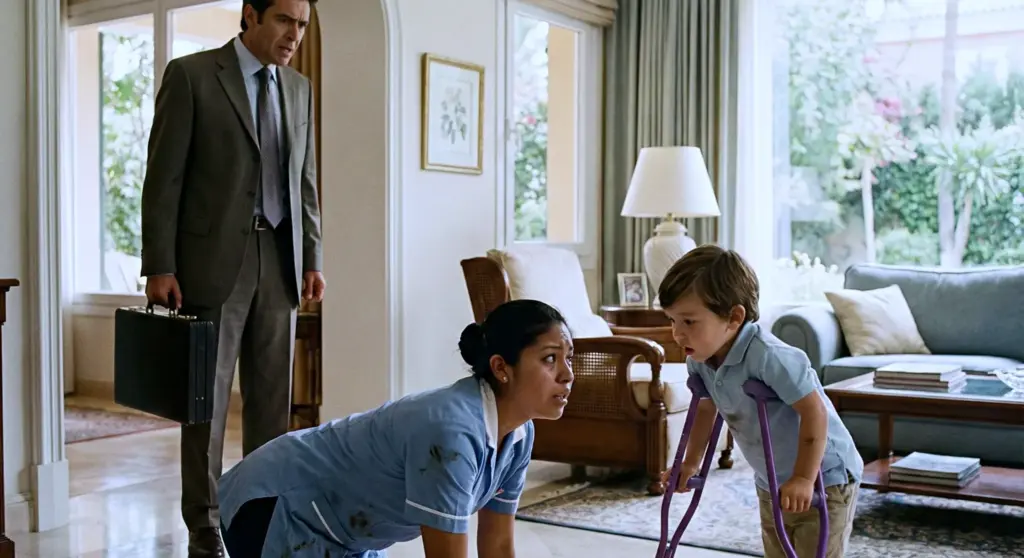
The expansive living room, usually a showroom of untouched designer furniture and cold elegance, was alive with activity. In the center of the room, kneeling on the wet, imported Italian marble, was Lupita. The twenty-eight-year-old housekeeper, usually a peripheral figure in his vision—someone who refilled his coffee or ironed his shirts—was now the focal point of the room. She was on her hands and knees, her posture one of focused labor, scrubbing at a section of the floor with a rhythmic intensity. Her blue uniform was stained at the knees, dark patches of moisture soaking through the fabric, evidence of her hard work.
But it wasn’t Lupita who paralyzed Alejandro. It was the figure beside her.
His son, Mateo.
At four years old, Mateo was small for his age, a fragile bird of a child with blond hair that caught the light of the chandelier. But there he was, standing. He was propped up by his small, purple crutches, the ones Alejandro had bought with a mixture of hope and despair months ago. But Mateo wasn’t just standing; he was working. Clutched in his small hand was a kitchen rag, damp and crumpled. The boy was leaning forward precariously, his face scrunched in concentration, attempting to scrub the floor alongside the housekeeper.
Alejandro felt the air leave his lungs. He watched, unnoticed, from the shadows of the foyer. This was not the Mateo he saw on weekends—the quiet, withdrawn child who sat in his specially designed chair or was carried from room to room. This Mateo was active. He was engaged. He was part of something.
«Aunt Lupita, I can clean this part right here,» the boy said. His voice, usually a soft murmur when Alejandro was around, rang out with a clear, determined timbre. He stretched his little arm out, the movement awkward and jerky due to his motor control issues, but filled with intent. He scrubbed at an invisible spot, his small knuckles white from the grip on the rag.
Lupita stopped her scrubbing. She sat back on her heels, wiping a strand of hair from her forehead with the back of her hand. She looked at the boy not with the professional detachment of an employee, but with a warmth that radiated across the room. It was a look of genuine affection, soft and unguarded.
«Don’t worry, Mateo, you’ve already helped me so much today,» Lupita responded. Her voice was a revelation to Alejandro. He had only ever heard her speak in hushed tones—»Yes, sir,» «No, sir,» «Dinner is served, sir.» Now, her voice was melodic, playful, filled with a gentle cadence that seemed to wrap around the boy like a blanket. «How about you sit on the sofa while I finish? You’ve done enough work for a grown man today.»
Mateo shook his head vigorously, his blond curls bouncing. «But I want to help,» he insisted, a stubborn pout forming on his lips.
«You need to rest your legs, warrior,» she said softly.
«You always say we’re a team,» the boy countered, shifting his weight. He wobbled slightly, and Alejandro’s instinct was to rush forward, to catch him, but he held himself back. He needed to see this. He needed to understand what he was witnessing. Mateo adjusted his grip on the crutches, finding his center of gravity again. «Teams work together until the end.»
Alejandro felt a lump form in his throat. «We’re a team.» When had he ever said that to his son? When had he ever made Mateo feel like a participant rather than a bystander in his own life? The realization that his son had found a teammate in the housekeeper, rather than his father, stung with a sharp, piercing pain.
Lupita laughed, a sound that bubbled up effortlessly. «Okay, my little helper, you win. But just a little bit more, okay? Then we have to dry everything so no one slips.»
«Okay!» Mateo beamed. The smile that broke across his face was blinding. It was a smile of pure, unadulterated joy, a smile that reached his blue eyes and made them sparkle. Alejandro felt a stranger’s jealousy. He couldn’t remember the last time his presence had elicited such a reaction from his son. Usually, when he came home, Mateo was already asleep, or if he was awake, he was quiet, perhaps intimidated by the tall man in the suit who smelled of stress and stale office air.
Mateo leaned forward to scrub again, his enthusiasm making him careless. As he turned to reach a new spot, his gaze swept past the sofa and landed on the doorway. The motion stopped instantly. The rag fell from his hand with a wet plop against the marble.
His little face, moments ago illuminated by laughter, went through a complex transformation. First, recognition. Then, shock. And finally, a heartbreaking flicker of fear mixed with surprise.
«Dad?» Mateo’s voice squeaked slightly. «You’re home early!»
The exclamation was a mixture of delight and panic. He tried to turn his body fully toward his father, a maneuver that was difficult with the crutches. One crutch slipped on the wet floor, and he teetered dangerously.
Lupita, whose back was to the door, reacted instantly to the change in Mateo’s demeanor. She scrambled up from her knees, her movements frantic. When she saw Alejandro standing there—a silent, imposing silhouette against the darkening evening—she gasped. The rag she was holding dropped from her fingers. She quickly wiped her wet, soapy hands on her apron, her eyes widening in alarm. Her posture collapsed from the easy confidence she had shown Mateo into the subservient slump of a terrified employee.
«Good evening, Mr. Alejandro!» she stammered, her voice trembling. She lowered her head, unable to meet his gaze. «I… I didn’t know you were home, sir. I didn’t hear the car.»
«I was just finishing up the cleaning,» she added quickly, the words tumbling over each other. «I’m so sorry, sir. The floor is wet. Please be careful.»
Alejandro didn’t move immediately. He was still processing the duality of the woman before him: the vibrant, loving companion to his son, and the terrified, invisible servant she had become the moment he appeared. He stepped into the light of the living room, placing his briefcase on a side table with a heavy thud.
«Mateo,» Alejandro said, his voice sounding raspier than he intended. He cleared his throat, trying to find a tone that wasn’t his usual boardroom command. «What are you doing?»
Mateo looked from his father to Lupita and back again. He seemed to sense the tension in the room, the fear radiating from his nanny. He puffed out his small chest, gripping his purple crutches tighter, deciding to be brave.
«I’m helping Aunt Lupita, Dad. Look!» Mateo took a step toward him. It was a clumsy, lurching step, but it was independent. He planted the crutches, swung his legs, and landed. Then another. «Today, I was able to stand on my own for almost five minutes! Without holding onto the wall or anything!»
Alejandro looked at his son, truly looked at him. The boy was glowing with pride. He wasn’t the invalid child Alejandro often despaired over in private; he was a boy showing off a victory. Alejandro’s gaze shifted to Lupita. She was still looking at the floor, her hands twisting the fabric of her apron so tightly her knuckles were white.
«Five minutes,» Alejandro repeated, the number echoing in the vast room. He remembered the last report from the expensive specialist they hired, a man with a wall full of degrees who charged a fortune for forty-five-minute sessions. The report had said, ‘Progress is slow; independent standing is unlikely for another six to eight months.’ «How is that possible?»
«Aunt Lupita teaches me exercises every day,» Mateo explained, his enthusiasm bubbling over again, erasing the tension. «She says that if I practice a lot, someday I’ll be able to run like the other kids. She says muscles are like rubber bands, and we have to stretch them to make them strong!»
Silence filled the room, thick and heavy. It wasn’t an angry silence, but a silence of profound realignment. Alejandro felt a mix of emotions swirling in his gut—anger that he didn’t know this, confusion as to why a housekeeper was doing the job of a doctor, and beneath it all, a powerful current of gratitude that almost brought him to his knees.
He looked at Lupita again, his eyes narrowing slightly as he tried to solve the puzzle of her. «Exercises?» he questioned, his voice low.
Lupita finally looked up. Her brown eyes were wide, glistening with unshed tears of fear. She looked like a deer caught in the headlights of an oncoming truck. She clearly thought she was about to be fired. «Mr. Alejandro, I… I was just playing with Mateo. I didn’t mean to do anything wrong. I know it’s not my place. If you want… if you want, I can leave. I can pack my things tonight.»
The resignation in her voice broke Alejandro’s heart in a way he hadn’t expected. She was willing to lose her livelihood, her income, everything, because she had tried to help his son.
«Aunt Lupita is the best!» Mateo shouted, the volume startling both adults. The boy moved as fast as his limitations allowed, inserting himself physically between his father and the housekeeper, as if to shield her from an attack. «Dad, don’t be mad! Aunt Lupita is the best. She doesn’t give up on me when I cry because it hurts. She says I’m strong like a warrior. She says pain is just weakness leaving the body!»
Alejandro felt something tighten in his chest, a physical constriction around his heart. Warrior. He had never called his son a warrior. He had called him «poor thing,» «buddy,» «sweetheart.» He had treated him like glass that might break. Lupita treated him like steel that needed to be forged.
«Mateo,» Alejandro said, crouching down so he was eye-level with his son. The movement made his expensive suit trousers pull tight, but he didn’t care. «Go to your room. I need to talk to Lupita alone.»
«But Dad…» Mateo’s lower lip trembled. «You can’t fire her. She’s my friend.»
«I said go to your room, Mateo. Please.» Alejandro tried to sound gentle, but the authority was there.
«Now, Mateo,» Lupita added softly. She gave the boy a reassuring smile, though it didn’t quite reach her terrified eyes. She made a small, secret hand signal—a thumbs up combined with a wink—that seemed to be a code between them. «Everything is okay. Go get ready for bed. I’ll come say goodnight later if your dad lets me.»
The boy hesitated, looking between the two adults. Trusting Lupita more than his father, he nodded. «Okay.» He turned and began the slow, arduous process of walking to the stairs. The thump-swish, thump-swish of his crutches on the marble was the only sound in the cavernous house. Before he disappeared around the banister, he turned back one last time and yelled, «Aunt Lupita is the best person in the world! Don’t you forget that, Dad!»
Then, he was gone.
Alejandro stood up slowly, his knees cracking slightly. He and Lupita were alone in the living room. The air conditioning hummed, a low drone that emphasized the silence between them. Alejandro walked closer to her. He noticed the details he had been blind to for six months. He saw the fraying hem of her uniform. He saw the redness of her hands, chapped from harsh cleaning chemicals and water. He saw the exhaustion etched into the corners of her eyes, masked by youth but present nonetheless.
«How long has this been going on?» he asked, his voice devoid of the anger she clearly expected. «The exercises. The training. How long have you been doing this with Mateo?»
Lupita swallowed hard, her throat clicking audibly. She clasped her hands in front of her apron as if in prayer. «Since I started working here, sir. About six months ago.» She spoke rapidly, desperate to defend herself. «But I swear, I never stopped doing my job because of it. I never neglected the house. The cleaning is always done. I do the exercises with him during my lunch break, or after I finish everything else in the evening. I promise, sir, I haven’t stolen any company time.»
«You don’t get paid extra for that,» Alejandro observed. It was a statement of fact, but it hung in the air like an accusation against himself. He paid her minimum wage plus a standard percentage. He paid her to scrub toilets and dust shelves, not to rehabilitate his son.
«No, sir,» she whispered. «And I’m not asking for anything. I don’t want money. I like playing with Mateo. He… he is a special boy.»
«Special?» Alejandro frowned. He had heard that word used as a euphemism for his son’s condition so many times it had lost all meaning. «Special how? Because he’s sick?»
Lupita looked up, surprised by the bitterness in his tone. «No, sir. Not because he is sick.» She paused, searching for the right words in a language of emotion that she wasn’t sure her employer spoke. «He is special because he has the heart of a lion. He is determined, sir. Even though the exercises are difficult—and they are, they hurt him sometimes—he never stops. He wants to cry, I see it in his eyes, but he bites his lip and keeps going. And he has a huge heart. He is always worried if I am tired or sad. He asks me about my day. He is a very loving child.»
Alejandro turned away from her, walking toward the large bay window that looked out over the darkened garden. He saw his own reflection in the glass—a man in a suit, successful, wealthy, and utterly ignorant of the treasure living in his own home. When was the last time he had noticed Mateo’s determination? When was the last time Mateo had asked him about his day? Never. Because Alejandro never gave him the opening.
«And the exercises,» Alejandro said, addressing the reflection in the window. «How do you know what to do? You’re a housekeeper. Where did you learn physical therapy techniques?»
There was a long pause. When Lupita spoke, her voice was thick with a memory of pain. «I have experience with that, sir.»
Alejandro turned back to face her. «What kind of experience?»
Lupita looked down at her worn sneakers. «My younger brother, Carlos. He was born with leg problems. Much worse than Mateo’s, actually. We… we didn’t have money for doctors like you do. We didn’t have specialists or fancy clinics.» She took a breath. «I spent my entire childhood taking him to the public charity hospital for physical therapy. I sat in the waiting room for hours, watching the therapists. I learned the exercises. I memorized them. And then I went home and forced Carlos to do them, every single day, for years. I helped him learn to walk when everyone said he would be in a wheelchair forever.»
«And when I saw Mateo,» she continued, her voice gaining strength, «when I saw him sitting in that chair all day, looking out the window… I couldn’t just stand by and watch him be sad. I couldn’t scrub the floors and ignore the boy who needed help.»
«Sad?» Alejandro asked, the word tasting like ash in his mouth. «Mateo is sad?»
«Sir, with all due respect,» Lupita said, taking a step forward, emboldened by the truth. «Little Mateo is very lonely. Mrs. Gabriela… she is a good woman, but she is always busy with her friends, her charities, her events. And you… well, you work a lot. You provide everything for him, yes. He has the best toys, the best clothes. But he is alone in this big house.»
She stopped, fearing she had said too much. «So I thought maybe… maybe I could help,» she finished quietly. «I just wanted him to smile more, sir. A child should smile every day. It’s not right for a child to be so serious.»
Alejandro remained silent for a long moment. The silence stretched, uncomfortable and heavy. He thought about his schedule. The early mornings. The late nights. The weekends spent on conference calls. He thought about the expensive toys he bought Mateo—the video games, the tablets—devices designed to keep a child occupied, not engaged. Devices that were essentially expensive babysitters.
«Where is Gabriela now?» he asked, his voice flat.
«Mrs. Gabriela went out to dinner with her friends from the club. She said she would be back late, perhaps after midnight.»
«And you stayed here with Mateo?»
«Yes, sir. I always stay until she returns, or until you return. He had dinner—he ate all his vegetables today—then he took a bath. We did the exercises, and I was just finishing up the cleaning because he spilled grape juice in the living room earlier. He was so upset about the spill, he wanted to help me clean it to ‘fix his mistake’.»
Alejandro looked at the spot on the floor. It was spotless. There wasn’t a trace of sticky purple juice.
«Lupita,» Alejandro said, and his voice changed. The corporate edge was gone, replaced by a raw curiosity. «Can I ask you a personal question?»
«Of course, sir.»
«Why do you work as a housekeeper? You clearly have knowledge, talent, patience. You understand physical therapy. You’re good with children. Why don’t you work in a clinic? Why are you scrubbing my floors?»
The question seemed to take the wind out of her sails. Lupita smiled, a sad, crooked expression that spoke of broken dreams. «Because I don’t have a diploma, sir. I don’t have a piece of paper. I learned everything by taking care of my brother, by watching, by doing. But in the eyes of the world, that doesn’t count. You can’t get a job in a hospital without a degree. And I need to work now. I need money every week.»
«Your family?»
«My mom and my brother, Carlos. He is sixteen now. He studies in the morning and works in a small store in the afternoon. My mom cleans offices at night, in a building downtown. We pool our money together to pay the rent and buy food. We get by however we can.»
Alejandro felt a wave of shame wash over him so hot it nearly burned. He looked at this woman—young, intelligent, capable—who was sacrificing her potential to ensure her family survived. And in her «spare time,» she was saving his son.
«And you never thought about studying? Taking a physical therapy course at a university?»
Lupita laughed again, but this time it was a hollow, dry sound. «With what money, sir? With what time? University is expensive. And the time…» She counted on her fingers. «I leave my house at six a.m. to catch the first bus. I take two buses and the metro to get here by seven-thirty. I work until six or seven p.m. Then I take the bus back. I get home at eight-thirty or nine. I help my brother with his homework, I make dinner for my mom before she leaves for her night shift. By the time I go to sleep, it’s almost midnight. On weekends, I clean other houses to earn extra money for Carlos’s school books.»
She looked him in the eye. «I don’t have the luxury of dreaming about university, Mr. Alejandro. I have the reality of rent.»