


The story of what happened to the man you are about to meet stands as a stark reminder of a dignity we are at risk of forgetting. His name was Robert Keene—Bobby, to the very few who knew him well enough to use it. On that unassuming Tuesday morning, he wasn’t looking for a fight, nor was he seeking recognition. He wasn’t there to create a spectacle, flash his medals, or recount tales of battles fought in mud and rain decades ago. His objective was humble and singular: he simply wanted to withdraw a few hundred dollars from a dormant account he hadn’t touched in years.
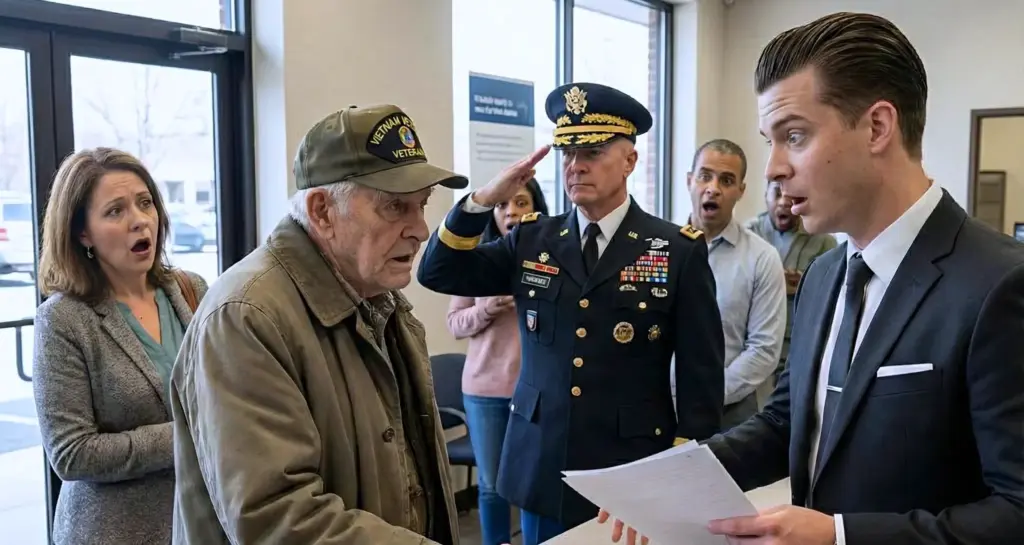
This was the same account he had utilized decades prior to deposit hazard pay from deployments that the government, even today, is hesitant to fully acknowledge in public records. He walked through the glass front doors of Summit Ridge National Bank just like any other patron would. His gait was steady, his demeanor calm, and he held his hat respectfully in his hands.
That hat was a piece of history in itself—a black cap, meticulously stitched with gold thread that read «Korea / Vietnam Veteran.» It had been brushed free of lint before he left his house. His shirt, though clean and pressed, showed the fraying cuffs of a garment that had seen many years of use. Tucked securely in his coat pocket were a folded VA card, two discharge papers soft with age, and a brass challenge coin that had been worn smooth around the edges. He stood in the queue with infinite patience, embodying the quiet discipline of men from his era, behaving as if waiting one’s turn was still a sacred social contract.
However, the atmosphere shifted perceptibly the moment he reached the teller’s window. The teller, a young woman likely in her mid-twenties, stared at the name on the screen and then raised a skeptical eyebrow. She was clearly uncertain how to proceed. Bobby offered his identification with a slight, involuntary tremor in his hands—not born of fear or weakness, but from the lingering neurological damage of time and too many freezing nights spent in places that didn’t appear on maps.
«I’m just trying to pull some funds,» he said, his voice polite and soft. «The account is under Robert Keene. It has been a while.»
The teller offered a tight, practiced smile that didn’t reach her eyes. She typed for a moment, then paused. Something on her monitor didn’t align with her expectations of the elderly man standing before her. Without a word to him, she flagged her manager.
The manager’s name was Caden. He sported a slick, gelled haircut and a tie that was tied fashionably too short. He wore the kind of permanent smirk that insulted you without him having to speak a single word. He stepped up to the station, glanced dismissively at Bobby’s documents, and then looked at Bobby himself. He let out a chuckle that was devoid of any warmth.
«You sure this account is yours, sir?» Caden asked, drawing out the word «sir» in a way that made it sound like a punchline. «This discharge form looks like it was typed on a dinosaur.»
The teller let out a nervous, tittering laugh. Bobby said nothing to defend himself. He simply reached into his coat with slow, deliberate movements and placed an object on the counter. It was a heavy brass challenge coin, engraved with a Thunderbird and seven stars—a symbol no civilian would recognize, but one that would make any authentic soldier stop breathing for a second.
Caden didn’t even bother to look closely at it. «Cute trinket,» he muttered, waving a hand dismissively. «Anybody can buy those online these days.»
He turned his head toward the security guard stationed near the entrance and motioned toward the door. «I think we’ve got another wannabe vet trying to game the system. Escort him out, please.»
The guard hesitated. It was just a second of pause, but it was long enough for Bobby to hear every syllable, and for the rest of the bank’s clientele to take notice. A few customers chuckled behind their raised smartphones, amused by the drama. One or two others averted their eyes, pretending they hadn’t heard a thing.
Bobby didn’t argue. He didn’t raise his voice or demand to speak to someone higher up. He simply picked up his coin, slid it gently back into his coat pocket, gave a single nod, and walked slowly to a bench situated by the window. There he sat, upright, his hands folded neatly in his lap, his gaze fixed on nothing in particular. The laughter in the lobby died down, replaced by a strange, heavy silence.
It wasn’t guilt. Not yet. It was something colder—discomfort. It was as if, deep down, the people in the room weren’t so sure of themselves anymore. One person, however, definitely didn’t laugh.
Her name was Maya Rodriguez. She was in her early thirties, a former Air Force logistics specialist who now worked in high-level defense contracting. She had seen a coin like that exactly once before. It was during a briefing where a retired JSOC colonel had addressed her team, and she vividly remembered how every officer in the room had snapped to their feet the moment he placed it on the table.
She walked straight up to the counter, locked eyes with the manager, and spoke clearly. «You just made a mistake.»
Caden blinked, taken aback. «Excuse me?»
Maya pointed a finger toward the bench by the window. «That man isn’t a fake. That coin alone outranks every single paycheck in this building.»
Caden snorted, unimpressed. «If he’s so important, why isn’t someone here with him?»
Maya didn’t dignify that with a reply. She simply turned on her heel, stepped outside into the crisp air, and pulled out her phone.
But she wasn’t the only one who had noticed. In the back office, an older employee—one of those quiet «lifers» who had no fancy title but possessed all the institutional knowledge—had overheard the name Robert Keene. He paused in his work, then walked slowly to the corner of the room where a brass plaque hung on the wall.
It had been there since the day the bank opened, a dedication to the Summit Ridge Command Base and to those who had built it. Among the list of engraved names was one that hadn’t faded with time: R.J. Keene. He was the man who had overseen the original military infrastructure long before the land was converted for civilian commercial use.
This was the same man now being accused of faking a service record in the very bank that existed solely because of his command. The employee didn’t speak to his colleagues. He picked up his desk phone, dialed a number that only a handful of people knew by heart, and spoke just six words into the receiver.
«It’s Bishop Coyne. Summit Ridge. He’s here.»
Then he hung up. Outside in the lobby, Bobby sat as still as stone. He didn’t pull out a phone to scroll through the news. He didn’t make a fuss or sigh loudly. He just watched the wind tug at the American flag across the street and waited. He wasn’t waiting for justice, and certainly not for praise. He waited because that is what men like him have always done. They wait until they are needed.
They wait even when no one believes them. They wait while the world laughs at them. But what no one in that bank knew—not the manager, not the teller, not even Maya—was that thirty minutes from now, that laughter would turn into a deafening silence.
Because down the road, a furious general had already slammed his secure phone onto a desk, thrown on his dress uniform jacket, and was currently tearing down the highway to make sure that the man everyone had dismissed—the man they called a fake—would never be overlooked again.
The next twenty minutes inside Summit Ridge National Bank passed like molasses. The air felt thick, slow, and incredibly uncomfortable, especially for those who had been snickering just moments ago. The teller who had laughed now kept her head low, pretending to be busy typing, while Caden, the manager, paced behind the counter. He threw the occasional nervous glance at the front doors, clearly agitated, though he didn’t yet know why.
Bobby Keene hadn’t moved an inch. He sat exactly where he had been told to sit, as if this were just another waiting room in another government building, just another day in a long life filled with lines and cold plastic chairs. His hands rested on the head of his cane, his posture straight despite the ache in his back he never talked about. That challenge coin remained tucked away, its presence as invisible to these civilians as his service record.
But the silence around him had changed. It was no longer the silence of dismissal. It was the heavy silence of doubt. Maya Rodriguez watched him from across the lobby, her arms crossed tight against her chest, her lips pressed into a thin line of frustration. She had already made her call to a retired command contact at Fort Brixton. He had only needed to hear the words «Bishop Coin» and «Robert Keene» before his tone changed completely.