


To the casual observer scanning the rows of Flight 831, the woman tucked away in seat 14A was entirely forgettable, a ghost in the machine of modern travel. She appeared to be just another traveler seeking solitude, a quiet figure lost in the pages of a paperback novel while the clouds drifted by outside the window. There was nothing about her demeanor to suggest she was anything other than a weary passenger minding her own business. No one on board, from the flight attendants patrolling the aisle to the businessman snoring softly in the adjacent seat, had the slightest inkling of the formidable skill set concealed behind her unassuming appearance.
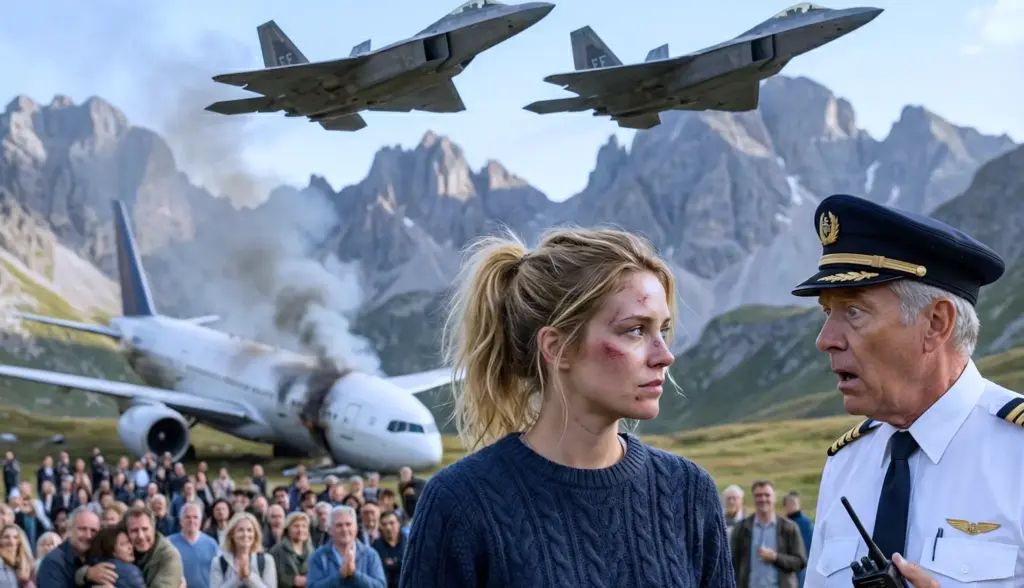
However, that carefully maintained veil of anonymity was destined to be shredded the instant both massive jet engines flamed out over the jagged, unforgiving peaks of the Rocky Mountains. In the blink of an eye, one hundred and eighty-five souls found themselves mere minutes away from a violent, fiery end. It was in that terrifying moment that the quiet woman in 14A stood up, marched into the chaos of the cockpit, and helped guide the dying machine back to solid ground. High above the unfolding disaster, F-22 fighter jets circled like metallic birds of prey, watching the struggle below, initially unaware that the voice guiding the crippled airliner belonged to a legend they all revered.
Before the chaos, the Boeing 777 had been cruising effortlessly at an altitude of 37,000 feet, suspended like a silver needle above the granite spine of the American West. The sky was a piercing, limitless blue, and the world below looked deceptively peaceful from such a height. En route from Seattle to Dallas, Flight 831 carried a heavy load, ferrying 185 passengers and a dedicated crew of 12 toward their various destinations. It was a typical Thursday afternoon operation, the kind of routine journey that occurs thousands of times daily across the intricate web of American airspace without incident.
Inside the cabin, the atmosphere was one of mundane comfort and drowsy relaxation. Passengers were dozing off with their mouths slightly open, engrossed in the flickering screens of the latest inflight movies, or losing themselves in their reading material. Flight attendants moved with practiced efficiency through the narrow aisles, dispensing beverages, collecting trash, and offering polite, professional smiles to anyone who made eye contact. The hum of the engines was a white noise lullaby that promised safety and consistency.
Everything felt perfectly safe, completely normal, and utterly routine. In the window seat of row 14, Kate Morrison turned a page, savoring the rare solitude. She was in her late twenties, dressed down in comfortable denim jeans and a cozy navy blue cable-knit sweater that had seen better days. Her blonde hair was swept back into a practical, no-nonsense ponytail, framing a face scrubbed clean of makeup. To the strangers sitting around her, she looked like a graduate student returning to campus or perhaps a young professional heading home after a tiring business trip.
There was absolutely nothing in her posture or appearance to suggest she was anything extraordinary. Kate had been navigating the labyrinth of the commercial air travel system for the last six hours, catching a connection in Seattle to make her long way back home to Texas. She was exhausted, but it was a good kind of tired—a content, bone-deep weariness born of fresh air and exertion. This had been her first real vacation in two years, a week spent hiking the pristine, pine-scented trails of Washington state. Now, her only ambition was to unlock her front door, hug her family, and collapse into her own bed for twelve hours.
What none of the passengers or crew could possibly know was that Kate Morrison was actually Captain Kate «Viper» Morrison, one of the most elite aviators in the United States Air Force. Her résumé was the stuff of modern legend, a document heavy with achievements that few pilots ever reach. She had piloted F-16s and the advanced stealth F-22 Raptor in active combat zones, logged more than 3,000 flight hours, and earned a dress uniform weighed down by medals for valor and technical precision. Her call sign, Viper, was spoken with reverence throughout the military aviation community.
She was known as one of the finest pilots of her generation, a natural stick-and-rudder flyer with ice-water in her veins. But today, she was officially on leave, a civilian in all but name. Clad in her casual attire, she was attempting to blend in, to be just another face in the crowd. She had deliberately omitted her military rank during the boarding process, craving a peaceful flight devoid of the questions and wide-eyed conversations that inevitably followed when people discovered she was a fighter pilot—especially a female fighter pilot. The novelty of those interrogations had worn off years ago.
Kate was deep into the third chapter of her book when she felt a subtle, almost imperceptible shudder run through the airframe. It wasn’t the rhythmic, jarring bump of normal turbulence that most passengers ignored. Her instincts, honed by years of flying unstable aircraft at supersonic speeds, immediately registered the anomaly as something distinct. The vibration felt wrong, a dissonance in the machine’s harmony. She glanced up, her senses suddenly heightened, analyzing the motion, though she initially tried to dismiss it as just a rough patch of clear-air turbulence.
The aircraft stabilized for a fleeting moment, and she forced herself to return to the printed page, trying to quell her internal alarm. Five minutes later, however, the sensation returned, but this time it was violent and undeniable. The massive plane lurched heavily, shaking the entire cabin with the force of a seizure, and a sickeningly loud bang reverberated from the rear of the fuselage like a cannon shot. Passengers gasped in unison, the collective intake of breath sucking the air out of the room. Somewhere a few rows back, the tension broke, and someone screamed.
The seatbelt sign illuminated with a chime that sounded far too cheerful and melodic for the grim circumstances. The captain’s voice crackled over the intercom a moment later, his tone professional but laced with an underlying current of tight-leashed tension that Kate recognized immediately.
«Ladies and gentlemen, we are experiencing some technical difficulties,» the voice announced, tight and clipped. «Please return to your seats and fasten your seatbelts immediately. Flight attendants, take your stations.»
Kate snapped her book shut and clicked her seatbelt into place, her mind already racing through diagnostic checklists and emergency protocols. That noise hadn’t been weather-related; it was mechanical, visceral, and catastrophic. A major failure had occurred somewhere in the aircraft’s critical systems. She leaned toward the window, pressing her forehead against the plexiglass, her eyes scanning the wing. A trail of thick, dark smoke was streaming from the left engine, staining the pristine sky.
Her stomach clenched into a hard knot. Engine failure. That was a serious emergency, certainly, but manageable if the pilots were competent and the remaining turbine held its load. But then, the sensation of flight changed drastically. The nose pitched down—not in a controlled, gradual descent, but in a steep, sinking slide that felt like the earth was pulling them down. They were losing altitude rapidly, the airframe groaning under the stress.
Oxygen masks tumbled from the ceiling compartments, dangling like bizarre yellow plastic marionettes. The cabin erupted into absolute pandemonium. The fragile facade of normalcy shattered instantly as passengers began to weep, pray aloud in a cacophony of languages, or frantically try to call their loved ones on phones that had no signal. Kate grabbed her oxygen mask and secured it over her face, her military conditioning creating a bubble of supernatural calm around her while others succumbed to hysteria.
She listened intently to the sounds of the aircraft, felt the angle of descent in her inner ear, and assessed the situation with the cool, detached analysis of someone who had faced death before and survived. They were in serious trouble. The pilots were fighting to control the plane, but the physics were against them. The captain’s voice came back on the intercom, and this time, he was no longer trying to hide the fear in his throat.
«This is the captain. We have lost both engines. I repeat, both engines are out. We are declaring an emergency. Brace for impact. Flight attendants, prepare the cabin for emergency landing.»
Both engines. The realization hit Kate like a physical blow to the chest. A twin-engine failure was catastrophic, a nightmare scenario that pilots discussed in hushed tones. Without engines, the plane was essentially a glider, and a Boeing 777 was a massive, heavy beast that did not glide well. They were drifting over the Rockies, a landscape of jagged peaks with few suitable landing sites. The pilots would be desperately scanning the horizon for anywhere to put the bird down.
The situation was catastrophic. Hopelessness began to creep into the cabin air, but Kate pushed it aside. Around her, the passengers were dissolving into panic. The man next to her was frozen in terror, gripping his armrests so hard his knuckles had turned bone-white. The woman across the aisle was sobbing uncontrollably, clutching a rosary. Flight attendants were shouting instructions about brace positions, their voices straining to be heard over the din, but many passengers were too panicked to process the commands. Kate made a decision. She unbuckled her belt and stood up, ignoring the steep, precarious angle of the deck.
She grabbed the seat backs for balance and forced her way toward the front, moving against the tilt of the descending aircraft like a salmon swimming upstream. A flight attendant, eyes wide with fear, tried to block her path.
«Ma’am, you need to sit down immediately!» she cried out.
Kate looked her dead in the eye, projecting an aura of absolute authority.
«I need to talk to the pilots. Right now. I’m a military pilot, and I might be able to help.»
Her voice held the unmistakable tone of command, the kind that bypassed panic and made people listen instinctively. The flight attendant hesitated for only a fraction of a second, then nodded. She grabbed the intercom phone and spoke urgently to the cockpit. Ten seconds later, the reinforced door buzzed and opened. Kate moved forward quickly, stepping into the sanctuary of the flight deck.
Inside the cockpit, the atmosphere was chaotic and heavy with the smell of sweat and fear. Both pilots were working frantically, their hands blurring as they tried every procedure, flipping switches, pushing buttons, and attempting to restart engines that refused to respond. The instruments showed a nightmare scenario: No thrust. Altitude dropping fast. Mountains filling the windscreen. The captain, a gray-haired veteran named Mike Sullivan, looked up sharply as Kate entered.