


The text message arrived precisely at 9:47 p.m. It wasn’t a holiday greeting or an apology. It was a demand from my father: «Rent due tomorrow.» Just hours earlier, my mother had forgotten to set a place at the Christmas table for my daughter, claiming there wasn’t enough food because she had upset the «golden grandchild.» Meanwhile, that same grandchild was happily eating a second helping. I didn’t scream. I didn’t flip the table. I simply gathered our gifts, took my family, and walked out the door.
My name is Alex. I am thirty-five years old, the lead of an IT support team, and the older brother by four years. More importantly, I am Sarah’s husband and the father of a seven-year-old girl named Lily, whom we adopted when she was three. I’m the guy who organizes the holiday storage bins, maintains a drawer full of fresh batteries, and brings extra folding chairs to events just in case they’re needed. I am not a heavy drinker, and I am not a yeller.
I fix things. That is my role. I fix spotty Wi-Fi connections and stabilize wobbly dining tables. My family appreciates me primarily because I am useful. Christmas at my parents’ house is a rigid ritual involving a plastic nativity scene that is older than I am and a paper snowman missing one eye. My mother plays the same burned CD from 2008 on a loop. My brother, Nate, always arrives late with his son, Max—nine years old, wild, and undeniably the favorite. Mom calls Max «my little man» with a level of affection that makes the rest of us feel like temporary tenants.
We walked into the house carrying a casserole and a tin of cookies. Sarah kept a reassuring hand on Lily’s shoulder. Lily was clutching a wrapped drawing she had made for Nana, depicting stick figures holding hands beneath a crooked tree. She looked up at me with wide, uncertain eyes, silently asking if her gift was acceptable. I smiled down at her and whispered that it was perfect.
— Coats on the chair, — Mom directed, bustling through the hallway without really looking at us. — Shoes off, please. We just had the floors redone.
— Help me with the roast, champ, — Dad said, giving me a nod.
Lily peeked around the corner into the dining room. The table was dressed with a red runner, eight plates, and polished silverware. She pointed a small finger at the arrangement.
— Where do I sit? — she asked.
— Right next to me, — I promised.
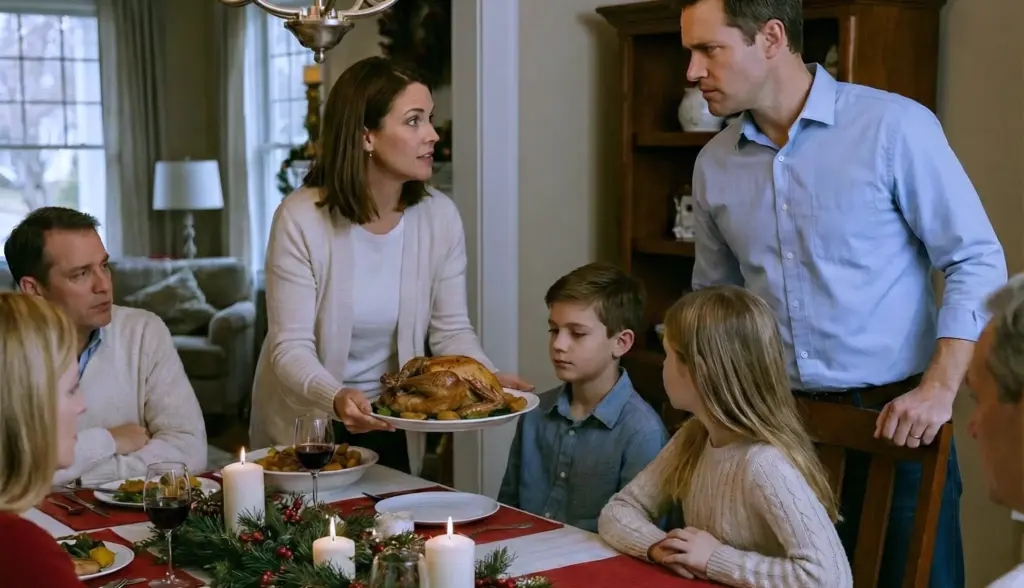
— Everyone, to the table! — Mom announced, clapping her hands. She placed a plate in front of Max before he had even fully sat down. He was already chewing something, and a side dish was waiting for his second helping. He grinned with the confidence of someone who owns the place. Lily slid into her chair and looked down at her placemat. It was empty. There was no plate, no fork—just a bare square of fabric with a sticky smear where a candy cane had melted the previous year.
I kept my voice calm and light.
— Hey, Mom. We need a place setting for Lily.
Mom didn’t even look up from the carving knife.
— There wasn’t enough. She upset Max, remember?
Sarah pressed her knee firmly against mine under the table.
— What? — she asked, her voice sharp.
— She bumped his tower, — Nate said with a shrug, barely glancing up.
— It was cups, — Lily whispered, shrinking into her seat. — I said sorry.
Mom waved a hand dismissively.
— We don’t reward bad behavior. — She scooped a large portion of potatoes onto Max’s plate as he reached for seconds. She laughed warmly. — Growing boy.
Lily folded her hands in her lap, her mouth pressing into a small, tight line of resignation. I heard my own voice come out, flat and unrecognizable.
— We’re going to head out.
Mom’s smile turned into a sharp, warning glare.
— Alex, don’t be dramatic.
— Dude, it’s Christmas, — Nate added with a smirk.
I stood up. Sarah stood up immediately. Lily scrambled to her feet. We picked up the gifts we had brought, still wrapped in their festive paper. No one moved to stop us. Dad watched the scene unfold, silent as a television that had been muted. On the porch, the air was knife-cold, cutting through our sweaters. I opened the car door, and Lily climbed in, buckling her seatbelt without making a sound. Sarah’s eyes were wet, but her expression was calm and determined.
— I didn’t say a word, — I told myself, gripping the steering wheel. — We’re not making a scene.
We pulled away from the curb, and the house shrank in the rearview mirror. The burned CD was still playing behind the closed door. I didn’t check my phone. Not yet.
We adopted Lily after a grueling year of parenting classes, home inspections, and paperwork stacks as thick as bricks. On the day the judge finally banged the gavel, Lily clutched a stuffed fox and whispered, «Am I yours now?» I told her, «Forever,» and I meant it with an intensity that physically hurt. My parents told me they were proud. They even took a photo with the judge, which Mom framed and placed on a side table, sandwiched between two large portraits of Max.
At family dinners, Mom would point to the adoption photo like it was a souvenir from a vacation we once took. Nate remained neutral about the whole thing until he realized that adoption didn’t involve baby showers with gift registries he could ignore. He refers to Lily as «your girl,» creating a verbal distance he can’t be bothered to cross. Max calls her «not-really-cousin,» a cruel title he likely didn’t invent on his own.
Money sits on the table in our family the way salt does: always there, used without thinking. When I landed my first help-desk job, Mom began texting me for quick favors. The internet bill was too confusing to figure out; the car insurance payment was time-sensitive. Nate needed a bridge loan between his bartending shifts. Then Dad’s back went out, and suddenly I was covering his daily expenses for a month, which quietly stretched into three.
Sarah is a nurse who often picks up night shifts. We are not swimming in cash, but we plan meticulously. We say no to expensive vacations so we can say yes to necessary dental work. We budget strictly. We refill our savings account with a scoop the size of a teaspoon.
Every December, the choreography repeats itself. Mom assigns the cooking dishes and slips in a big-ticket item for us to buy because we are «reliable.» One year it was the turkey. Twice it was the ham. «You get points on your card,» she says, as if credit card points are a currency we can use to feed our child. When I once asked to split the costs, Mom’s voice became dangerously soft. «Don’t make this about money, sweetheart.»
— Dude, I’m between gigs, — Nate would say loudly. He has been «between gigs» for three years, yet Max never seems to run out of brand-new sneakers.
Before Christmas this year, Mom called with her signature cheerful voice.
— Can you grab the roast? And the good napkins, the ones with the gold edge? And wine—two reds, one white. Oh, and plates. Ours are chipped. You know where to find a deal.
— We can bring sides and dessert, — I told her. — That’s our cap.
She went quiet for a long beat.
— It’s Christmas, Alex. Don’t nickel-and-dime the season.
Sarah squeezed my hand for support.
— We’ve got our own bills, — I said firmly.
Nate chimed in on the family group chat immediately. «Don’t start,» he wrote, followed by a photo of Max at an expensive trampoline park captioned, «Worth it.» Two days later, Dad sent me a screenshot: «Utilities went crazy this month,» accompanied by a number that looked suspiciously round. When I asked to see the actual bill, he wrote back, «It’s complicated,» which is his shorthand for, «Don’t ask questions.»
We kept our heads down and tried to push through. Lily made cards for everyone using stick-on stars, spelling «Nana» as «Nona.» She practiced a little «Merry Christmas» speech because she likes giving speeches now; school has given her that confidence. That morning, laying out Lily’s tights, I thought, «We can survive one dinner. Smile, nod, and leave at a normal time. Don’t be the problem.»
At the house, the blow landed quickly: «There wasn’t enough.» Lily’s empty spot at the table. Max’s second helping. The entire room bending around one child’s whims like gravity. I felt the old instinct crawl up my spine—the part of me that runs interference, that wants to say, «Fine, I’ll fix it, just stop yelling.» But then I looked at Lily’s hands, folded like a prayer, and something even older and fiercer woke up inside me. We left.
Back in the safety of our home, I heated up chicken nuggets. Sarah added carrot sticks to the plates. We ate on the couch under a blanket that smelled like our laundry soap. Lily watched a movie, providing the running commentary that kids do. «Look, a dog!» She didn’t mention the table. She didn’t ask why we left. After she brushed her teeth and curled up with her stuffed fox, I finally checked my phone.