


I am Nathan. I am thirty-three years old, and tonight, I am a ghost haunting my own life. I am sitting at the head table of a restaurant called Aria, a place that feels less like a dining establishment and more like a temple erected to the worship of accumulation. In roughly twenty minutes, I will stand up and detonate the existence I have spent the last six years meticulously constructing. But right now, to the casual observer, I am simply the lucky groom. I am the man who won the lottery, the quiet architect who managed to land the golden girl, Emma Sterling.
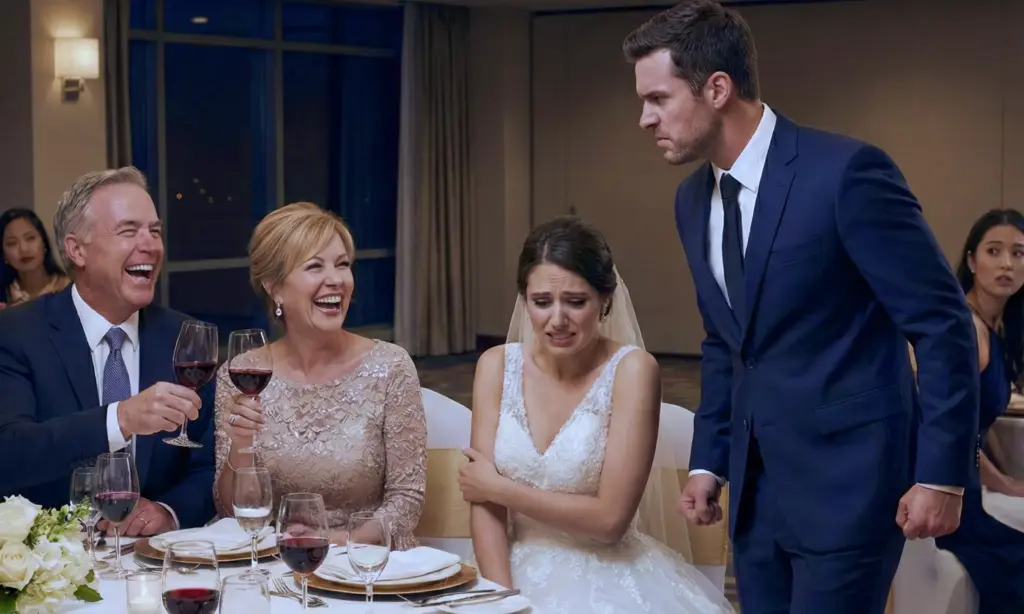
Before I tell you how a tarnished, stolen piece of antique silver became the catalyst for the single most important decision of my life, you need to understand the air in this room.
It is suffocating. Aria is a cavern of polished mahogany and aggressive minimalism, lit so dimly that the shadows seem to have more substance than the people. The air is heavy, perfumed with a cloying, expensive mixture of truffle oil, aged leather, and the specific, metallic scent of anxiety masked by designer fragrances. It is the smell of money—not the comfortable, worn-in money of a grandfather’s wallet, but the sharp, desperate money that needs to be seen to exist.
I look down at my hands. They are resting on a tablecloth so white and starched it feels like a sheet of ice. My knuckles are white, blending in.
To my right sits Emma. In the flickering candlelight, she is undeniably breathtaking. Her silk dress flows around her like liquid mercury, catching the light with every subtle movement. She is laughing at something the woman across from us—the wife of a hedge fund manager—just said. It is a practiced laugh, a musical scale ascending perfectly to a high C. It is the laugh of a woman who knows she is the center of the universe and finds the view entirely agreeable.
But I know her tells. I can see the tension in the tendons of her neck. I can see her eyes darting frantically around the periphery of the room, cataloging the guests, gauging reactions, ensuring that the lighting is hitting her good side, that the «vibe»—her favorite word—is unblemished. She isn’t present in the moment; she is managing a production.
And I am not her partner. I am a prop. I am the statuette on the wedding cake, necessary for the symmetry, but ultimately inedible and easily discarded.
How did we get here? How did the woman I once laid in bed with on Sunday mornings, eating burnt toast and laughing until our sides ached, become this brittle, beautiful curator of surfaces?
To understand the end, we have to go back to the foundation. We have to go back to before the cancer, before the debts, before the rot set in.
I met Emma five years ago in a dusty used bookstore in the University District. It sounds like a cliché, a scene from a romantic comedy that didn’t have the budget for a better location, but it’s the truth. She was looking for a first edition of The Great Gatsby for her father; I was looking for a quiet place to hide from the rain.
She wasn’t the Emma of Aria back then. Or maybe she was, and I was just too blinded by the light to see the shadows. She was vibrant, funny, and seemingly unburdened by the crushing weight of her family’s expectations. We bonded over a shared hatred of dark roast coffee and a love for old architecture.
For the first two years, it was magic. It was the kind of love that feels inevitable, like gravity. We were a team. When I got my first major commission, she celebrated louder than anyone. When she struggled with her interior design courses, I stayed up with her until 3:00 AM, drafting floor plans and drinking cheap wine.
But looking back, with the clarity of a man about to burn his life down, I can see the fissures even then.
I remember the first time I took her to meet my mother, Sarah.
My mother lived in a small, clapboard house in the suburbs. It wasn’t impressive. The paint was peeling slightly on the porch railing, and the garden was a chaotic explosion of wildflowers rather than a manicured lawn. But it was a home. It was warm. It smelled of baking bread and dried lavender.
Emma had been polite, charming even. She complimented Mom’s ceramic collection. She ate the pot roast and asked for seconds. But on the drive home, the mask slipped.
«Your mom is… sweet,» Emma said, examining her manicure in the passenger seat. «But doesn’t she feel a little… cramped? I mean, that kitchen. How does she breathe in there?»
«She loves that house,» I said, a defensive edge creeping into my voice. «It’s the house I grew up in. It’s got history.»
«Of course,» Emma said quickly, reaching over to squeeze my knee. «I just meant… don’t you want more for her? Don’t you want to get her out of there?»
I didn’t answer. I didn’t realize then that Emma viewed «enough» as a failure. To her, contentment was just a lack of ambition.
Then came the diagnosis. Stage IV ovarian cancer. The words hit my life like a meteor impact, vaporizing the future I had taken for granted.
The three years that followed were a brutal, grinding war of attrition. Hospitals became my second home. I learned the language of oncology—markers, white counts, palliative care.
In the beginning, Emma tried. I have to give her that. She was my foxhole buddy. She learned the nurses’ names at St. Jude’s. She brought Mom stacks of fashion magazines and sat in the infusion room, reading aloud while the poison dripped into my mother’s veins.
I saw her presence as strength. I thought, She is standing with me in the fire.
But as the months dragged on, as Mom grew thinner and the reality of death became a physical presence in the room, Emma began to fade. She stopped coming to the appointments, citing «work emergencies» that never seemed to manifest into actual projects. When she did visit, she would hover near the door, terrified to touch anything, terrified to look too closely at the woman shrinking in the bed.
«It smells like sick people in here, Nate,» she whispered to me once in the hallway, wrinkling her nose. «It’s just… it’s such a heavy vibe. I need to get some fresh air.»
She left me there for three hours.
I forgave her. I told myself she was young, that she had never lost anyone, that she didn’t know how to process this level of grief. I made excuses for her because I needed her to be the person I thought she was.
But the real turning point—the moment the transaction truly began—happened a year into the sickness.
It was a Tuesday in November. A cold, gray rain was lashing against the windows of Mom’s sunroom. Mom was having a good day; the chemo fog had lifted enough for her to sit up and watch the cardinals at the feeder.
I was making tea when my phone buzzed. It was Emma.
«Nate,» she sobbed. The sound of her voice froze the blood in my veins. It was the sound of total collapse. «Nate, you have to come. It’s over. It’s all over.»
«What? Is it a car accident? Are you hurt?»
«No,» she choked out. «It’s the restaurant. It’s The Gilded Spoon. Daddy… Daddy missed the loan payments. The bank is calling the note. They’re going to seize everything. The restaurant, the house… Nate, we’re going to be homeless.»
My heart broke for her. Truly. Despite her flaws, I loved her. And I knew that for the Sterlings, losing their wealth was a fate worse than death. It was an erasure of their identity.
I hung up and walked back into the sunroom. My face must have been pale because Mom set her book down immediately.
«Nathan?» Her voice was raspier than it used to be, but her eyes—those sharp, intelligent blue eyes—were clear. «What’s wrong?»
I sat down on the ottoman beside her. I didn’t want to burden her. She was fighting for her life; she didn’t need to worry about a failing bistro in the city. But my instinct was always to talk to her. She was my moral compass.
So I told her. I told her about Robert’s mismanagement, the leverage, the looming foreclosure.
«They need a co-signer,» I finished, staring at the floor. «A bridge loan to restructure the debt. But their credit is shot. No bank will touch them.»
Mom was quiet for a long time. The only sound was the ticking of the grandfather clock and the rain against the glass.
«What is the amount?» she asked softly.
«Mom, don’t,» I said, looking up. «It’s huge. It’s a quarter of a million dollars.»
She didn’t flinch. She just looked at the birds. «And the bank?»
«First National,» I said, before realizing what I was doing. «Mom, absolutely not. You are sick. You need your savings. This is your security. This is… this is everything Dad left you.»
She turned to look at me. She looked so fragile then, wrapped in a heavy wool cardigan that seemed to swallow her skeletal frame. But when she spoke, her voice had the density of steel.
«Nathan, look at me.»
I met her gaze.
«Money is a tool,» she said. «It is not a god. It is not a scorecard. It is a tool meant to be used to build things or to fix things. What good is it sitting in an account when the family you are about to join is about to be destroyed?»
«They aren’t your family, Mom,» I argued. «You barely know them.»
«They are your family,» she corrected. «Or they will be. And a family should be secure. You cannot build a marriage on a foundation of ruin, Nathan. You help family. That is what we do.»
«It’s too risky.»
«Life is risky,» she smiled, a weak, crooked smile. «I’m living proof of that. Get the car.»
«Mom—»
«Get the car, Nathan.»
The drive to the bank is etched into my memory like a nightmare recorded in high definition.
I had to lift her into the passenger seat of my sedan. She weighed nothing—she was like a bird made of hollow bones and determination. I buckled her in, my hands trembling. She just adjusted her wig and stared straight ahead.
First National was a fortress of glass and steel downtown. I parked right in front, ignoring the ‘No Standing’ zone. I walked around and helped her out. It took us ten minutes to cross the lobby. Every step was a battle for her. She was out of breath, her face gray, beads of sweat forming on her upper lip.
People stared. They saw a sick old woman leaning heavily on her son. They didn’t see the titan walking beside me.
We sat in the office of a loan officer named Mr. Gathers. He was a young man, slick and efficient, and he looked at my mother with open skepticism.
«Mrs… West, is it?» he asked, glancing at the file. «You understand that by co-signing this restructuring loan, you are putting your primary residence and your liquid assets up as collateral? If the Sterlings default…»
«I can read, young man,» Mom interrupted. Her voice was faint, breathless, but it whipped across the desk like a lash. «I didn’t come here for a lecture on risk management. I came here to sign a paper. Do you have the paper?»
«Yes, ma’am, but—»
«Then give me the pen.»
I watched her hand. It was trembling. The tremors from the medication were bad that week. She gripped the pen so hard her knuckles turned yellow. She took a deep breath, steadied her hand by sheer force of will, and signed her name. Sarah West.
It took everything she had. When she finished, she dropped the pen and slumped back in the chair, eyes closed.
«Done,» she whispered.
I drove her home in silence. She slept the whole way, exhausted by the exertion.
When I told Emma that night, I expected tears of gratitude. I expected awe. I expected her to drive out to my mother’s house and fall to her knees.
Instead, she let out a sigh of relief that sounded disturbingly like annoyance leaving her body.
«Oh, thank God,» Emma said, pouring herself a glass of wine. «I thought Daddy was going to have a heart attack. This fixes everything.»
«Emma,» I said, staring at her. «My mom barely made it to the bank. She put her house on the line. Her house.»
Emma looked at me, her eyes wide and innocent. «I know, Nate. And it’s amazing. Really. She’s an angel. We’ll pay her back, obviously. Daddy’s already working on a new menu. It’s going to be huge.»
She took a sip of wine. «So, can we talk about the venue now? Because if the money is sorted, I really think we should look at Aria again.»
I felt a cold prickle on the back of my neck. It was the first true warning shot. My mother had just mortgaged her dying days to save their skins, and Emma was already pivoting back to the party.
I pushed the feeling down. I told myself it was just stress relief. I told myself she was in shock.
I was a fool.
But that was just the beginning of the meddling. The erosion of my boundaries didn’t happen all at once; it was a slow, steady drip of acid.
We are back at Aria.
The waiter is pouring wine. It’s a vintage Cabernet, dark as blood. Robert Sterling is laughing at the head of the table, his face flushed. He raises his glass to a man on his left, a business partner who probably doesn’t know that the only reason Robert isn’t pouring coffee at a diner right now is because of a dead woman’s signature.
I look at the service door again. My sister Chloe catches my eye. She isn’t eating. She is watching me with the intensity of a hawk. She knows. She has seen the cracks for months. She has been begging me to open my eyes.
Don’t marry into this circus, Nate, she had told me three days ago. They will eat you alive and pick your bones with a silver toothpick.
I look back at Emma. She is texting under the table. Probably complaining to a bridesmaid that I’m being «moody.»
The waiter places a plate in front of me. Scallops with a saffron reduction. It looks beautiful. It looks expensive.
It looks like a lie.
I take a deep breath, inhaling the truffle oil and the perfume. The air is getting thinner. The fuse is lit.