


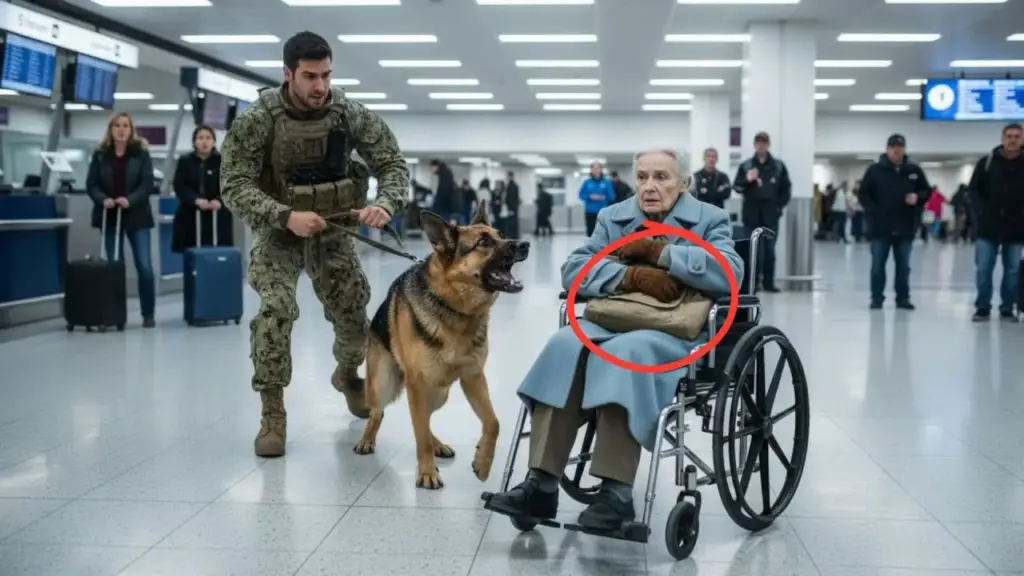
The station fell silent as Atlas, the German Shepherd, suddenly broke free from his handler, barking furiously at an old woman in a wheelchair. She clutched a faded canvas bag to her chest, eyes wide in fear. «Please, make him stop,» she pleaded, her frail voice trembling. Passengers froze. Silas Monroe, a former Navy SEAL now working security, struggled to restrain his partner.
«Easy boy, what’s wrong?» he shouted, but Atlas wouldn’t listen. His growls turned desperate—warning, not aggression. Something in that bag had set him off, something no scanner or soldier could have detected. Moments later, when the truth surfaced, it would expose a secret so dark it reached back into Silas’s own past, and no one in that station would ever forget what they saw.
The winter air inside Portland Central Station carried the heavy scent of steel, coffee, and restless humanity. Snow pressed against the wide glass panels, turning the morning light pale and cold. Beneath that glass canopy, hundreds of travelers moved like a restless tide, heels clicking, voices rising, and the steady hum of announcements blending with the rhythm of departure and return.
Among them walked Silas Monroe, tall and broad-shouldered, his Navy jacket marked by the faint emblem of the city’s security division. He didn’t belong here, not entirely. The easy chaos of civilians, the chatter about vacation plans, the clatter of luggage wheels—these belonged to another world, softer and unscarred.
His world, once filled with gunmetal skies and sandstorms, had taught him that peace was often just silence before the next noise. Beside him moved Atlas, a five-year-old German Shepherd with a coat the color of burnt gold and ash.
His gait was calm, precise, the quiet power of a creature trained for loyalty rather than comfort. There was an intelligence in his amber eyes that drew glances from passing travelers. For them, he was a beautiful dog in uniform. For Silas, he was something far deeper—a lifeline that had once dragged him out from a burning convoy in Kandahar three years earlier.
Since then, the two had rarely been apart. Atlas carried shrapnel scars in his shoulder, Silas a matching one across his ribs. Both walked the world as survivors, haunted yet tethered together by something wordless.
The station’s loudspeaker hummed, announcing the 9:45 to Augusta delayed by snow on the tracks. Silas exhaled, the sound faint under the weight of his memories. He glanced at Atlas, who sniffed the air methodically.
«Routine, partner,» Silas murmured, his voice low and steady. «Just another quiet morning.»
Atlas’s ears twitched, acknowledging the command. They moved past the waiting lounge, past a group of college kids filming themselves in front of the holiday tree. The old instinct inside Silas, the one honed to read rooms faster than words, remained calm.
There was nothing unusual, just ordinary life. A mother tugging a sleepy child, a businessman muttering into his phone, the soft laughter of strangers. Then, Atlas stopped.
It was sudden, a rigid halt mid-stride, the leash drawing taut. Silas felt the pull immediately, the shift of muscle under tension.
«What is it?» he whispered, following the dog’s gaze.
Atlas’s head had turned sharply toward the far bench near the east exit, where an elderly woman sat motionless in a wheelchair. She was small, wrapped in a gray wool coat that looked older than the decade, a knitted blue scarf looped loosely around her neck.
Snowflakes clung to her thinning silver hair, and her hands, knotted with age, held tightly to a faded canvas bag resting on her lap. The woman, Evelyn Hart, seemed harmless, almost fragile. Her pale face was drawn and delicate, her lips trembling as if she were whispering to herself.
She glanced around with the slow caution of someone who had been invisible for too long. Nothing about her shouted danger, yet Atlas’s body stiffened completely. His ears pricked forward, his breathing sharpened.
«Easy, boy,» Silas said under his breath.
But the warning came too late. Atlas erupted in a deep, thunderous bark that cut through the entire terminal like a breaking wave. Travelers froze mid-step, heads turning, hearts jolting. The echoes rolled along the glass walls, amplified by the cold air.
Evelyn gasped, clutching the canvas bag closer to her chest. «Please, please make him stop,» she cried, voice cracking, eyes wide with sudden terror.
Silas tightened the leash, but Atlas pulled harder, his paws scraping against the tile.
«Atlas!» Silas barked. «Heel!»
The dog ignored him, something that had never happened in four years of working together. Every line of Atlas’s body radiated urgency, not aggression. His tail was rigid, not wagging. His barks came in bursts—warning, not attack.
Passengers began stepping back, creating a circle around the scene. A security guard hurried over, a younger man in his twenties with nervous eyes and a coffee stain on his sleeve.
«Sir, what’s going on?» he asked, voice too loud.
Silas’s focus never left Atlas. «Something’s wrong,» he muttered.
The guard frowned. «Wrong? It’s just an old lady.»
Evelyn’s breathing turned shallow, her fingers clutching the bag like a lifeline. «I haven’t done anything,» she whispered, shaking her head, her voice fading into panic. «I’m just waiting for my train.»
But Atlas barked again, three sharp, desperate bursts that made Silas’s pulse spike. It wasn’t the bark of suspicion. It was the bark of recognition. Silas moved swiftly, lowering himself beside the wheelchair, trying to make his voice gentle.
«Ma’am,» he said, «please don’t be afraid. We’re not here to harm you. My dog is trained to detect certain scents, sometimes even things people can’t sense themselves. Can I take a look at your bag?»
Evelyn hesitated, her lower lip quivering. «It’s nothing important,» she said softly. «Just some things that belong to my husband.»
Her words hung fragile in the air, almost believable, but Atlas lowered his head, sniffed once, twice, and growled low in his throat—the kind of sound that lived somewhere between instinct and warning.
«Silas,» the young guard whispered nervously. «This is weird, man. You sure your dog’s not spooked?»
Silas’s gaze stayed fixed on Atlas. «He doesn’t spook,» he said quietly. «He reacts.» Then, more softly, «He reacts to what we can’t see.»
Outside, snow thickened, swirling past the glass windows like white smoke. Inside, tension congealed into silence. Evelyn’s knuckles turned white around the bag’s handles. Silas could see the faint tremor in her wrist, the way her eyes darted toward the exit—not in guilt, but fear. Deep, soul-rooted fear.
Atlas barked again, shorter this time, his chest heaving. Then he sat abruptly, tail low, eyes fixed on Evelyn as though waiting for something invisible to reveal itself. Silas exhaled slowly.
«Ma’am,» he said, his tone calm but firm, «I’m going to have to ask you to come with me for a brief check. It won’t take long.»
«I can’t,» she whispered, tears glimmering at the corners of her eyes. «Please, my train…»
«I’ll make sure you don’t miss it,» Silas said gently. «But for your safety, and everyone else’s, we need to understand why my dog’s reacting.»
The crowd murmured, curiosity mixing with unease. Evelyn looked around helplessly, then back at Silas, who stood tall but kind-eyed, his hands steady on the wheelchair handle. Something in his calmness broke through her panic. Slowly, she nodded.
«All right,» she said faintly.
As he guided her toward the security corridor, the young guard followed behind. «Man,» he whispered, «that was intense. I’ve seen dogs get jumpy around food or noise, but that…»
Silas cut him off quietly. «Atlas doesn’t bark for noise. When he barks like that, something’s off.»
The guard gave a nervous laugh. «Well, whatever it is, I hope it’s nothing. The old lady looks like she could barely lift that bag.»
Silas didn’t respond. His eyes drifted to the frosted window ahead. Snow fell harder now, blurring the outside world into a haze of white. It reminded him of a night in the desert when sand had covered everything the same way—soundless, blinding, deceptive.
The night he’d ignored Atlas’s first warning bark and lost a man because of it. He had learned then that instinct was often the echo of something divine. They reached the narrow hallway leading to the private screening room.
The lights flickered slightly, reflecting off the white tile. Atlas walked ahead, still tense, nose low, every breath measured. Silas could feel the invisible thread pulling between them. Whatever Atlas sensed, it wasn’t danger in the usual sense. It was something buried, quiet, waiting.