


«Dr. Brooks, you’re fired.» The words echoed through Memorial Hospital’s emergency department as Dr. Talia Brooks stood over the elderly man whose heart she’d just restarted with her bare hands. «You performed surgery without authorization.» «He was dying,» Talia whispered, blood still on her gloves. «Leave, now, before I call security.» The five-foot-four resident walked through the hallway in silence, colleagues avoiding eye contact. Some whispered behind her back. Others shook their heads in regret. She’d saved a life and lost her career in the same moment.
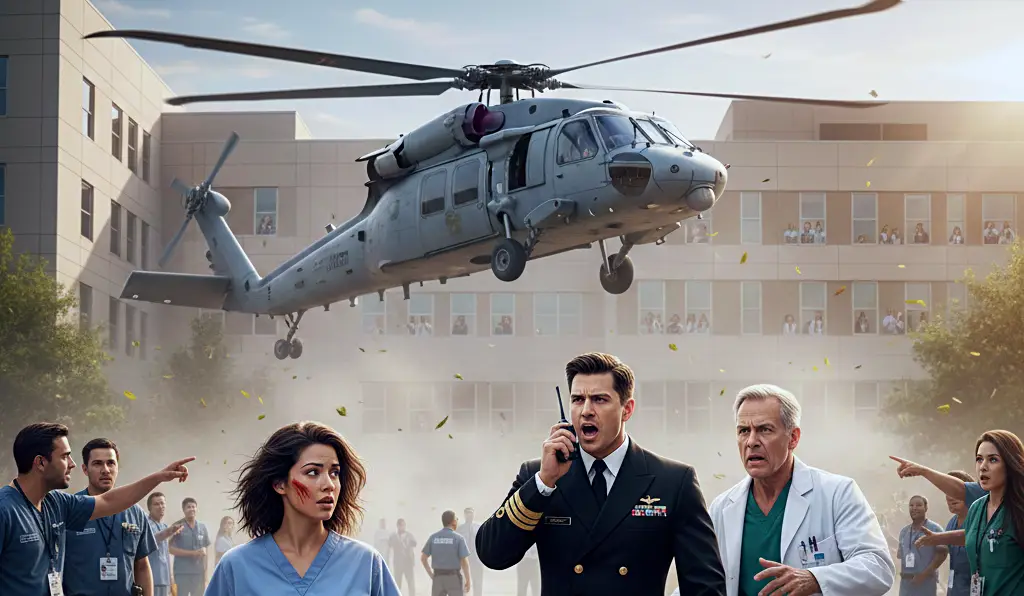
But as she reached the parking lot, the thunderous roar of rotor blades shattered the afternoon quiet. A Navy helicopter descended toward the hospital rooftop, its gray hull blocking out the sun. Security guards scattered. Patients pressed against windows.
From the aircraft’s cabin stepped Commander Jake Rodriguez, his voice cutting through the chaos. «I need Dr. Talia Brooks, now.»
A nurse pointed frantically toward the parking lot. «She was just fired.»
«Then get her back here immediately,» Jake barked into his radio. «We have a pilot down at sea, severe chest trauma. We need someone with combat medical experience, and there’s only one person within 500 miles who qualifies.»
The same woman they’d just kicked out for saving a life was about to become their only hope for saving another. What they didn’t know was that Talia Brooks carried more than medical knowledge. She carried secrets that would turn everything upside down.
Talia sat in her beaten Honda Civic, hands trembling as she gripped the steering wheel. The adrenaline from the emergency surgery was wearing off, replaced by the crushing reality of unemployment. She straightened her shoulders unconsciously, a habit from years of standing at attention, though she’d never told her colleagues where that posture came from.
The hospital’s automatic doors slid open as Dr. Harrison Mitchell emerged, his imposing six-foot frame and silver hair commanding immediate attention from the gathering crowd of staff members. Mitchell had been chief of surgery for 12 years, and his reputation for rigid enforcement of hospital protocols was legendary throughout San Diego’s medical community.
«I want everyone to understand what happened in there,» Mitchell announced, his deep voice carrying across the parking lot with the authority of someone accustomed to absolute obedience. «Dr. Brooks violated multiple protocols. She performed an unauthorized thoracotomy without proper supervision, without following established procedures, and without regard for this institution’s liability.»
The crowd murmured, most nodding in agreement. Few people challenged Dr. Mitchell’s pronouncements. His medical expertise was undeniable, and his political influence within the hospital system had ended careers before.
Dr. Patricia Williams, the hospital’s administrative director, stood beside Mitchell, looking uncomfortable with the public nature of his declaration, but unwilling to contradict the chief of surgery in front of the staff.
«Always too aggressive,» Mitchell continued, his tone sharp with disapproval. «I’ve been saying it for months; she’s reckless, dangerous even. You can’t just cut into someone’s chest because you feel like it. Medicine is about following procedures, not playing hero.»
A young intern near the back of the crowd raised his hand tentatively. «But Dr. Mitchell? She saved his life, didn’t she?»
Mitchell’s expression hardened, his gray eyes focusing on the intern with the intensity of a predator identifying prey. «That’s not the point, Dr. Williams. Medicine is about following procedures, not gambling with patients’ lives. What if she’d killed him? What if there were complications we couldn’t handle?»
«She put this entire hospital at risk, and frankly, she put all of your careers at risk by association.»
The intern’s face flushed red, and he stepped back into the crowd, properly intimidated. Mitchell’s message was clear: questioning his judgment was a career-limiting move.
If this hospital’s injustice makes your blood boil, you’re not alone. Hit that like button, and subscribe, because what happens next will shock you even more than what you’ve already seen.
Meanwhile, three miles offshore on the USS Abraham Lincoln, Commander Jake Rodriguez was receiving the worst possible news. His radio crackled with urgency as the flight deck officer’s voice broke through the static.
«Commander, we have an emergency. Lieutenant Harris went down during a training exercise. His F-18 Super Hornet experienced engine failure at 1,200 feet. He managed to eject, but the impact was severe. We’re looking at massive chest trauma, possible cardiac involvement.»
Jake’s jaw tightened. He’d seen enough combat injuries to know what massive chest trauma meant. Time wasn’t just critical; it was everything.
«What’s his status now?»
«Unconscious, vitals dropping. Our ship’s doctor is good, but this is beyond anything he’s handled. We need someone with real combat medical experience, someone who’s worked on chest trauma under impossible conditions.»
Jake’s mind raced through every military medical contact he had within 500 nautical miles. The Navy’s best trauma surgeon was in Norfolk. The Marines’ top field medic was deployed overseas. The Air Force specialist was in Germany.
Then something clicked in his memory. A name he had heard whispered in certain circles, always with respect, sometimes with awe.
«Brooks,» he said quietly, then louder into his radio. «There’s someone at Memorial Hospital in San Diego. Dr. Talia Brooks. I need you to prep the chopper immediately.»
His communications officer looked puzzled. «Sir, is she Navy?»
«Just prep the bird,» Jake ordered, already moving toward the flight deck. «And tell the pilot we’re going to need emergency authorization to land on a civilian hospital.»
Back at Memorial Hospital, Talia remained in her car, watching through the windshield as her former colleagues dispersed back into the building. She’d given four years to this place, working double shifts, studying every spare moment, trying to prove herself worthy of the surgical residency she’d earned through sheer determination.
But she’d never been able to shake the feeling that Dr. Mitchell was looking for reasons to dismiss her. From her first week, he’d questioned her unconventional approaches, criticized her speed in emergency situations, and repeatedly emphasized that proper protocol was more important than rapid intervention.
A soft knock on her passenger window made her look up. Emily Chen, a nurse from the trauma unit, gestured for her to roll down the window. Emily was one of the few people who’d shown Talia genuine kindness during her residency.
«Hey,» Emily said softly, leaning down to window level. «You okay?»
Talia managed a weak smile. «Been better. Definitely been better.»
«What you did in there?» Emily glanced around to make sure no one was listening, then continued. «That was incredible. I’ve never seen anyone work that fast. That precisely. Where did you learn to do a thoracotomy like that?»
The question hung in the air. Talia had been asked variations of it countless times during her residency. How did a 28-year-old resident have the steady hands of a 20-year veteran? How did she know exactly which instruments to call for before the attending physician even assessed the situation? How did she remain so calm when everyone else was panicking?
«Textbooks,» Talia said simply. «Lots of studying.»
Emily’s expression suggested she didn’t entirely believe that answer, but she didn’t push. «Well, whoever taught you, they taught you right. That man is going to see his grandchildren grow up because of what you did today.»
A flash of memory crossed Talia’s mind. Another chest wound. Another race against time. But instead of sterile hospital walls, it had been the inside of a medical tent with mortar rounds exploding in the distance. She pushed the memory away quickly.
«Thanks, Emily. That means a lot.»
Above them, the sound of rotor blades was growing louder, though neither woman paid much attention initially. Helicopters weren’t uncommon near the hospital. Medical evacuations happened regularly. But this sound was different, heavier, more purposeful.
Emily straightened up, squinting at the sky. «That’s not our usual medevac bird.»
The helicopter that appeared over the hospital’s main building was clearly military, a Navy MH-60 Seahawk, its gray paint scheme and official markings visible even from the parking lot. It circled once, then began its descent toward the hospital’s rooftop helipad. Inside the building, chaos erupted immediately.
Patients and visitors pressed against windows, phones coming out to record the unexpected arrival. Security guards scrambled to understand what was happening, their radios crackling with confused chatter.
Dr. Mitchell burst out of the hospital’s main entrance, his face red with fury at this disruption to his carefully ordered domain. «What is going on?» he demanded of anyone within earshot. «Did someone call for a military evacuation? We have protocols for this.»
The helicopter touched down with practiced precision, its rotors still spinning as the side door slid open. Commander Jake Rodriguez stepped out, his Navy dress uniform impeccable despite the wind from the rotors. Behind him came a crew chief and a medic, both moving with the efficient urgency of military personnel on a mission.
Jake strode toward the hospital entrance, his bearing unmistakably that of an officer accustomed to command. He approached the first person in hospital scrubs he could find, a confused-looking orderly who pointed him toward Dr. Mitchell.
«Sir,» Jake said, his voice cutting through the noise of the helicopter. «I’m Commander Rodriguez, United States Navy. I need to speak with Dr. Talia Brooks immediately. We have a medical emergency requiring her specific expertise.»
Dr. Mitchell drew himself up to his full height, clearly irritated by the military officer’s presumptuous tone. «Commander, I appreciate the Navy’s enthusiasm, but I must inform you that Dr. Brooks is no longer employed by this hospital. She was terminated less than an hour ago for serious violations of medical protocol.»
Jake’s expression shifted from professional courtesy to barely controlled surprise. «Terminated for what?»
Mitchell’s voice took on the condescending tone he typically reserved for medical students who disappointed him. «She performed unauthorized surgery, violated multiple hospital policies, and endangered a patient’s life with reckless disregard for proper procedure. I can recommend several other qualified physicians who can assist with your emergency. Physicians who actually follow established medical protocols.»
The commander’s mind raced. The intel he’d received about Brooks was sparse but compelling. Someone with extensive combat medical experience who’d ended up in civilian medicine. The termination actually explained a lot.
Combat medics were trained to save lives first and worry about paperwork later. That mindset didn’t always translate well to civilian hospitals run by bureaucrats.
«Sir, with respect, we don’t have time for alternatives. Our pilot is critical. And from what I understand, Dr. Brooks has the specific experience we need. Where is she now?»
Mitchell’s expression hardened further. He was accustomed to having his medical expertise deferred to, not questioned by some military officer who clearly didn’t understand hospital administration.
«Commander, I understand your situation may seem urgent to you, but I cannot in good conscience recommend someone who just demonstrated a clear and dangerous disregard for proper medical procedure. What Dr. Brooks did today was not medicine. It was cowboy behavior that could have killed that patient.»
From across the parking lot, Emily Chen had been watching the exchange with growing alarm. She looked down at Talia, who was sitting in stunned silence as she processed what was happening.
«They’re asking for you,» Emily said. «The Navy is asking for you specifically.»
Talia’s heart began to race. This wasn’t possible. She’d been so careful to keep her past buried, to present herself as just another resident working her way through the medical system. How could they know? What could they possibly know?
«There has to be some mistake,» she said quietly.
But even as she spoke the words, part of her recognized the signs. The military precision of the helicopter landing. The urgency in the commander’s voice. The specific request for her by name. This wasn’t a random medical consultation. This was something that required her particular background.