


The words my daughter hurled at me were as sharp and final as a slammed door: “You’re useless now. Find somewhere else to die.” After a lifetime of quiet obedience, I did what I had always done. I packed my bags. Just three days after that devastating command, however, I found myself sitting in the polished mahogany office of a high-profile attorney, where a stunning truth was unveiled. My husband, the man I had loved and trusted for decades, had been orchestrating the most elaborate chess match imaginable from beyond the grave.
My daughter, Jessica, was on the verge of learning a powerful lesson about the game of life: every now and then, a pawn makes it to the other side of the board and becomes a queen. A mere two months ago, my identity was simple and defined. I was Helen Peterson, the loyal wife of forty-three years to Richard Peterson, and the mother of one profoundly ungrateful child. When Richard succumbed to a sudden heart attack at the age of seventy-one, I was convinced my own world had shattered right alongside his.
During the rawest moments of my sorrow, Jessica descended upon me like a bird of prey elegantly cloaked in designer fashion, murmuring empty platitudes about how overwhelming this all must be for a woman of my age.
— “Mom, there’s no way you can handle this enormous house by yourself,” she insisted, her voice practically syrupy with feigned sympathy. “Think of the stairs, all the upkeep… and the memories. It’s simply not healthy for you.”
I should have recognized the cold, hard calculation hiding beneath that veneer of compassion. Jessica had always been Richard’s cherished princess, the one in his eyes who could never falter. When she married Mark, that ambitious investment banker, and began providing him with grandchildren, Richard lavished them all with affection. I, in the meantime, was relegated to the background—the quiet force who prepared the meals, managed the household, and ensured the entire domestic machine operated without a single hitch.
In the days that followed the funeral, Jessica’s persistence about my living situation grew more intense. She would bring Mark over for what were supposed to be comforting family dinners, but which inevitably became ambushes where they’d trap me with glossy real estate pamphlets and brochures for upscale retirement communities.
— “Mom, just look at these places, they’re incredible! You’d be surrounded by people your own age, with social activities and absolutely no responsibilities.”
What they truly meant, of course, was no inheritance for them to share, and no inconvenient, aging mother to manage.
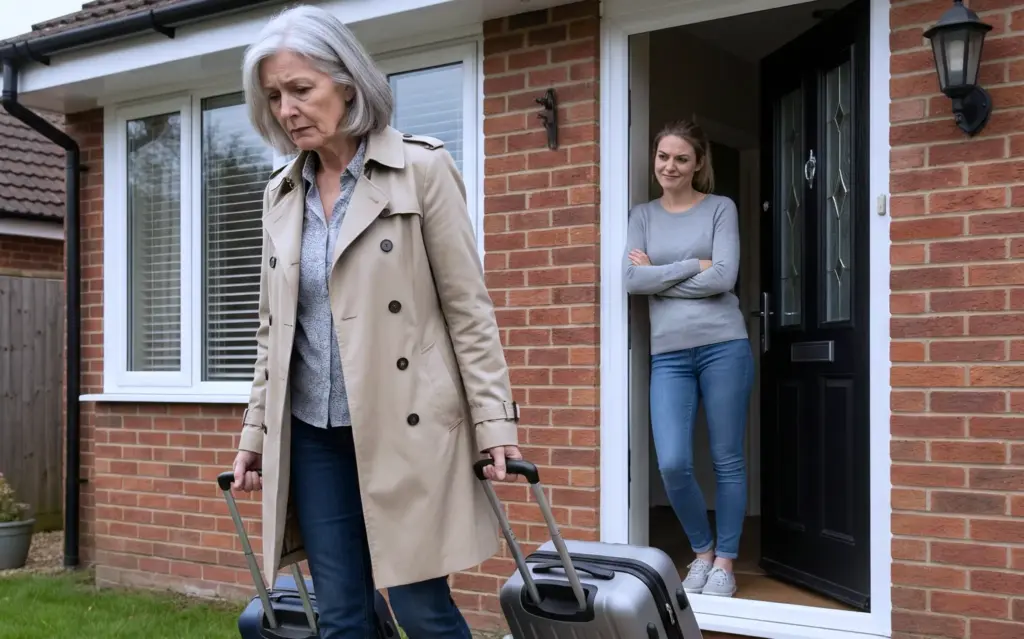
The final, decisive blow was delivered last Tuesday. I had been adrift in what Jessica had started referring to as our house for six long weeks since Richard’s passing, taking refuge in the guest room, unable to face the task of clearing out the bedroom we had shared for a lifetime. Jessica showed up without warning, Mark at her side, trailing two enormous suitcases.
— “Mom, we’ve come to a decision. Mark received the promotion, which means we have to relocate into the city effective immediately. This house is absolutely perfect for our needs.”
I could only stare at her, the meaning of her words struggling to penetrate my fog of grief.
— “Move in? But, Jessica… this is my home.”
For a fleeting second, Jessica’s carefully constructed mask of concern fell away, exposing the chillingly pragmatic woman beneath.
— “Actually, Mom, Dad’s will stipulates that I inherit everything. The house, the stock portfolio, all of it. I’ve been allowing you to stay here as a kindness, but the time has come for you to arrange for your own accommodations.”
The statement struck me with the force of a physical impact.
— “Jessica, there must be some kind of misunderstanding.”
— “There’s no mistake. Dad was fully aware that I would be a much better steward of his legacy than you could ever be. You never had a mind for finances or the market. You were… just the wife.”
Just the wife. Forty-three years of my life, of our shared history, were suddenly condensed into that one dismissive phrase. And it was then that she delivered the fatal thrust.
— “Find somewhere else to die. You’re useless now.”
I packed my belongings in a numb trance. The sum of a forty-three-year marriage was reduced to two suitcases and a small, precious box of photographs. From the doorway, Jessica observed my progress, impatiently glancing at her watch as if my sorrow were an inconvenience making her late for an important engagement.
— “There’s a very nice senior complex over on Maple Street,” she offered, with the kind of detached enthusiasm one might use to recommend a new café. “It’s quite affordable. I’m positive they’ll have vacancies.”
Affordable. My daughter, who was poised to inherit an estate worth thirty-three million dollars, was suggesting I look into a place that was little more than a government-subsidized facility for the elderly. Mark loaded my life into the trunk of their gleaming BMW with the impersonal efficiency of someone taking out the trash.
— “Helen, you’ll really enjoy having your independence again,” he said, his gaze carefully avoiding mine. “No more stressing about leaky roofs or property taxes.”
He meant no more home. As their car pulled away, I watched the house—Richard’s house, which was now Jessica’s house—shrink and vanish in the rearview mirror. The crushing irony was not lost on me. I had dedicated four decades to transforming that structure into a warm, loving home. It was the backdrop for every one of Jessica’s childhood birthday parties, the sanctuary where I’d nursed Richard through his illnesses, the place where I had meticulously preserved every single detail he held dear. Now, I was being chauffeured to a rundown motel, an unwelcome guest who had finally overstayed her welcome.
The Sunset Inn was precisely the kind of establishment you’d imagine for forty-nine dollars a night. The walls were paper-thin, the towels were even thinner, and the carpet had clearly seen its best days several decades ago. Jessica pressed two hundred dollars in cash into my hand, a gesture that felt more like a tip for a chambermaid than a provision for her own mother.