


I stood outside my son’s in-laws’ mansion, my hand frozen on the brass door handle. Through the mahogany door, I could hear my daughter-in-law Jessica’s voice carrying clearly in the crisp evening air. «Don’t worry, Mom. Mark’s father is… well, he’s simple. Just be patient with him. He means well, but you know, different backgrounds and all that.»
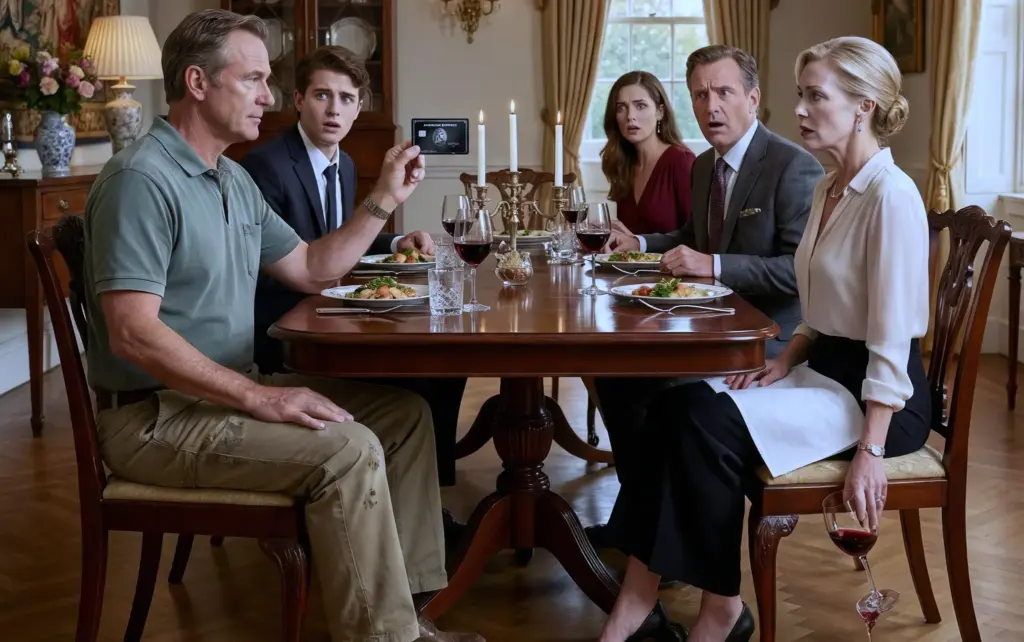
My name is David Mitchell. I’m 56 years old, and I make $40,000—not a year, but a month. But my son Mark has no idea, and tonight I was about to find out exactly what kind of family he’d married into.
It started seven years ago when Mark was still in college. I’d built my tech consulting firm from nothing, landing Fortune 500 clients and government contracts. But I learned early that money changes how people see you.
My ex-wife’s family taught me that lesson the hard way. The moment they smelled success, they came circling like vultures, hands out, sob stories ready. Relationships suddenly became «important.»
I drove the same 2008 Honda Civic I’d had since before the success, lived in the same modest two-bedroom house, and wore clothes from Target. When Mark visited, I’d hide the Armani suits in storage and park the Tesla at my office. He saw a father who worked hard, lived simply, and taught him the value of every dollar.
He never knew about the investment portfolio, the vacation homes I rented out, or the fact that I’d already set aside $2 million for his future. That was money he’d only get when he proved he could build something himself. Three weeks ago, Mark called with nervous excitement.
Jessica’s parents, the Harringtons, had finally agreed to meet me. They lived in Westchester—old money, apparently. According to Mark, they were concerned about Jessica marrying beneath her social status.
He actually used those words, not realizing how each one stung. My boy had been with Jessica for three years, married for one, and I’d been strategically unavailable for every suggested meeting until now.
«Dad, just try to make a good impression, okay?» Mark had said on the phone. «Maybe don’t mention the Honda, and if they ask about your work, just say consulting. They don’t need all the details about your little contracts.»
Little contracts. If only he knew that last month’s «little contract» was implementing cybersecurity for a federal agency. But I just said what I always said.
«Don’t worry about me, son. I’ll be myself.»
And that’s exactly what I planned to do. Or rather, I’d be the version of myself everyone expected to see. The morning of the dinner, I stood in my walk-in closet, running my fingers along the two distinct sections.
On the left, designer suits and Italian leather shoes. On the right, my «Mark clothes»: polo shirts from Walmart, khakis from Old Navy, and a pair of worn loafers I’d bought at Payless before they closed. I reached for a particularly unfortunate green polo that screamed, «I don’t know how to dress for nice dinners!» and paired it with khakis that were just a touch too short.
Looking in the mirror, I almost laughed. The same face that had been on the cover of Tech Entrepreneur Monthly last year now looked like every working-class dad trying too hard. The drive to Westchester gave me time to think about why I’d kept this charade going for so long.
It wasn’t just about my ex-wife’s family, though that had been the catalyst. When Linda and I divorced 28 years ago, her relatives suddenly remembered I existed. Her cousin needed a loan for a «sure-thing» business.
Her brother thought I should invest in his restaurant idea; he had no experience in food service, naturally. Her mother suggested I owed them for supporting me when I had nothing. The fact that they’d actually mocked my ambitions back then seemed forgotten.
But with Mark, it became about something more. I wanted him to love me for me, not for what I could buy him. I wanted him to develop his own ambition, not coast on Daddy’s success.
And honestly, it worked. Mark graduated with honors, landed his own job at a marketing firm, and never once asked me for money beyond the occasional dinner when times were tight. He was proud, independent, and hard-working. Everything I’d hoped for.
My phone rang through the Honda’s ancient speakers. Yes, I’d had Bluetooth installed; I’m not a masochist. It was Mark.
«Dad, you’re coming, right? You’re not going to cancel last minute again?»
«I’m on my way, son. GPS says 20 minutes.»
«Okay, good. Listen, when you get here, Jessica’s parents are very particular. Use the side entrance, not the main door. Park on the street, not in the circular drive.»
He paused. «And Dad, please don’t order beer if they offer drinks. They’re wine people.»
I bit my tongue to keep from mentioning the $3,000 bottle of Chateau Margaux sitting in my temperature-controlled wine cellar at home. «Got it. Street parking. Side door. No beer.»
«And if her brother Thomas starts talking about investments, just nod and smile. He’s between ventures right now.»
Between ventures. Rich people speak for unemployed. I’d met a hundred Thomases in my career: silver spoon kids who thought DNA was a business plan.
«And Dad, Jessica’s mom, Victoria… she might seem a little cold. It’s not personal. She’s like that with everyone who’s not from their circle.»
Their circle. Mark said it like he was already inside, but I could hear the insecurity in his voice. He was still auditioning, still trying to prove he belonged, and apparently, I was his biggest liability.
The Harrington estate sprawled across three acres of manicured perfection, the kind of place where the grass looked like it had been cut with nail scissors and every hedge was shaped into geometric precision. The main house—calling it a house felt like calling the Titanic a boat—rose three stories of red brick and white columns. Very subtle.
I parked my Honda on the street between a landscaping truck and what looked like a catering van. Walking up the long driveway, I counted no fewer than six security cameras. The side entrance Mark had mentioned turned out to be through a garden that probably cost more than most people’s houses.
Before I could ring the bell, the door opened. A man in an actual butler’s uniform looked at me with polite confusion.
«Delivery entrance is around back,» he said, already starting to close the door.
«I’m David, Mark’s father. Here for dinner.»
His face went through several expressions—confusion, disbelief, resignation—before settling on professional neutrality. «Of course, my apologies. Mr. Mitchell, was it? Please follow me.»
The foyer alone was bigger than my entire fake modest house. Real marble floors, a chandelier that belonged in a palace, and artwork that I recognized as authentic. One of the perks of my success was developing an eye for these things.
The butler led me through hallways lined with family portraits, each face radiating the kind of inherited confidence that came from never worrying about mortgage payments. We emerged into what they probably called the casual dining room. Only 16 chairs instead of 30.
Mark jumped up from his seat like he’d been electroshocked. «Dad, you made it!»
He rushed over, and I could see him taking in my outfit with barely concealed horror. «Everyone, this is my father, David.»
Harold Harrington stood slowly, like he was doing me a favor. He was everything you’d expect: silver hair, golf tan, and a handshake that tried too hard to establish dominance.
«David, we’ve heard so much about you.» The way he said it made clear that none of what he’d heard was good.
Victoria Harrington didn’t stand. She extended a hand like she expected me to kiss her ring. «Charmed, I’m sure. You must be exhausted from the drive. Traffic from… where is it you live again?»
«Riverside,» I said, naming my modest neighborhood.
«How quaint.» She said «quaint» the way other people might say «contagious.»
Jessica at least tried to smile, though it looked painful. «So nice to finally meet you, Mr. Mitchell. Mark talks about you all the time.»
«Does he?» I looked at my son, who was suddenly fascinated by his water glass.
Then there was Thomas, the brother. Late twenties, soft around the middle, wearing a Harvard Business School shirt just in case anyone forgot where he’d wasted his parents’ money. He didn’t stand, just gave me a little wave like I was the help.