


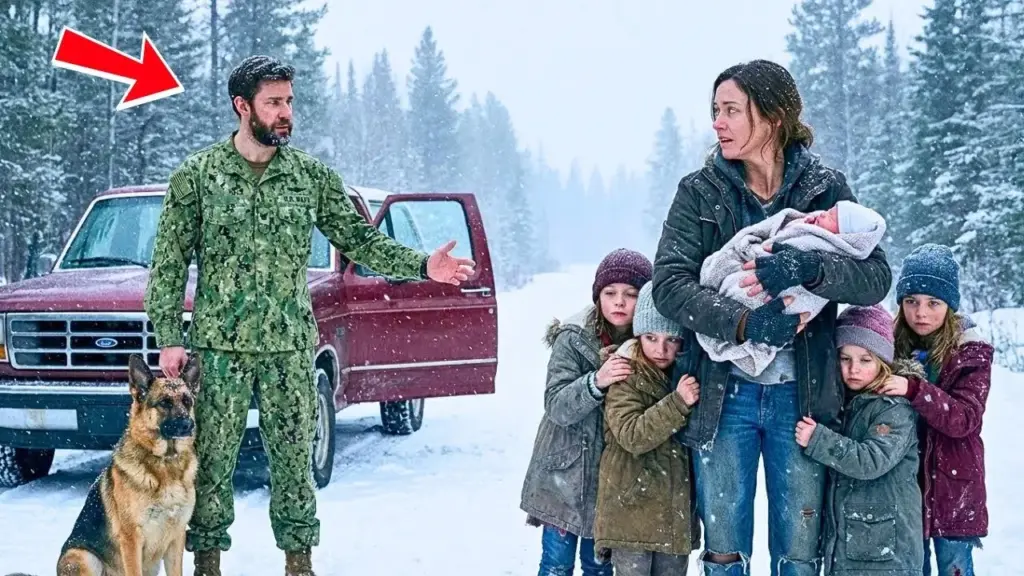
On a frozen Montana highway, an ex-Navy SEAL hit the brakes so hard his canine lurched forward, because in the blizzard he saw something no man should ever witness: a widow clutching a baby to her chest. Children stumbled behind her, wrapped in thin layers that did nothing against the storm. All of them trembling in the wind, their footprints already fading into the snow. When the cold tore at them like claws, she didn’t cry, she didn’t scream, she just kept walking, as if survival wasn’t a choice, but a punishment she had learned to endure in silence. Then the SEAL stepped out into the storm, wind tearing at his coat, and spoke the words that would change all their lives: “Come with me.”
The winter night pressed hard against the Montana highway, wind carving white scars across the dark as if the land itself were shivering beneath the storm. Inside the old pickup, Ethan Hale, thirty-five, former Navy SEAL, and a man built from quiet storms, tightened his grip on the steering wheel. His hands, rough and scar-lined from years of breaching doors and dragging wounded teammates to safety, flexed unconsciously when the truck jolted over a patch of black ice.
The dashboard light caught the sharp planes of his face: high cheekbones, a squared jaw darkened by several days of unshaved stubble, and eyes the color of cold steel, eyes that had seen more than they ever admitted. His canine partner, Ranger, a four-year-old sable German shepherd with a broad chest and ears always pricked toward danger, shifted in the passenger seat. Ranger’s fur bristled at the edges, catching the dim glow like frost.
Ranger was trained to detect fear, grief, and the subtle tremor of human panic, and tonight his low rumble vibrated through the cab of the truck. Ethan wasn’t heading anywhere urgent, not in the way he once did. He was simply returning to the old family ranch his parents left behind, the one that burned down two winters ago while he was deployed. He’d imagined this drive would be quiet, empty, maybe even numbing. Instead, the storm grew harsher, needles of snow whipping the windshield, reducing the world to a tunnel of white.
Then Ranger growled sharply, not at the wind, but at something alive. Ethan instinctively eased off the gas. His headlights swept across a shadow hunched near the roadside. At first, it looked like a fallen fence post, half buried in snow.
Then it moved, and Ethan’s breath caught. A woman staggered into view, a thin figure wrapped in a faded wool shawl woven with Lakota patterns, her long black hair plastered to her cheeks by melting frost. Her skin, a warm copper tone beneath the cold, had blanched into a worrying pallor. She clutched a bundled baby tightly to her chest, holding the infant as though the storm might rip the child away.
Behind her stumbled four more children, all small, all shaking, their clothes not nearly warm enough for a night like this. Ranger let out a sharp bark. Ethan slammed the brakes so hard the truck fishtailed before steadying.
“Damn,” he muttered under his breath, heart surging in a way it hadn’t since combat. Not fear, instinct. He threw the truck in park and stepped out into the slicing wind. The woman froze. Even exhausted, she stood with a protective fierceness, shoulders angled slightly forward, feet planted despite the snow slipping beneath them.
Her dark eyes, large and watchful, held both terror and defiance. She looked like someone used to meeting danger alone.
“Stay back,” she whispered, her voice hoarse, tightening her grip on the baby.
Ethan raised both gloved hands slowly, palms open. He observed everything: the trembling of her arms from cold and fatigue, the bluish tint on the children’s lips, the way the oldest child pressed herself between her mother and him like a small, trembling shield. He noticed the silver necklace at the woman’s throat, a traditional Lakota piece stamped with the motif of a running horse, and saw how fiercely she guarded the little ones behind her.
His experience as a SEAL had taught him to read people in seconds. The woman wasn’t aggressive; she was desperate, on the edge of collapse yet refusing to yield. Ranger hopped down from the passenger seat, landing softly beside Ethan, his posture alert but non-threatening. Snow clung to his whiskers, turning him into a silent sentinel.
Ethan’s voice, when he finally spoke, came out low and steady, the tone he once used with civilians in shock zones. “Come with me,” he said. “No one survives alone.” For a moment, nothing existed except the wind screaming across the highway and the quiet thud of his heartbeat.
The woman blinked, snowflakes catching in her lashes. She didn’t cry. She didn’t plead. She simply looked at her children, at their shaking knees and reddened fingers, and something in her resolve cracked just enough to let hope seep through. She nodded once, barely visible.
Ethan moved instantly but gently, lifting the children one by one into the warm cab. Ranger backed up to make room, positioning himself between the kids and the door like a guardian. The baby whimpered when the heat touched his face, then settled. The woman climbed in last, hesitating only to look back down the deserted road, as if expecting the storm itself to chase her.
Ethan shut the door behind her, feeling the weight of the decision settle into his bones, a familiar steadying weight. He returned to the driver’s seat, cranked the heater, and guided the truck off the highway toward the cabin he’d planned to face alone. Tonight, it would hold more than silence. It would hold the beginning of something none of them yet understood.
The cabin settled into a fragile warmth, the kind that came slowly, like a fire learning to breathe. Snow tapped against the window panes in restless bursts, but inside, the air held the trembling stillness of people who hadn’t felt safe in far too long. The children huddled under thick blankets borrowed from an old cedar trunk, their cheeks no longer the alarming shade of blue they’d worn on the roadside.
Even Ranger, stretched out near the hearth with a quiet vigilance, his amber eyes tracking every shift in the room. The woman sat closest to the fire, her posture straight despite exhaustion. Her long black hair clung to her shoulders, damp from melted snow. The shawl she wore, a woven Lakota design in deep reds and charcoal tones, had dried stiff in the heat.
Beneath it, her frame appeared slender but resolute, the kind of strength shaped not by choice but by survival. When she finally spoke her name, Sarah Wiyaka, her voice held the soft resonance of someone careful with speech, as though every word had to be weighed before leaving her lips. Her story unspooled slowly, not because she wanted to hide it, but because the memories cut deep.
Her father had vanished on these Montana mountains fifteen years earlier, leaving behind only unanswered prayers and a family that refused to mourn a man without a grave. With his absence, Sarah’s world had weakened. Her mother, fearing for her daughter’s future, agreed to marry her into another Lakota family, one with traditions as old as the land itself, but with expectations Sarah could never meet. Her husband, Tawan, had once been a man with broad shoulders and quiet pride, but whiskey turned that pride into obsession.
He demanded a son. Each daughter’s birth drove him deeper into bitterness, and his hands, once steady from working leather and carving bows, became instruments of rage. There were apologies at first, tearful promises and sober days. Then the apologies grew fewer, the bruises darker. Sarah didn’t raise her voice as she spoke. That, Ethan realized, was part of what made the story hurt more.
When the children finally drifted into sleep, one resting against Ranger’s flank as though the dog were a living blanket, Ethan moved to sit across from her. The fire illuminated the sharp edges of his face—the pronounced jawline, the slight curve of an old cut near his brow, the stubble shadowing his cheeks—but his eyes softened, turning from steel to something weary, something human. He spoke quietly, the way soldiers sometimes do when they step back into civilian air yet still carry the weight of sand and gunpowder in their lungs.