


My daughter laughed and said, «My mother-in-law achieved everything on her own, completely different from you.» I replied, «Then from now on, I’ll stop paying your bills. Let’s see how much she helps you.» She froze for a second, then asked, «What bills, Mom?»
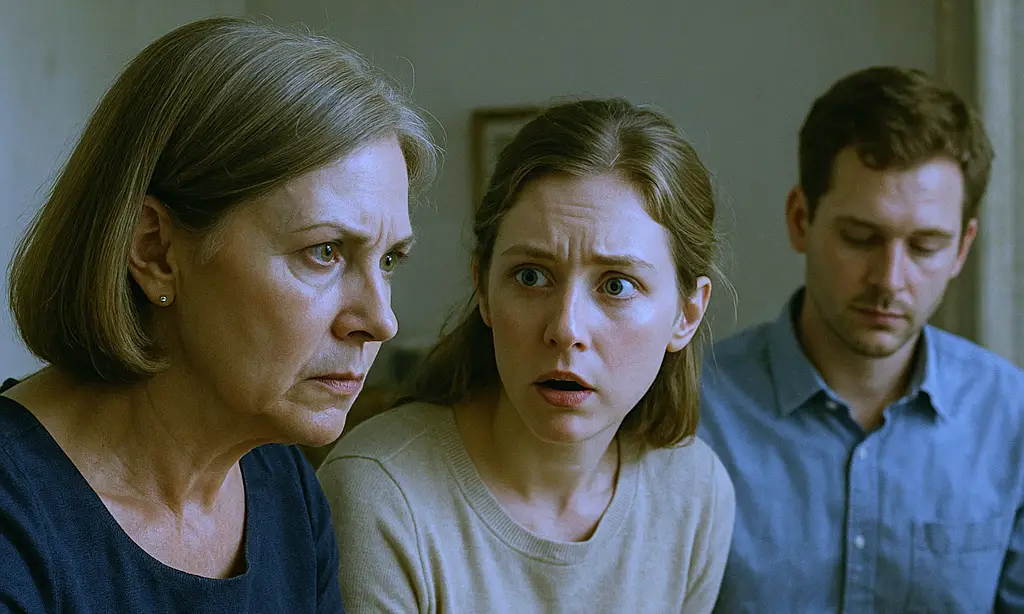
I sat on my usual chair, the one with the worn-out cushion that Larissa never bothered to replace, my hands trembling as I held a glass of water. On the table sat the white dinnerware set I had given her ten years earlier, at her own wedding. The smell of garlic and tomatoes drifted from the kitchen, but my stomach was empty.
I wasn’t hungry, only choked by a lump that rose to my throat. Larissa sat across from me, smiling with that half-smirk I knew too well—the same one she used as a child whenever she thought she’d won an argument. Next to her, her husband, Michael, stared down at his plate as if it were the most fascinating thing in the world.
My two grandchildren, Kyle and Julia, were glued to their phones, completely unaware of how heavy the air in the room had become. Then Larissa said, in a tone full of condescension, «You need to understand something, Mom. Eileen built everything by herself. She started her company from nothing, travels the world, and raised Michael well. She’s not like you, depending on Dad and later, just existing.»
Just existing. Those two words echoed in my head like a stone falling into a deep pit. My face burned, and my eyes stung, but I didn’t cry. Not in front of her. Not after everything I had done.
I took a slow breath, counted silently to three, and spoke calm and cold, as if awakening from a long sleep. «I understand.»
I placed my napkin on the table slowly, deliberately. «If Eileen is that capable, then let her help you from now on.»
Larissa frowned. «What are you talking about?»
«I’m going to stop paying your bills.»
My words landed firmly, each one hitting like a stone thrown into still water. «Tuition for the kids, the car loan, health insurance, gym membership, mortgage, everything. Let Eileen help you.»
The silence that followed was suffocating. Michael looked up, his eyes wide. Kyle set down his phone. Julia stared at me, suddenly sensing something serious had just shifted.
And Larissa, her face went pale. «Mom…» She swallowed hard. «What bills are you talking about? What bills?»
That question was the final drop that overflowed the glass. My 45-year-old daughter with a degree, a husband, and two teenage kids had no idea how many things I had quietly carried for her all these years. She had no clue about the weight I bore, month after month, while she praised her mother-in-law and looked down on her own mother.
I stood up slowly and picked up my old brown leather purse, the one that had followed me through the years, worn but reliable, just like me. I looked straight into Larissa’s eyes. There was no anger there, only disappointment, and something she hadn’t yet recognized: resolve.
«You’ll find out,» I said softly, each word heavy as stone. «Ask the bank. Or ask Eileen.»
I left the apartment without looking back. My footsteps echoed down the hallway, steady and firm. As the elevator doors closed, I could still hear Larissa calling after me.
«Mom! Wait!»
But I didn’t wait. Not this time.
That night, driving back to my own house—the one I built brick by brick with my own sweat—I realized something. Being invisible doesn’t mean being weak. And when an invisible woman finally decides to speak, the whole world trembles.
My name is Anne. I’m 68 years old. My hands are calloused from a lifetime of work, but my heart, though scarred, still beats strong. That dinner conversation wasn’t an ending; it was a beginning.
For twenty years, I had built castles so my daughter could live in them, never noticing I was the foundation beneath her feet. Do you want to know why Larissa’s words hurt me so deeply? Because my daughter never truly knew who I was. No one did.
I had become so quiet in my sacrifices that even my own child thought I merely existed. Let me tell you the truth.
I was 35 when my husband, Daniel, died. Larissa was twelve. That morning, it drizzled—the kind of day that warns you something bad is coming. He left early to make a delivery.
We owned a small stationery shop in the northern part of the city. It wasn’t much, but it was ours. Two hours later, I got the phone call that split my life in half. Accident. The truck’s brakes failed. Daniel didn’t make it.
I still remember the funeral: the closed casket, the heavy smell of white flowers, Larissa clinging to me and soaking the black dress I wore. I just stood there, unable to cry. Not because I didn’t want to, but because I feared that if I started, I’d never stop.
People looked at me with pity. «Poor Anne. How will she survive? A single woman with a child, no real profession.»
No profession—as if running a home, raising a child, and keeping a business alive wasn’t work. A week after the funeral, Daniel’s accountant came by with a folder. Debts. Overdue rent. Unpaid invoices. I stared at the red numbers: negative $34,800.
And I thought: either collapse or rise.
I rose. I took over the shop. I learned how to negotiate with suppliers, how to build spreadsheets, and how to wake up at 5:00 a.m. to check inventory before Larissa got up for school.
My hands toughened from carrying boxes. My back ached constantly, but I didn’t stop. Why? Because I’d look at my daughter in her school uniform, eating breakfast, and think: She’ll have a better life than I did. She’ll make it further.
And she did. Or at least, I thought she did.
When Larissa said she wanted to study business administration, I didn’t hesitate. Tuition was $1,780 a month for four years. I calculated over $85,000 total. It was far beyond what I had saved.
But I agreed. I worked twice as hard. I turned our small shop into a distribution company, signing contracts with schools in the area. I stayed up nights preparing bids and quotes. I refused outings, vacations, and every small joy.
My life was Larissa. I was there at her graduation, sitting in the last row, wearing my old navy blue dress. I cried out of pride, exhaustion, and relief.
Two years later, she said, «Mom, I need to get my MBA. Everyone at work has one if they want to be promoted.»
Cost: $42,000. I said, «Go ahead, I’ll handle it.» And I did, somehow.
When she married Michael, I paid $120,000 as the down payment on their condo. «You don’t have to, Mom,» she said. But her eyes sparkled.
I hugged her and whispered, «I just want you to start your life debt-free.»
Three years later, I bought her a $68,000 car, paid in full. I sold my stocks and emptied my emergency savings just to see her smile as she held the keys. And through all those years, not once did Larissa ask, «Mom, are you okay? Do you need anything for yourself?»
I became the invisible provider, the magic account that paid every bill, and no one ever asked where the money came from. Until I stopped.
When I finally said no, instead of gratitude, she compared me to her mother-in-law, Eileen—the woman she believed had conquered the world on her own. But the truth about Eileen? That, I’ll tell you later. Only when I discovered it did everything finally make sense.
Eileen. Just hearing that name made my chest tighten—not from envy, at least not at first, but from the bitter sting of being constantly compared to someone who wasn’t even in the same race.
The first time I heard about her was three months after Larissa started dating Michael. She came home, eyes glowing. «Mom, I had lunch at Michael’s house today. His mother is amazing.»
That word—amazing—rang in my ears like a sharp bell. Not because I was jealous, I told myself, but because there was something in her voice: admiration I’d never heard directed at me.
«She owns a cosmetics company, Natural Beauty. You’ve probably seen their products in drugstores,» Larissa scrolled through her phone excitedly. «Look, this is their office. Isn’t it gorgeous? And she built everything after divorcing Michael’s dad, all by herself.»
All by herself. Those words again.
When I first met Eileen at the engagement party, I understood why Larissa idolized her. She walked into the room as if it belonged to her. Sixty-four years old, but looking barely fifty, with perfectly highlighted blonde hair, a designer dress, that faint expensive perfume, manicured nails, and discreet yet costly jewelry.
Everything about her screamed one message: I made it.
And me? I wore my old navy blue dress, carried my scuffed leather purse, and wore flat shoes because my feet couldn’t bear heels after years of standing at work.
«You must be Anne,» she said, kissing the air near both my cheeks, polite but detached, as if she didn’t truly see me. «Larissa talks about you so much. It’s lovely to have such a present mother.»
Present. That word sounded like she meant something else entirely.
Time passed. The wedding came and went. Gradually, Eileen took up more space in my daughter’s life. Weekly lunches, shopping trips, weekend getaways at her beach house in Florida.
«Mom? Eileen invited me to a business fair in Chicago,» Larissa said over the phone, thrilled. «I’ll learn so much about entrepreneurship.»