


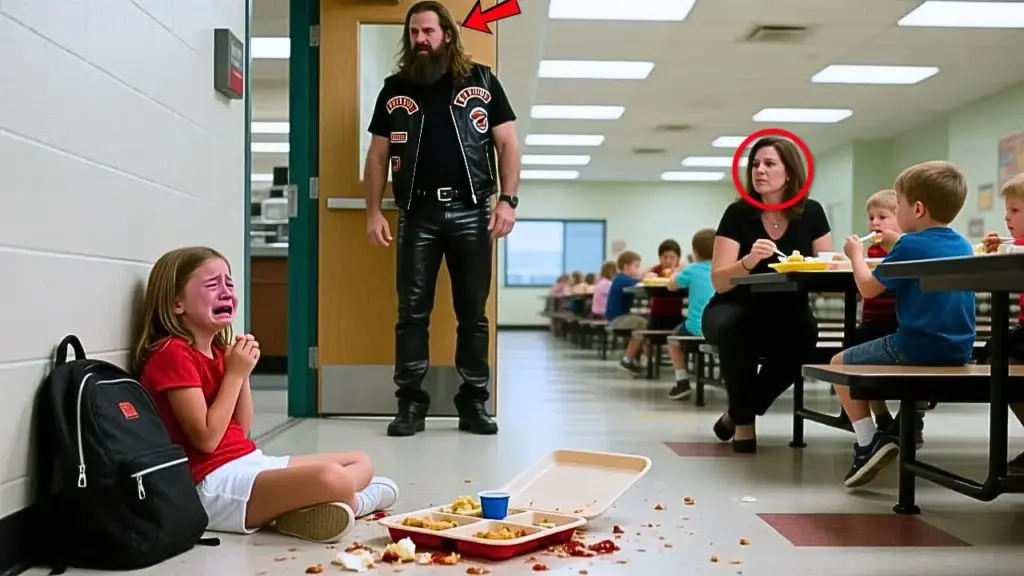
Morgan Jax walked into his daughter’s school cafeteria, expecting to surprise her with lunch. What he found instead would change everything. His seven-year-old daughter, Agnes, was on her knees, picking food off the cold floor with trembling hands. A boy stood over her, laughing. A teacher watched from ten feet away, arms crossed, doing absolutely nothing. Morgan didn’t yell.
He didn’t charge. He just stared. Because in that moment, a father’s worst nightmare became real.
And a promise he made to his dying wife shattered in front of him. What happened next brought 200 Hells Angels to that school’s front steps. But they didn’t come for revenge.
They came for something the town never expected. Before we continue, please subscribe to the channel and let us know where you are watching from in the comments. Enjoy the story.
It was a cafeteria that smelled of industrial cleaner and overcooked spaghetti. It was the kind of place where noise and fluorescent light conspired to make everything feel both small and permanent. The lunch rush had ended.
Most of the children were already back in class. But in a corner near the emergency exit, a scene was unfolding that no child should ever have to face. Agnes Jax, seven years old, with her mother’s brown eyes and her father’s stubborn jaw, was on her knees.
Her pink lunch tray lay upside down against the wall, its contents scattered. A bruised apple, a crushed sandwich, and a carton of milk spreading white rivers across the tile. Standing over her was Evan Marsh, twelve years old, broad-shouldered, and smirking like someone who thought cruelty was a kind of talent.
«You people don’t deserve real food,» he said. «Pick it up. That’s what you’re good at.»
Agnes didn’t answer. She had learned the economy of silence, and how it could make danger pass for peace. She reached for a soggy piece of bread, her hands trembling so badly she could barely hold it.
Ten feet away, Mrs. Linda Dorsey, the cafeteria supervisor, stood with her arms crossed. She watched. She waited. She said nothing.
The door swung open, and Morgan Jax pushed through. He was forty-four, six-foot-two, with a salt-and-pepper beard and a leather vest that announced his allegiance: Hells Angels, Texas Chapter. He’d come to surprise his daughter with a grilled cheese from the diner on Route 9, the kind of small comfort ordinary families keep for one another.
The sandwich slipped from his hands when he saw her. His body tightened; every fiber demanded something fierce and immediate. He imagined crossing the room, seizing Evan by the collar, the quick physics of punishment.
But Agnes looked up. Relief was not there. There was shame, the kind that makes a child look as if she is the one who’s been found wanting.
«Daddy,» she whispered. «He keeps doing this. He kicked my tray again.»
Again. The word struck him like a bullet. He turned his gaze to Mrs. Dorsey, her arms uncrossed.
Her posture went brittle. «Mr. Jax,» she said, her voice thinly calm. «Children will be children. Agnes needs to learn to stand up for herself.»
«How long?» Morgan interrupted. «Excuse me, how long has this been happening?»
Mrs. Dorsey’s silence answered more plainly than any confession. Morgan did not shout. He did not threaten.
He knelt beside Agnes and began to help her pick up the food. «It’s okay, baby girl,» he murmured. «I’m here now, and this is never, ever going to happen again.»
He meant it, and he did not yet know how large that promise would have to be. Now, you might be thinking: a Hells Angel finds his daughter humiliated, and his first move is to help her pick up food? That is not the story you expected, is it?
What Morgan understood, though, was this: brute force might satisfy in the moment, but it would not change the thing that hurt her. To truly protect Agnes, he would need something far more powerful than fists. He would need the truth.
And the truth, as he was about to discover, ran deeper than a single bully and one complacent teacher. Before the cafeteria, before the scattered lunch tray and the trembling hands of a little girl trying to make herself small, there was another life. A quieter one, warmer, shaped by desert light and the steady hum of motorcycles.
Eighteen months earlier, Morgan Jax lived in Mesa, Arizona, with his wife, Rebecca, and their daughter, Agnes. It was an ordinary life in the way that the most precious ones are: a small home, a familiar neighborhood, and routines built on love rather than luxury. Rebecca had once been a nurse, but she traded the frantic rhythm of hospital corridors for the soft glow of a bakery kitchen.
She opened a small shop that always smelled of cinnamon and cardamom. Morgan ran a motorcycle repair shop, working shoulder to shoulder with the Arizona chapter of the Hells Angels, a brotherhood he’d ridden with for fifteen years. They weren’t wealthy, not by any stretch, but happiness came easily to them.
Agnes grew up surrounded by leather-clad uncles who treated her like royalty. They lifted her onto their shoulders and called her «princess,» teaching her to pedal her tricycle in formation as if she were part of the pack. She laughed often, loudly, filling rooms with a brightness that seemed impossible to dim.
She was stubborn in the most endearing way—determined, bold, unmistakably her parents’ daughter. Then, Rebecca started coughing. At first, it was nothing; a winter cold, they thought.
A bit of desert air dryness. But coughs became fits. Fits became exhaustion.
Tests were run, and then came the words that hollow out a family in an instant: Stage IV lung cancer. She had never smoked a day in her life. The doctors gave her eight months.
She lasted six. On the night she died, the house was quiet except for the sound of her struggling breaths and the soft hum of machines that offered no hope. She held Morgan’s hand, her grip weak but urgent.
She made him promise one thing. «Protect her, whatever it takes,» she whispered. «She’s going to need you to be her everything now.»
Morgan had never broken a promise to his wife. He wasn’t about to start. After the funeral, Arizona became too heavy to breathe in.
Every street corner carried a memory. Every room reminded him of what he’d lost. His brothers in the Texas chapter saw the toll and offered him something simple but life-saving: a fresh start.
They offered a position helping run the chapter’s legitimate businesses. Diners, distribution routes, honest work grounded in community. Morgan accepted.
He packed their lives into a truck, buckled Agnes into the passenger seat, and headed east toward a sunrise he hoped would hurt a little less. But grief doesn’t disappear; it only changes shape. In Texas, Agnes, once sunlight and sneakers, grew quiet.
She stopped asking for friends to come over. She picked half-heartedly at her meals. She walked with her shoulders curled inward, as if bracing for something unseen.
Morgan told himself it was normal. A move. A loss. An adjustment.
He believed she would settle with time. What he didn’t know, what he couldn’t have imagined, was that Agnes was fighting a battle every single day at Ridgeview Elementary. A battle she believed she had to face alone.
Here’s what I need you to understand. Agnes didn’t tell her father because she didn’t want to burden him. She had just watched him lose his wife.
She thought she was protecting him. And if that breaks your heart the way it broke mine when I first learned this story, let me ask you to do something simple. Drop a comment that says, «Protect Agnes.»
Because the next part of this story shows how an entire community failed her. And I want to see how many of you refuse to look away. Let’s keep going.
That night, sleep refuses to come for Morgan. He sits on the edge of Agnes’s bed, the room lit only by the soft glow of a night light shaped like a little crescent moon. Agnes lies on her back, staring at the ceiling as if answers might be hidden in the plaster.
He keeps his voice gentle, steady, even though everything inside him feels like a tightening wire. «How long?» he asks. There is a long pause, too long for a child who should never have had to measure silence like this.
Finally, in a voice thin as paper, she says, «Since the first week.» Five months. Five months his daughter had been tormented while he made breakfast, packed her bag, and told her to have a good day.
Five months of quiet suffering that he mistook for grief, or shyness, or the lingering weight of a move she never asked for. «Why didn’t you tell me, baby girl?» His voice fractures on the question. Agnes turns her head toward him.
Her eyes shine with tears, but she doesn’t let them fall. «Because Mommy said you’d protect me, and I didn’t want you to fight. I didn’t want you to get in trouble. I didn’t want to lose you, too.»
The words hit him harder than anything Evan Marsh could deliver with fists. Guilt and love crash together, swallowing him whole. His little girl, trying to protect him from her pain, thinking that asking for help might cost her the only parent she had left.