


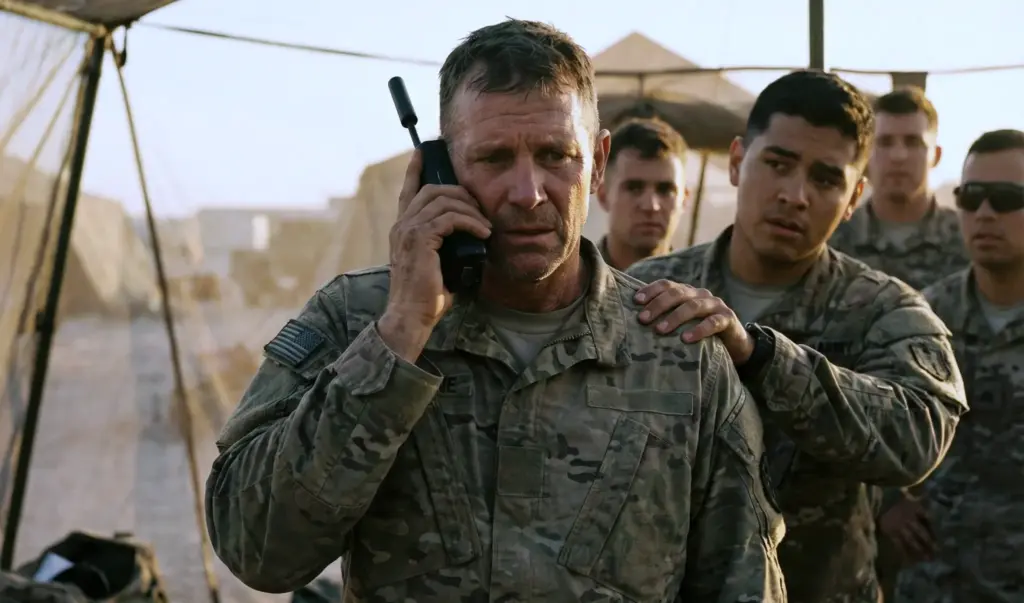
Scott Kane had learned to interpret the souls of men amidst the choking dust of Kandahar. It wasn’t a skill taught in manuals; he didn’t read them through their spoken words, but rather through the heavy, suffocating weight of their silence, the unwavering steadiness of their hands when bullets cracked the air overhead, and that hollow, haunted look they gave you when the world was going to hell. Over the course of twelve long years serving with the Rangers, Scott had become fluent in a language that most civilians would never even encounter: the brutal vocabulary of violence and the rigid grammar of survival.
He was a product of the harsh, open country of rural Montana, the son of a third-generation rancher who had drilled into him the belief that a man’s word was a binding contract and his fists were always the tool of last resort. His father, William Kane, had suffered a broken back when Scott was just seventeen, leaving Scott to shoulder the burden of the ranch alone that summer. Those were grueling sixteen-hour days spent under a merciless, baking sun. It was in that forge of exhaustion and responsibility that he learned a vital truth: he could endure anything.
When his father recovered sufficiently to sell the ranch, Scott enlisted. He carried a chip on his shoulder, a need to prove something, though he had never been able to articulate exactly what that was. The Army took that raw potential and refined him like steel in a blast furnace. He transformed from a cocky kid into a disciplined team leader, earning his Ranger tab through blood, sweat, and a singular, razor-sharp focus that bordered on obsession.
His commanders had dubbed him «Ice» because absolutely nothing rattled him. Firefights, roadside IEDs, midnight raids deep into hostile territory—Scott navigated them all with the terrifying calm of a man who had already accepted the worst possible outcome and decided it wouldn’t slow him down. Then, in 2019, the armor cracked. He met Tammy Vasquez at a USO event. She was stunning, possessing dark, perceptive eyes that seemed to see right through his defenses to the man beneath.
For the first time in years, Scott felt a pull toward something other than the mission. They married four months later, and their son, Tommy, arrived ten months after that. Scott tried desperately to balance the two competing gravities of his life: the deployments and the family, the war and the home. But the demands were impossible. Tammy eventually grew weary of the life of a military wife—tired of the cold, empty side of the bed, and exhausted from raising Tommy alone while Scott was a world away.
The divorce papers reached him while he was deployed in Syria. She kept the proceedings civil, kept it clean. They agreed on joint custody, though Scott knew his share was theoretical at best given his relentless deployment schedule. Tommy was seven years old now, and it had been eight agonizing months since Scott had seen him in person.
Video calls, carefully wrapped presents shipped from overseas bases, and the repeated promise that «Daddy will be home soon» were all he had to offer. It was never enough. Scott stood in the operations tent at Forward Operating Base Raven, scanning intelligence reports alongside his squadmates, Felix Galloway and Bernie Graham.
Outside, the sun was dipping below the horizon, painting the Syrian desert in bruised shades of blood and sand.
«You good, Ice?» Felix asked, his eyes catching the tension bunching in Scott’s jaw.
«Always,» Scott lied smoothly, though his mind was drifting thousands of miles away.
Tommy’s last video call had been unsettling. The boy had seemed skittish, nervous, his eyes darting off-screen as if checking the room. Scott had dismissed it as typical kid stuff, but a gut instinct nagged at him. Suddenly, his satellite phone rang. It was his personal line, not the official comms.
Scott’s stomach tightened into a knot. Personal calls out here meant emergencies.
«Kane,» he answered, his voice tight.
«Dad?» Tommy’s voice was a terrified whisper, tight with fear.
Scott’s entire body locked up, going rigid. «Tommy? What’s wrong, buddy?»
«Dad? Mom’s new man hurt me again.» The words tumbled out in a rush, barely audible. «He said you’re a soldier a thousand miles away and can’t do a thing.»
A roaring white noise filled Scott’s head, loud as an avalanche. His hand clenched around the phone with such force that his knuckles turned bone white.
«Tommy, where—»
The phone rustled, as if being snatched away. A man’s voice, thick with arrogance and malice, came on the line. «You heard the boy. My brothers run this town. You come home, soldier boy. You’re gonna find out what happens to heroes who stick their nose where it don’t belong.»
The line clicked dead.
Scott didn’t remember the physical act of crossing the compound to Captain Reginald Valencia’s tent. He only knew that one moment he was staring at his silent phone, and the next he was standing before his commanding officer’s desk, his voice eerily steady despite the molten fury burning through his veins.
«Sir, I need emergency leave. My son is in immediate danger.»
Valencia looked up from his paperwork, studying Scott’s face. The captain was a twenty-year veteran who had climbed the ranks; he recognized the specific look in Scott’s eyes. It was the look men wore right before they did something that couldn’t be undone.
«Explain,» Valencia said simply.
Scott told him everything, his voice never wavering. When he finished, Valencia leaned back in his chair, his expression grim.
«You know what you’re asking me to do, Sergeant?»
«Yes, sir.»
«And you know what you’re going back to do?»
«Yes, sir.»
Valencia studied him for a long, heavy moment. Then he picked up his phone. «Give me Transport Command. I need a priority flight out of here. And get me Master Sergeant Vince Rios.»
Twenty minutes later, Vince Rios walked into the tent, trailed by Felix Galloway, Bernie Graham, Jonathan Garza, and Bill Blackwell. They were Scott’s fire team, the brothers he’d served with for three years straight. These were men who had carried him when he was hit in Mosul, men who had held the line in Raqqa when the world fell apart.
«Gentlemen,» Valencia announced, «Sergeant Kane has a family emergency. I’m granting him emergency leave effective immediately.» He paused, his gaze sweeping across each man’s face. «I’m also granting all of you leave. You’re going with him.»
Felix stepped forward. «Sir, we didn’t request—»
«I know what you didn’t request, Corporal. And I know what you’re going to do anyway. So let’s make it official. Two weeks emergency leave. All of you. If anyone asks, you were visiting Sergeant Kane’s family for moral support.»
Valencia’s voice hardened, dropping an octave. «But understand this. You are still soldiers. You represent this unit, this Army, and this nation. Whatever you do, whatever happens, I expect you to conduct yourselves accordingly.»
The unspoken order was crystal clear: Don’t get caught. Don’t embarrass the unit. Do what needs doing.
«Yes, sir,» they replied in unison.
Eight hours later, Scott sat in the belly of a cargo transport heading for Ramstein Air Base in Germany, and then on to the States. His team sat around him, weapons cleaned and stowed, but each man wore the same expression: the blank, laser-focused look of operators prepping for a mission.
«What’s the situation on the ground?» Vince asked. At thirty-four, he was the oldest of the group, a career NCO with a wife and two daughters of his own back in Texas.
Scott pulled out his phone, scrolling through the intelligence he’d been gathering during the flight prep.
«My ex-wife, Tammy, has been seeing a guy named Gilberto Barajas. Small-time criminal in Ridgefield, Oregon. That’s where she moved after the divorce. Population 12,000. Barajas has two brothers, Rafael and Jeremy. All three have records: assault, drug possession, extortion.»
«Police?» Bernie asked.
«I called the Oregon State Police from the base. Reported the abuse. They said they’d send someone to do a welfare check.» Scott’s jaw tightened. «That was six hours ago. No call back.»