


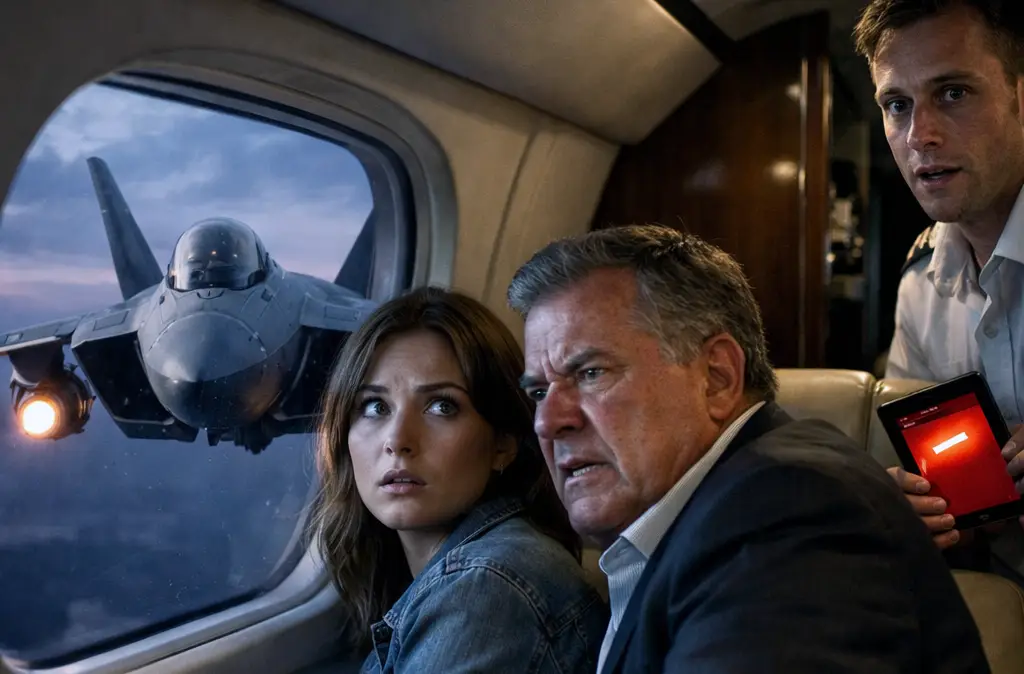
The champagne flute on the table wasn’t just shaking; it was vibrating with a deep, chest-rattling bass that triggered a primal fear in the gut. My uncle, Marcus, a man who prided himself on controlling every room he entered, was gripping his leather armrest so hard his knuckles were white. Outside the oval window, the sky had turned into a nightmare.
A silhouette—distinct, lethal, and impossibly close—banked hard against the clouds, its afterburners glowing like angry eyes. It was an F-22 Raptor, the apex predator of the skies. It wasn’t just passing by; it was hunting us.
Marcus was screaming into the intercom, demanding to know why we were being targeted. He was convinced his pilot had strayed into restricted airspace, or that a coup had started without his permission. The cockpit door burst open, but the pilot didn’t look at Marcus.
He was pale, sweating, and holding an iPad that was flashing a terrifying shade of crimson. He bypassed the man paying his salary and looked directly at me.
«Sir, you didn’t tell me we had a Valkyrie-class asset on board,» he stammered, his voice trembling over the roar of the engines outside. He turned the screen toward us, the red security banner reflecting in his terrified eyes. «ATC just grounded us. That escort isn’t for you, sir. It’s for her.»
Uncle Marcus spent millions on this Gulfstream G-650 to feel powerful, to separate himself from the common people he viewed as ants. But as the F-22 screamed overhead, reminding everyone that true power isn’t bought, it’s sanctioned, he realized his money meant absolutely nothing compared to my clearance.
To understand how he ended up detained on his own tarmac, stripped of his dignity and his ego, we have to go back to the dinner invite where he made the biggest mistake of his life.
It happened a week earlier at a family gathering that felt more like a corporate merger than a meal. My uncle, Marcus, a pompous defense contractor lobbyist who truly believed he ran the world from his country club membership, had summoned us to discuss his daughter’s destination wedding. I was sitting at the far end of the table, nursing a glass of water, trying to remain invisible.
Invisibility was a skill I had perfected over years of being the «disappointing niece.» He looked down the table at me, a smirk playing on his lips, and offered me a seat on his private jet. But like everything with Marcus, it wasn’t a gift.
It was a transaction designed to make him look big and me look small. «You can hitch a ride, Elena, but there are rules,» he announced loudly, silencing the rest of the table so they could witness his benevolence. «Don’t bring that beat-up duffel bag you always drag around. And try not to embarrass us in front of my investors.»
«Just sit in the back, keep your mouth shut, and don’t touch the single malt.» The table chuckled, a polite, obedient sound. To them, I was just a low-level logistics clerk for the State Department, a paper pusher who couldn’t afford a commercial ticket.
They had no idea that my beat-up duffel bag contained encrypted hard drives that could topple governments. I tried to decline, or at least warn him without breaking my cover, knowing exactly what kind of trouble this would cause. «Uncle, I appreciate it, but I have travel protocols,» I started, trying to explain that my movement required specific security clearances he didn’t possess.
He cut me off with a wave of his hand, dismissing me like a waiter who got the order wrong. «Stop pretending your little government job has protocols, Elena,» he snapped, his voice dripping with condescension. «You’re flying with me, or you’re not going at all.»
To my family, I was simply poor Elena, the cautionary tale they whispered about over shrimp cocktails. My cousin Jessica, the bride-to-be whose entire personality was curated for Instagram, treated me less like a relative and more like a charity case she could feel benevolent about. At the rehearsal dinner, she made a show of asking if I could afford the dress code for the reception, loudly offering to lend me something from last season that might fit my frame.
Uncle Marcus chimed in right on cue, cracking a joke about my ten-year-old sedan, asking if the engine was held together by duct tape and government prayers. They laughed, a synchronized wealthy sound that made my skin crawl. To them, my modest apartment and lack of designer labels were proof of a life wasted pushing paper for a government that didn’t pay.
I smiled and took a sip of my water, swallowing the sharp retort that rested on my tongue. They didn’t know that my poverty was a carefully constructed operational cover, a necessary camouflage known in the trade as being a «gray man.» If you look important, you become a target.
If you look like a logistics clerk who struggles to pay rent, nobody looks twice. In reality, I am a Chief Strategic Analyst for the Defense Intelligence Agency, specializing in high-value target extraction. I don’t book flights or file travel vouchers; I authorize Tier 1 extraction teams to pull assets out of hostile nations before the borders close.
When I disappear into a windowless basement for work, I’m not sorting mail. I’m entering a sanitized SCIF environment with biometric scanners reading my retinas to grant access to cybernet terminals where a single keystroke can reroute a drone strike or burn a spy network.
I looked at my uncle, who was bragging about dodging a parking ticket, and I thought about the decision I made last Tuesday to extract a compromised family from a safe house in Damascus. The silence I kept at the dinner table wasn’t submissiveness. It was the disciplined silence of a woman who carries state secrets in her head that are worth more than Uncle Marcus’s entire investment portfolio.
But the worlds were about to collide, and the friction started with a phone call. I stepped away from the table to answer a secure line. It was Colonel «Viper» Ricks, my commanding officer, a man with a voice like grinding gravel who viewed civilian life as a chaotic liability.
He didn’t waste time with pleasantries. «Elena,» he growled, the line crackling with encryption static. «We’re seeing movement on your tracker. You know the rules.»
«I’m visiting family, Colonel,» I whispered, turning my back to the dining room.
«You are currently holding the decryption keys for Operation Black Sands in your head,» he countered, his tone dropping an octave. «You are a walking vault. If you go off-grid for more than 60 minutes, the Pentagon assumes you’ve been taken. Do not get on any transport that hasn’t been vetted. I don’t care if it’s your mother’s minivan. If we lose your signal, we escalate.»
He was right. I was a walking national security risk. Hopping on a private jet with a man who treated flight laws as mere suggestions was a tactical nightmare. But I was tired of the fighting.
I wanted, just for once, to be the niece who didn’t cause a scene, to just sit in the back and let them have their day. So, I decided to compromise. I opened the secure portal on my phone and logged a movement request.
I typed in the tail number of Marcus’s jet and marked the trip as civilian transport, low visibility. It was a digital failsafe—a breadcrumb trail telling the Air Force: «I am here, I am safe, do not panic.» I assumed, quite naturally, that Marcus’s pilot would file a standard flight plan.
If both our records matched in the system, the military tracking software would see a green light. I underestimated Marcus’s greed. I didn’t know that my uncle, in his infinite arrogance, planned to fly off the books to save a few thousand dollars in landing fees and taxes.
He was going to run a «ghost flight.» No manifest, no transponder squawk, no record. He was about to take a jet carrying a Tier 1 intelligence asset and make it disappear from the grid completely. He thought he was being clever, but the United States Air Force would think he was kidnapping me.
When I walked onto the polished concrete of the private hangar, the sharp smell of jet fuel mixed with the familiar, suffocating scent of my family’s disapproval. Uncle Marcus stood by the stairs, eyeing my carry-on—a reinforced tactical bag containing a secure satellite phone and encrypted drives—like it was a bag of dirty laundry.