


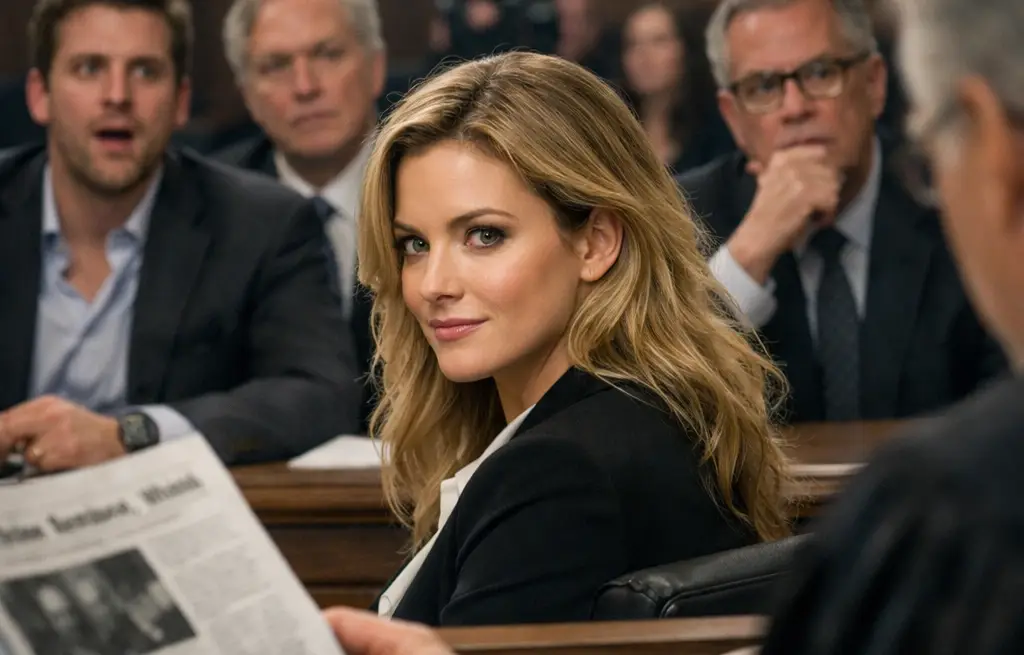
I sat in a bankruptcy courtroom packed with strangers, not because I was out of money, but because my parents wanted the entire city to believe I was destitute. My mother wept into her silk scarf while my brother smirked, certain I would be humiliated publicly. Then the judge paused, looked up, and asked the one specific question that made their lawyer turn pale.
After eight years of silence, I knew my moment had finally arrived. My name is Sydney Ross, and I am 36 years old. I sat at the defendant’s table in the Federal Bankruptcy Court in downtown Chicago, my hands folded on the cool mahogany surface.
The air conditioning was humming a low, industrial drone, fighting a losing battle against the heat of the bodies packed into the room. This was not a standard bankruptcy hearing. Usually, these proceedings were dry, administrative affairs attended only by tired lawyers and the occasional desperate creditor.
But today, courtroom seven felt less like a hall of justice and more like a coliseum. My parents had made sure of that. Across the aisle, the plaintiff’s table was crowded.
My father, Graham Hawthorne, sat with the posture of a man posing for a statue, his spine rigid. His expression was capable of winning an Academy Award for «Grieving Father Betrayed by Wayward Child.» Beside him sat my mother, Vivian. She was dressed in severe black, a color choice that suggested she was mourning the death of my financial solvency.
She held a silk handkerchief to her face, dabbing at dry eyes with the rhythmic precision of a metronome. And then there was Bryce, my brother, the golden boy of Lake Forest. Bryce sat slightly forward, his elbows on the table, exuding the easy confidence of a man who had never been told «no» without a checkbook eventually appearing to soften the blow.
He caught my eye for a fleeting second and offered a small, sad smile. It was a masterpiece of gaslighting. To the gallery behind him, which included three reporters from the local papers and a scattering of Lake Forest socialites who treated gossip like oxygen, that smile said: I tried to save her. I did everything I could.
To me, however, it said: I am going to crush you into dust, little sister. I looked away, focusing on the seal of the United States hanging behind the empty judge’s bench. The room smelled of floor wax and expensive perfume, a nauseating mix that brought back memories of Sunday dinners I had spent years trying to forget.
«You doing okay?» The whisper came from my left. Daniela Ruiz, my attorney, did not look at me when she spoke. She was busy arranging three heavy banker’s boxes on the table in front of us.
She stacked them with deliberate slowness, the cardboard scraping against the wood.
«I am fine,» I whispered back.
«Good,» Daniela said, smoothing the lapel of her charcoal blazer. «Because they are putting on quite a show. Look at the press. Your father must have called in every favor he has owed since 1995.»
«They want a spectacle,» I said, my voice steady despite the adrenaline spiking in my blood. «They do not just want to bankrupt me, Daniela. They want to make sure I can never work in this town again. They want to paint me as the incompetent daughter who played business and lost her brother’s inheritance.»
Daniela finally looked at me. Her dark eyes were hard, intelligent, and devoid of fear.
«Let them paint,» she said softly. «We brought the turpentine.»
The bailiff called out, and the room shuffled to its feet as Judge Mallory Keene entered. He was a man in his sixties with a face that looked like it had been carved out of granite and then left out in the Chicago winter for a decade. He did not look happy. The docket was full, and a contested family bankruptcy involving high-profile socialites was likely the last thing he wanted to referee.
We sat. The air in the room grew heavy, a physical weight pressing down on my chest. The lawyer for the Hawthorns, a man named Sterling Vance who charged $600 an hour to destroy lives, stood up. He buttoned his suit jacket with a flourish.
«Your Honor,» Vance began, his voice a rich baritone that carried to the back of the room without a microphone. «We are here today with heavy hearts. This is not a case of malicious prosecution. This is a tragedy of a family trying to recoup a massive loss caused by mismanagement.»
He gestured toward me as if I were a stain on the carpet.
«The debtor, Ms. Ross, solicited a personal loan from her brother, Mr. Bryce Hawthorn, in the amount of $2.4 million,» Vance continued. «This money was explicitly earmarked to save her failing technology startup, a company she calls Northbridge Shieldworks. The agreement was clear. The money was an investment to cover payroll and essential server costs to prevent immediate insolvency.»
A murmur went through the gallery. $2.4 million. To the average person, it was a fortune. To my family, it was a weapon.
Vance paced before the bench, weaving a narrative that I had heard a thousand times over the dinner table. Only now, it was being transcribed for the legal record.
«Mr. Hawthorn provided these funds out of love, Your Honor,» Vance said. «He wanted to support his sister’s ambition, but we have evidence—bank statements, emails, witness testimony—that shows the company was already a sinking ship. Ms. Ross took the money, burned through it in less than six months on frivolous expenses, and is now claiming inability to pay.»
He paused for effect.
«We are asking the court to pierce the corporate veil, declare the company’s assets—what little there are—forfeit, and grant Mr. Hawthorn immediate relief as the primary creditor.»
I watched my mother. She let out a soft, audible sob, right on cue. My father patted her hand, looking stoically at the floor. It was a perfect story: the reckless daughter, the benevolent brother, the squandered fortune.
«Northbridge Shieldworks has no viable product, Your Honor,» Vance concluded, leaning on the lectern. «It is a shell, a hobby that got out of hand. And now, Mr. Hawthorn simply wants to recover what he can from the wreckage.»
Vance sat down. The silence that followed was thick with judgment. I could feel the eyes of the reporters burning into the back of my neck. They were already composing the headlines: Hawthorn Heiress Bankrupts Startup. Brother Left Holding the Bag.
Judge Keene looked over his reading glasses at our table. «Ms. Ruiz, does the defense wish to make an opening statement?»
Daniela stood up. She did not pace. She did not use big hand gestures. She stood perfectly still.
«We do, Your Honor,» she said. Her voice was not loud, but it cut through the room’s humidity like a scalpel. «The narrative presented by Mr. Vance is compelling. It has drama. It has emotion. It has a very large number attached to it.»
She paused, letting the silence stretch for three seconds.
«However, it lacks one critical element: Truth.»
Daniela reached for the first of the three boxes.
«We can test the validity of the debt. We can test the claim of insolvency. And we can test the characterization of my client’s business as a hobby. The plaintiff claims Ms. Ross borrowed $2.4 million to save a failing company. We will demonstrate that no such transfer ever occurred, that the loan documents submitted to this court are fabrications, and that Northbridge Shieldworks is not only solvent but is currently one of the most secure financial entities in the state of Illinois.»
She patted the top of the box.
«We have prepared 3,000 pages of discovery, Your Honor. Forensic accounting, server logs, and sworn affidavits that paint a very different picture of why the Hawthorne family is so desperate to force this company into receivership.»
Bryce laughed. It was a short, sharp sound, quickly stifled, but it was there. He thought we were bluffing. He thought I was still the girl who hid in her room while he charmed the country club.
Judge Keene did not look impressed by the laugh. He pulled the case file toward him, opening the thick binder that Vance had submitted. He flipped through the pages, his expression neutral.
«$2.4 million,» the judge muttered, reading. «Promissory note dated October 14, 2022.»
«Yes, Your Honor,» Vance said, half-rising from his chair. «Signed and notarized.»
The judge turned a page, then another. He rubbed his temple. For a moment, it seemed like he was just going through the motions, skimming the paperwork so he could move on to the next case on his docket. I watched his hand. He had a gold wedding band and a watch that looked practical, not flashy.
He stopped. His hand froze on a page near the back of the plaintiff’s exhibit. It was the section detailing the assets of Northbridge Shieldworks that Bryce wanted to seize.
The judge’s brow furrowed. He tilted his head slightly as if he were trying to read fine print that didn’t make sense. He looked up at the ceiling for a moment, narrowing his eyes, searching his memory. Then he looked back down at the document.
The atmosphere in the room shifted. The scratching of the reporter’s pen stopped. Even my mother seemed to hold her breath, sensing a disruption in the rhythm of the performance.
Judge Keene slowly took off his reading glasses. He folded them and placed them on the bench. He looked at me. It was not the look of a judge looking at a defendant. It was the look of a man trying to solve a puzzle that had just changed shape in front of his eyes.
He looked at me, then at the name on the file, then back at me.
«Counsel,» the judge said. His voice was quiet, but the microphone picked it up and amplified the bass, sending a rumble through the floorboards. «Approach the bench.»
Daniela moved instantly. Vance hesitated for a split second, glancing at Bryce, before buttoning his jacket again and walking to the front. I could not hear what was being whispered, but I saw the body language.
The judge was leaning over, tapping a finger on the document. He spoke in a low, urgent murmur. Daniela nodded once, her face impassive. But Vance froze.
I watched the color drain out of Sterling Vance’s face. It started at his neck and moved up to his hairline until he looked like a sheet of printer paper. He gripped the edge of the bench, his knuckles turning white.
He tried to say something, shaking his head, pointing back at his client. But the judge cut him off with a sharp hand motion. The judge waved them back.
«Sit down,» Judge Keene ordered.
Vance practically stumbled back to his table. He leaned over and whispered something frantically to Bryce. For the first time all morning, the smirk vanished from my brother’s face. He looked confused, then annoyed.
My father sat up straighter, his betrayed parent mask slipping to reveal the shark underneath. Judge Keene picked up his glasses but did not put them back on. He held them like a gavel.
He looked out over the courtroom, his gaze sweeping over the reporters, over my parents, and finally landing squarely on me.
«Ms. Ross,» the judge said. He did not address my lawyer. He addressed me directly.
I stood up. My legs felt weak, but I locked my knees.
«Yes, Your Honor.»
«I was reading the Financial Times this morning with my coffee,» the judge said conversationally, though there was steel underneath the tone. «There was a rather extensive article about the vulnerability of the national power grid and the new safeguards being implemented by the Department of Energy.»