


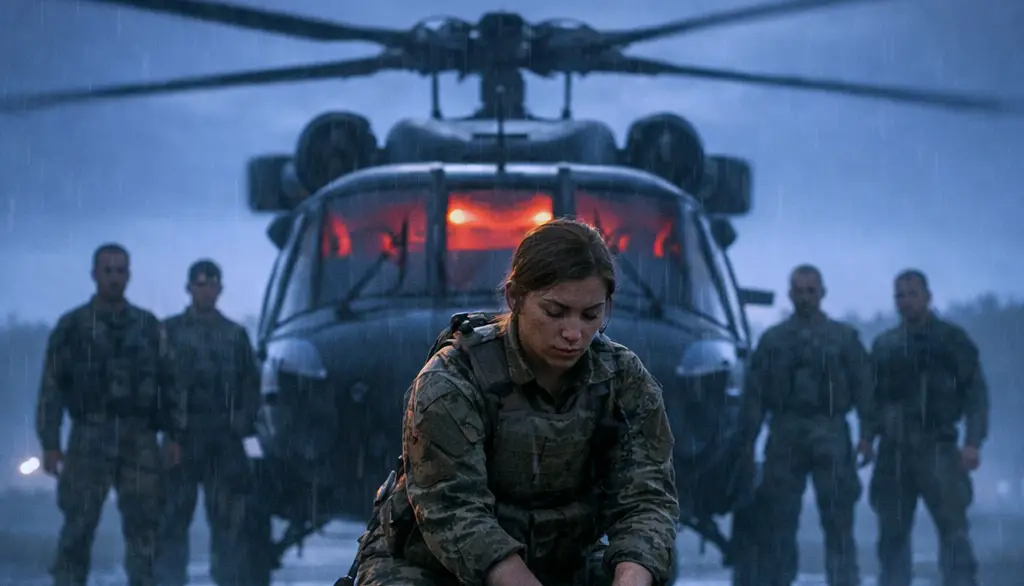
They were laughing when she walked in. The gym at Fort Breckford was echoing with jokes, loud voices, and the restless confidence Marines carry before a big field exercise. No one stops talking. No one shifted seats.
A female medic entered late: Sergeant Leah Rowan, 29. The mood barely changed.
Someone whispered, “Paperwork medic.”
Another said she was only good for bandages. A corporal muttered that she had never deployed, never seen anything real. The comments weren’t loud, just careless enough to land.
Leah didn’t defend herself. She stood still, hands behind her back, chin lifted—not proud, just unmoved. The silence that followed wasn’t respect. It was judgment.
That was the moment everyone thought they had her figured out. They had no idea that within hours, a flooded river would trap hundreds, radios would fall silent, real fire would hit the ridge, and all the people laughing would be praying someone could reach their wounded.
And when no one else moved, when leaders hesitated, when distance turned deadly, she crossed alone.
Leah Rowan looked like the kind of Marine people overlooked. Average height, lean build, brown hair pulled back tight. Nothing about her presence demanded space when she walked into a room.
Her uniform was squared away, boots clean, sleeves rolled just the way the regulations wanted them, but there was no swagger in how she moved across the gym at Fort Breckford. She was 29 years old and carried herself with the quiet posture of someone who had learned early that words usually did more harm than good.
When she stood at the back of the formation, her hands folded calmly behind her, she did not fidget. She did not shift her weight from foot to foot. She watched and listened, eyes steady, like she was cataloging the room rather than trying to belong to it.
On paper, she was a medic with the combat medical support unit, temporarily reattached to 3rd Marine Battalion for their annual field evaluation. To most of the Marines here, that sounded like background noise. An administrative footnote, not a story.
Units like hers were supposed to show up, check boxes, sign forms, and disappear back into some building with flickering lights and stacks of medical files. Most of the battalion only knew two things about her.
First, that she had spent a long stretch at an administrative unit on base handling clinic schedules and medical readiness reports. Second, that there was a rumor she had once frozen during a live training scenario.
Nobody seemed to know where that rumor started, but nobody cared enough to check it either. Rumors have a way of turning into truth when nobody bothers to challenge them. A private heard from a corporal who heard from a sergeant that she had locked up under pressure while a casualty lane went sideways.
The details changed every time someone repeated it, but the label stayed fixed in people’s minds: medic who could not handle the real thing.
Leah never corrected them. She did not jump into conversations to defend her record. She did not try to outtalk the loudest voices in the platoon bay.
When Marines traded deployment stories in the chow hall, she sat at the edge of tables, eating quietly, eyes on her tray, instead of the big gestures and bigger laughs. She was not unfriendly, but she was not social either. She nodded when spoken to, answered questions in complete sentences, and then let the talking drift away from her like smoke.
More than once, a young Marine tried to pull her into a storytelling circle only to realize within seconds that she was not going to compete for attention. What they never saw was what she carried home every night.
In the small, on-base room she barely decorated, inside the top drawer of her wall locker, she kept a worn, green field notebook wrapped in a folded piece of cloth. The cloth had faded from olive to something closer to gray over the years, corners frayed and soft.
The notebook had belonged to her father, a Vietnam-era medic who had survived more than one extraction that should have gone wrong. His handwriting filled the pages in tight, slanted lines. Notes about improvised splints, chest wounds, shock, and the simple rule he wrote three times on the inside cover: Do not waste a heartbeat you can save.
Leah had grown up watching him trace a finger over those words without speaking them out loud. When she enlisted, she did it quietly, without a big family send-off, without social media posts. Her father simply handed her the notebook and said it had never been meant to stay in a drawer.
She trained hard, not because anyone was watching, but because she believed you were not allowed to fail once someone’s life was in your hands. Her instructors knew she had a head for trauma stabilization; she was quick with assessments and steady with pressure on arterial bleeds. They noted her focus in after-action reports that almost no one ever read again.
When deployment rosters came out, she volunteered for remote rotations far from the main bases. Desert outposts, mountain observation posts—any place that put her closer to the point of impact instead of the waiting room. Time after time, the answer came back the same.
She was needed here, on base, in clinics and admin halls, filling out the quiet roles that never made it into stories. Every medic knows there is a difference between clinic medicine and riverbank medicine, between well-lit treatment rooms and dirt packed into wounds. Leah felt that gap every time she filed another set of readiness forms into metal cabinets.
She did her job, and did it well, but at night she would sit on the edge of her bunk and wonder if the notebook had been wasted on her.
If anyone had looked closely at her gear, they might have noticed something that did not quite match the rest of her standard issue. On her rucksack, near the stitching where straps met fabric, there was a faded, desert-torn patch from a unit that no longer existed. The colors were bleached, the lettering barely readable unless you were close enough to touch it.
Few Marines ever got that close. Those who did usually noticed the small scar at the inside of her lower wrist before they saw the patch.
It was not the clean, straight line of a clinic incision. It was crooked, slightly jagged, and closed in a way that told another medic it had been stitched quickly in the field with more urgency than time. Leah never explained that scar, either.
When someone asked, she gave a simple answer about an accident with broken equipment and moved the conversation somewhere else. The scar was an old story, and she had no interest in reopening it for people who only saw her as a paperwork medic.
What they did notice, at least eventually, was her habit of asking for everyone’s blood type. She did it casually, like she was just checking a box, but she remembered every answer. She could have written them down, but she did not need to.
Once she heard it, it stayed with her. In morning formations, while others stared at their watches and counted minutes until dismissal, Leah’s eyes drifted quietly across the ranks.
She would match faces to blood types, to minor past injuries, to who had already been treated for heat exhaustion or knee strain. It was not a game. It was a map she drew in her head, one name at a time.
At night, when the noise of the day finally drained out of the barracks, she wrote letters at the small desk in her room. One page at a time, neat handwriting, black ink, no crossed-out lines. She folded each letter carefully and slid it into a worn envelope without a visible address.
No one knew who those letters were for. They only knew that her light stayed on later than most, and that she always looked like she had already lived through something before Reveille even sounded. She never talked about those late hours, and no one had the courage or curiosity to ask.
Marines at Fort Breckford formed impressions quickly. A glance at your uniform, a half-heard rumor, a single story told in the wrong tone, and your role settled in people’s minds. Leah let them think what they wanted.
She did nothing to polish her image, nothing to correct the offhand jokes or assumptions. Her strength did not show up in loud rebuttals or sharp comebacks. It was in how she stood at attention without shifting, how her eyes never left the speaker during a briefing, how her breathing stayed even when the room turned on her with quiet judgment.
There was a steadiness about her that no one had found the context to understand yet. Most saw a medic who had spent too long behind a desk. They saw paperwork, not pressure dressings; readiness reports, not river crossings under fire.
They saw a woman who walked softly across the gym floor and assumed that softness told the whole story. But the truth of who Leah Rowan was waited somewhere else, just beyond the edge of their assumptions, like a distant storm building over a river they had not tried to cross yet.
The orders came down on a gray morning that felt more like late fall than early training season. Low clouds hung above Fort Breckford, and the air carried that heavy smell that warns of rain long before the first drop hits. Third Marine Battalion formed up on the motor pool lot while trucks rumbled to life, exhaust drifting past rows of camo-clad shoulders.
They were heading to the Serpent River Training Corridor, a multi-day exercise designed to test crossings, logistics, and forward holding positions. To most of the Marines, it sounded like another box to check. A good chance to get muddy, fire a few rounds, complain about rations, and come home with stories about who slipped first on the riverbank.
Leah stood near the back of her assigned element, rucksack strapped, medical bag resting on the ground beside her boot. She listened as the operations officer briefed the mission, his voice carried through a portable loudspeaker.
«Forward elements will push across the river, secure the far ridge, and hold it under simulated pressure.»
Two hundred eighty Marines would be positioned forward along the far bank, broken into companies and platoons stretched along the curve of the Serpent River. The terrain there was tricky even in good weather: narrow crossings, uneven rocks, and a current that could turn from calm to dangerous if the right storm rolled through.
Rain was already on its way. Leah watched the clouds and measured the wind by how the tree line bent at the edges of the lot. She shifted her weight just enough to ease the strap off a tender spot on her shoulder, but otherwise stayed still.
Her name was called with the support elements, not the forward-crossing teams. Lieutenant Jacob Marin moved along the line with his clipboard, checking assignments. Late twenties, square jaw, his uniform looked like a recruiting poster.
He carried himself with that mix of confidence and pressure that came from being just high enough in rank to be blamed for everything if it went wrong.
«Forward teams are Alpha through Delta,» he called out. «Support remains on the near bank until crossing lanes are secure.»
Leah’s heart did not quicken. Her pulse did not spike. She simply listened, cataloging where each platoon would move when they reached the river.
She already knew who had which blood type, who was prone to dehydration, who carried nagging knee issues that would hate the uneven rocks.
A Marine behind her whispered, just loud enough to be heard, «She’ll cross later after things are safe.»
Another chuckled. «If someone sprains an ankle getting out of the truck, she’ll be ready.»
The joke passed down the line quicker than the wind. A few laughed openly. Others smiled and looked away.
Leah did not turn. She fixed her eyes on the trucks, on the gear being loaded, on the map that had been briefly displayed at the front of the formation. Lieutenant Marin glanced back when the laughter hit a certain pitch.
His expression flattened, unimpressed. For a second it looked like he might say something. He did not. He turned back to his paperwork and kept calling out squad leaders.
That is how it often goes. Sometimes leaders hear the disrespect and choose silence because correcting it would take time, or make them unpopular, or force them to explain what they themselves do not fully understand.
The words drifted away like they had never existed, but Leah felt them land all the same. They rolled out in a slow convoy, tires hissing over wet pavement, headlights carving through veils of mist as the base fell away behind them. The road narrowed as they moved closer to the training corridor. Trees grew taller, denser, closing in on both sides.
The first drops of rain hit the windshield of Leah’s transport halfway there. She watched them streak and merge, forming small rivers that slid out of sight along the glass.
Across from her, a Lance Corporal made swimming motions with his hands. «They should issue life vests instead of flak.»
Someone laughed. Someone else asked if the medic knew how to swim.
Leah answered simply, «Well enough.»
The Serpent River lived up to its name. It did not run straight. It twisted between slopes and rocky outcroppings, curling around sandbars and narrow, shifting banks. When the trucks pulled up to the staging area, the sound of the water was already louder than the idling engines.
Platoons formed up quickly. Forward elements began final gear checks while engineers moved toward the water with ropes, stakes, and portable bridging equipment. Radio antennas lifted toward the thickening sky. The rain that had started as a drizzle turned steady.
Leah stayed with the support element on the near bank, as ordered. Her station was just behind the main command node, a cluster of tents and vehicles that would serve as the coordination point for the entire exercise. She unfolded a laminated field map on the hood of a truck and traced the planned positions with a gloved finger.
Across from her, a young Corporal from Communications watched her work. «You hoping they call you forward?» he asked.
She did not look up. «I am hoping they do not need to.»
He smirked, not unkindly, but with that edge of doubt. «They say this is mostly blank fire and maneuver, no real chaos. Good day for you to check sprained ankles and hand out painkillers.»
She folded the map and tucked it under her arm. «There is no safe side of a river when people forget that water rises.»
He frowned, not sure if she was joking. Before he could press the point, a shout went up from the forward crossing lane. First squads were heading toward the water.